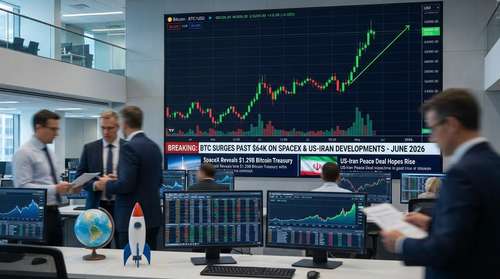
A sudden confluence of massive corporate disclosures and shifting geopolitical tides has jolted digital asset markets back to life. After a turbulent start to the month, a decisive bitcoin price recovery has pushed the leading digital asset back over the $64,000 mark. Just days ago, unrelenting selling pressure had driven the cryptocurrency down toward a critical floor near $59,000. Now, a historic aerospace initial public offering and easing Middle Eastern conflict tensions are rapidly altering the macroeconomic landscape, signaling a fresh wave of bullish momentum.
The SpaceX Bitcoin Treasury Reveal Shocks Wall Street
The catalyst catching traditional finance completely off guard arrived on Friday, June 12, when Elon Musk's aerospace giant officially debuted on the Nasdaq under the ticker SPCX. The company successfully raised a staggering $75 billion, making it the largest public market debut in history. However, the real shockwave for digital assets came buried inside the firm's S-1 registration filing, which unveiled a tightly kept corporate secret: a massive SpaceX bitcoin treasury.
According to the regulatory documents, the rocket manufacturer holds exactly 18,712 BTC. Acquired at a total historic cost of $661 million—averaging roughly $35,300 per coin—the stash now boasts a fair market value of approximately $1.29 billion. The revelation immediately positioned the newly public entity as the eighth-largest corporate holder of the cryptocurrency.
Prior to the IPO, on-chain analytics platforms had severely underestimated the aerospace firm's holdings, pegging them at roughly half the actual size. The realization that Elon Musk now oversees corporate reserves exceeding 30,000 BTC across both Tesla and SpaceX has forced institutional analysts to recalibrate their supply models. With SpaceX shares surging 20% during their opening hours on Friday, traditional equities traders are recognizing the undeniable premium attached to forward-thinking treasury management.
Industry leaders were quick to highlight the macroeconomic significance of this move. MicroStrategy's Michael Saylor noted that 25% of the so-called \"Mag8\" mega-cap technology firms now hold the digital asset directly on their balance sheets. Public market investors suddenly have a brand-new, highly liquid vehicle for indirect exposure to digital assets, fundamentally shifting long-term cryptocurrency market trends.
US Iran Peace Deal Crypto Market Implications
Beyond massive corporate adoption, easing global conflict is acting as a secondary, yet equally vital, macroeconomic tailwind. Over the weekend, widespread reports surfaced indicating that a formal diplomatic framework between Washington and Tehran could be signed as early as Sunday. Mediated extensively by Pakistan, this two-phase memorandum of understanding aims to lift specific naval blockades and safely reopen the critical Strait of Hormuz.
The potential US Iran peace deal crypto reaction was instantaneous. Because the Strait of Hormuz handles roughly a fifth of global oil transit, the promise of unhindered shipping caused energy prices, particularly Brent crude, to ease considerably. Lower oil prices directly relieve the broader inflation anxieties that have pressured risk assets throughout the second quarter.
Traders rapidly seized on these de-escalation signals to push capital back into the digital economy. Pakistan's Prime Minister Shehbaz Sharif confirmed that technical-level talks are slated for the coming week, further cementing the reality of the diplomatic progress. For months, digital assets have acted as a highly sensitive barometer for global liquidity. The sudden evaporation of strike threats essentially green-lit a return to risk-on investing strategies across the board.
While Iranian officials have cautioned that the exact signing timeline remains fluid, the stark reduction in immediate military threats allowed institutional traders to confidently bid the market higher, betting that suppressed energy costs will keep the U.S. Federal Reserve on track for potential interest rate cuts later this year.
ETF Capital Returns and Network Health Stabilization
Under the hood, several vital technical factors are reinforcing this weekend's price action. Capitalizing on the broader relief rally, institutional capital has aggressively rotated back into regulated exchange-traded products. After a brutal five-session outflow streak that drained over $720 million from the market, spot bitcoin ETF inflows turned sharply positive on June 12. These funds secured $85.85 million in fresh net capital, driven primarily by BlackRock's IBIT vehicle. This sudden reversal indicates that large-scale buyers view the sub-$60,000 range as a deep value zone.
Simultaneously, the blockchain's internal economics have granted infrastructure operators a much-needed operational reprieve. A recent bitcoin mining difficulty drop has alleviated severe margin pressure on institutional mining farms. By lowering the computational threshold required to produce new blocks, operators have stabilized their revenue streams. Consequently, miners are selling far fewer freshly minted coins to cover their exorbitant electricity costs. This organic tightening of overhead supply is colliding perfectly with the renewed ETF demand.
Navigating Crypto Market News June 2026
Anyone closely tracking crypto market news June 2026 can easily identify a stark transition in prevailing market sentiment. Earlier this month, panic liquidations and hawkish central bank fears dominated the tape. Today, the landscape is defined by historic Wall Street integrations, resilient ETF demand, and a fragile but profoundly welcome geopolitical truce.
Whether this momentum sustains a legitimate assault on the heavily contested $70,000 threshold depends almost entirely on the follow-through of these twin catalysts. If diplomatic progress holds steady in the Middle East and institutional fund flows maintain their current upward trajectory, the firm foundation established near the $59,000 level may very well serve as the definitive market bottom for this cycle's mid-year correction.