
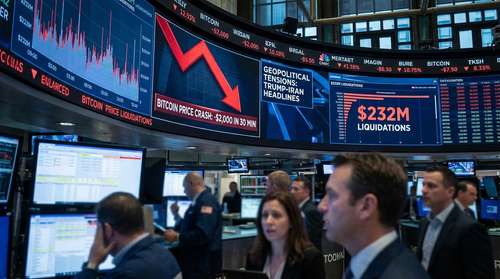
The digital asset landscape was jolted early on March 22, 2026, when the leading cryptocurrency shed roughly $2,000 in a frantic 30-minute window. The Bitcoin price crash today wasn't driven by fundamental flaws in blockchain technology or sudden regulatory shifts, but rather by rapidly escalating global conflicts. Over-leveraged traders found themselves caught completely off guard, resulting in a staggering $232 million in crypto market liquidations. The sudden plunge highlights a growing reality for digital assets: they are increasingly sensitive to macroeconomic shocks, international diplomacy, and the fragile nature of physical supply chains.
Trump Iran News Impact Crypto: The Geopolitical Catalyst
The immediate catalyst for the abrupt sell-off stemmed from mounting tensions in the Middle East. President Donald Trump issued a stark public warning, threatening to obliterate Iran's power plants if the strategic Strait of Hormuz is not reopened within a tight 48-hour window. Because this waterway is one of the globe's most vital energy and trade chokepoints, the ultimatum sent immediate shockwaves across financial sectors.
While traditional equities often wait for the opening bell to react to weekend or overnight developments, digital currencies trade around the clock. This structural difference makes them the frontline absorbers of macroeconomic fear. Consequently, Bitcoin geopolitical volatility was on full display. In a matter of minutes, market sentiment reversed drastically. Multiple metrics reflected a sharp deterioration in mood, pushing the widely tracked Crypto Fear and Greed Index down to a reading of 10, a level firmly entrenched in extreme fear territory.
Inside the Crypto Long Liquidations in March 2026
When an asset class drops vertically, the mechanics of leveraged trading usually accelerate the damage. That is exactly what materialized during the crypto long liquidations March 2026 event. Traders who had borrowed funds to bet on continued upside momentum were forced into immediate closure by exchanges protecting their collateral.
According to on-chain analytics, the swift $2,000 downward candle resulted in $232 million in wiped-out long positions. This cascading effect not only crushed individual retail accounts but rippled aggressively through major altcoins and trading pairs such as BTC/USD and BTC/ETH. Liquidations act like gasoline on a fire. As automatic sell orders are triggered to close out failing long bets, those same sell orders push the spot price down further, triggering the next batch of stop-losses. The chain reaction bypasses traditional market rationality, driven purely by the brutal mathematics of margin calls.
Bitcoin Trading Volume Surge and Exchange Activity
Amid the chaos, market participation spiked dramatically. Exchange metrics recorded a massive Bitcoin trading volume surge, jumping more than 50% during the specific 30-minute flash crash window. Large whale transactions amplified the selling pressure, dragging Bitcoin from a relatively stable consolidation range near $70,000 down to intraday lows touching $68,241 across major platforms like Bitstamp and Binance. This sudden rush to the exits painted a stark picture of how quickly liquidity can evaporate when global stability is threatened by military posturing.
Evaluating BTC Price Support Levels Amid the Chaos
With the dust beginning to settle, market participants are now tasked with identifying reliable BTC price support levels. The immediate psychological barrier sits at $68,000, a threshold the asset barely defended following the initial geopolitical shock. If selling pressure continues to mount due to further developments near the Strait of Hormuz, technical analysts warn that the next major defense lines rest near $65,000. At the same time, the average crypto Relative Strength Index dipped to 39.03, signaling that the broader asset class is quickly approaching oversold territory.
Despite the severity of the crypto market liquidations, the underlying structure of the digital asset market retains some optimism. Historically, steep leverage flushes help reset overextended derivative markets, clearing out speculative excess and allowing organic demand to step back in. Furthermore, substantial institutional accumulation continues in the background, providing a buffer against total capitulation.
However, until the standoff regarding global trade routes resolves, digital asset valuations will likely remain tethered to the 24-hour news cycle. Traders navigating this hostile environment are heavily reducing their leverage, preparing for unpredictable and volatile price swings as the 48-hour deadline approaches.