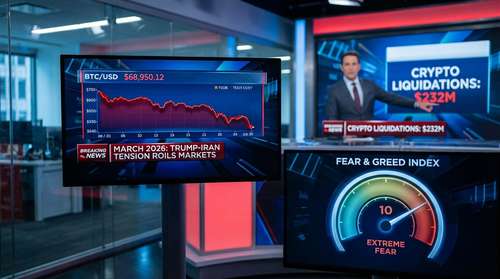
The global digital asset economy faced a sudden and brutal reality check this weekend. The Bitcoin price crash March 2026 materialized rapidly on March 22, as the world's leading cryptocurrency surrendered the vital $69,000 support level. This sudden downward spiral was ignited by a geopolitical ultimatum from the U.S. administration directed at Iran over the Strait of Hormuz. The ensuing panic across global exchanges triggered a staggering $232 million cascade in derivatives liquidations, pushing market sentiment into a state of absolute panic and leaving traders scrambling for stability.
Trump's Iran Threat and the Strait of Hormuz
The catalyst for this weekend's sell-off originated far from the blockchain. U.S. President Donald Trump issued a severe warning on Truth Social, threatening to obliterate Iran's power infrastructure if the strategically critical Strait of Hormuz is not reopened within a 48-hour window. This escalation over one of the world's most important global oil shipping routes sent immediate shockwaves through all financial sectors, causing widespread uncertainty.
The geopolitical impact on crypto was instantaneous and severe. Within hours of the ultimatum, traditional safe havens like gold saw shifts as investors flocked to tangible security, while Brent crude oil prices remained elevated above $90 per barrel due to supply chain fears. Risk assets bore the brunt of the market's anxiety. Bitcoin, which had been consolidating comfortably above the $70,000 mark for weeks on the back of institutional buying, suddenly found itself entirely vulnerable. The Trump Iran threat markets reaction definitively proves that cryptocurrencies remain deeply tethered to macroeconomic developments and global conflicts.
$232M Wiped Out: Anatomy of the Crypto Market Liquidations
When Bitcoin's price sliced through the psychological $69,000 barrier, eventually touching lows near $68,241, it set off a violent chain reaction in the derivatives market. Highly leveraged retail and institutional traders who were aggressively betting on a swift breakout to new all-time highs were caught completely off guard by the geopolitical news.
The resulting crypto market liquidations were exceptionally fierce. Industry data indicates the event wiped out $232 million in long positions almost instantaneously. This phenomenon, known as a "long squeeze," occurs when over-leveraged traders are forced by exchanges to sell their holdings at market price to cover failing margin requirements. This forced selling only adds to the downward momentum, creating a self-fulfilling cascade of liquidations. Ethereum and various high-cap altcoins suffered even steeper declines, plunging more than 3% to 5% in tandem with the broader market panic. This massive flush-out of leverage serves as a stark reminder of the inherent volatility within digital asset markets during times of international crisis.
Challenging the Crypto Safe Haven Narrative
This weekend's chaotic price action poses critical questions regarding the crypto safe haven narrative. Proponents have long argued that Bitcoin serves as "digital gold"—an uncorrelated, decentralized asset that protects wealth during periods of geopolitical instability. However, the immediate reaction to the Strait of Hormuz tensions mirrored the performance of high-beta tech stocks rather than traditional safe-haven assets. Instead of catching a massive bid during the flight to safety, Bitcoin's correlation with risk-on equities was on full display. This behavior is forcing wealth managers and financial analysts to reevaluate Bitcoin's role in a diversified, wartime investment portfolio.
Bitcoin Fear and Greed Index Hits Rock Bottom
The psychological toll of the weekend's crash has been equally dramatic. The Bitcoin Fear and Greed Index, a widely tracked algorithmic metric of market sentiment, plummeted into "Extreme Fear" territory, registering a bleak reading of 10. This marks a drastic, violent reversal from the "Greed" levels observed just days prior when continuous spot ETF inflows were successfully sustaining the market's bullish momentum.
Historically, readings this low on the Fear and Greed Index have often signaled potential local bottoms, as weak hands exit the market in a panic and institutional players quietly accumulate digital assets at a deep discount. Yet, with a looming 48-hour deadline attached to the U.S. military ultimatum, many retail investors are choosing to step back and stay entirely on the sidelines until the geopolitical dust finally settles.
BTC Price Analysis Today: What to Watch Next
Looking closely at the BTC price analysis today, the technical landscape has abruptly shifted from bullish continuation to defensive consolidation. The primary battleground for bulls is now the crucial $68,000 support zone. If buyers can fiercely defend this line and geopolitical tensions begin to cool off through diplomatic channels, we could see a rapid reclaim of the $69,000 to $70,000 range as sidelined capital confidently re-enters the market.
Conversely, if the rhetoric around the Strait of Hormuz escalates into tangible military action, further technical downside is highly likely. A confirmed daily close below $68,000 could expose the next major liquidity pockets near the $65,000 level, an area that historically served as strong support earlier this month. For now, day traders and long-term holders alike must exercise extreme caution. The market is not currently trading on underlying network fundamentals or chart patterns; it is entirely at the mercy of breaking international news and unpredictable geopolitical maneuvering.