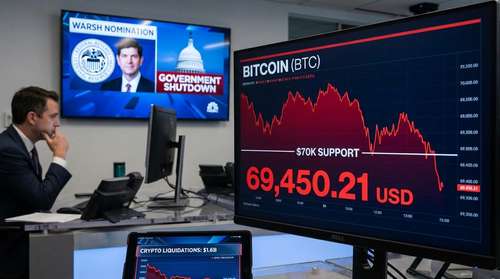
Bitcoin has crashed below the critical $70,000 support level for the first time in 15 months, signaling a potential start to a Bitcoin price crash 2026 scenario. The world's largest cryptocurrency plummeted in early trading Thursday, triggering a massive sell-off that wiped out over $1.6 billion in leveraged positions. The sudden downturn is being driven by a perfect storm of macroeconomic fears: the controversial nomination of Kevin Warsh as Federal Reserve Chair and a paralyzing U.S. government shutdown that has frozen key regulatory initiatives.
Kevin Warsh Fed Nomination Impact Roils Markets
The primary catalyst for the sell-off appears to be the market's delayed but violent reaction to President Trump's nomination of Kevin Warsh as the next Federal Reserve Chair. While the announcement was made on January 30, the full Kevin Warsh Fed nomination impact is only now hitting the crypto sector. Warsh, a former Fed Governor known for his hawkish stance during the 2008 crisis, is viewed by many institutional investors as a threat to the easy-money policies that often fuel crypto rallies.
Despite Warsh's recent comments suggesting he might favor rate cuts, bond markets have reacted with skepticism, sending yields higher. "The market is pricing in a regime change," says James Butterfill, a senior analyst at CoinShares. "Investors fear Warsh will prioritize fighting inflation over stimulating growth, effectively removing the liquidity safety net that risk assets like Bitcoin depend on." This uncertainty has accelerated the flight to safety, leaving high-risk assets exposed.
US Government Shutdown Finance News: Regulatory Freeze
Compounding the monetary policy anxiety is the ongoing US government shutdown finance news, which has ground federal agencies to a halt. Of particular concern to the crypto industry is the suspension of operations at the Securities and Exchange Commission (SEC) and the Commodity Futures Trading Commission (CFTC). This shutdown has officially frozen "Project Crypto," a highly anticipated joint regulatory framework that was expected to provide clarity for institutional investors this quarter.
The Project Crypto SEC CFTC freeze means that pending approvals for new crypto ETFs and derivatives products are indefinitely stalled. "Markets hate uncertainty, and right now we have a double dose," explains Kristin Smith of the Blockchain Association. "With 90% of SEC staff furloughed, there is no cop on the beat and no progress on the regulatory clarity we were promised. Institutional capital is moving to the sidelines until the lights come back on in Washington."
Crypto Market Liquidation Today Hits $1.6 Billion
The price action has been brutal. Data from Coinglass confirms that the crypto market liquidation today has exceeded $1.6 billion, with long positions accounting for nearly 85% of the losses. Bitcoin's drop below $70,000 triggered a cascade of stop-loss orders, pushing the price as low as $66,500 in Asian trading hours before a modest recovery.
Technical analysts are now scrambling to identify the next floor. The breakdown of Bitcoin support levels $70k is significant because this price point had held firm since late 2024. "The $70,000 mark was a psychological fortress," notes a report from TradingView. "Breaking it so decisively opens the door to a retest of the $60,000 region. If bulls cannot reclaim $72,000 by the weekly close, the technical damage could take months to repair."
Institutional Exodus?
Unlike previous dips driven by retail panic, this crash shows signs of institutional capitulation. On-chain data indicates that large wallets (whales) and ETF issuers have been net sellers for the past three days. The correlation between Bitcoin and high-beta tech stocks has tightened, suggesting that Wall Street is treating crypto as a risk-off asset class to be dumped alongside software equities during this period of volatility.
Is a Cryptocurrency Bear Market 2026 Imminent?
The severity of the drop has reignited fears of a cryptocurrency bear market 2026. With the macroeconomic backdrop deteriorating—rising bond yields, a paralyzed government, and a hawkish Fed outlook—the bullish thesis for the first half of the year is being challenged. However, not all experts are pessimistic. Some see this wash-out as a necessary reset.
"We are seeing a leverage flush," argues a strategist at JPMorgan. "While the headline numbers are scary, the fundamentals of the network haven't changed. Once the government reopens and the market digests Warsh's actual policy path, we could see a V-shaped recovery." For now, however, traders are advised to exercise extreme caution as volatility remains at peak levels.