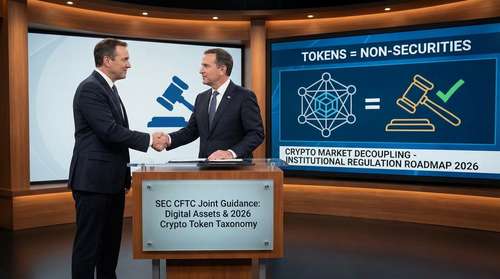
The United States cryptocurrency industry just received the regulatory clarity it has been demanding for over a decade. On March 17, 2026, federal regulators issued a historic 68-page document that fundamentally changes how the government oversees the blockchain ecosystem. The long-awaited SEC CFTC joint crypto guidance officially declares that the vast majority of cryptocurrencies and digital tokens do not qualify as securities. This sweeping policy shift effectively closes the door on the controversial "regulation by enforcement" era that defined the previous administration. By unifying the oversight approaches of the nation's top two financial watchdogs, Washington has finally provided a predictable environment for both retail participants and institutional giants to operate within the digital asset economy.
Breaking Down the Crypto Token Taxonomy 2026
At the core of this joint interpretation is a comprehensive framework that definitively categorizes the market. Regulators have established a formal crypto token taxonomy 2026, dividing the sprawling ecosystem into five distinct classifications. This digital assets securities classification system provides immediate, actionable rules for exchanges, developers, and asset managers.
The five categories include:
- Digital Commodities: Assets whose value is intrinsically linked to the programmatic operation of a functional network and market dynamics. This formally encompasses heavyweights like Ethereum (ETH), Solana (SOL), and XRP. Naturally, this classification also cements the narrative around the premier decentralized asset, reinforcing the Bitcoin store of value 2026 thesis by securing its status far outside the reach of traditional securities law.
- Digital Collectibles: Non-fungible tokens (NFTs) and most meme coins fall into this bucket, treated essentially as digital art or consumer goods.
- Digital Tools: Utility tokens used strictly to access or operate software applications and decentralized networks.
- Stablecoins: Fiat-pegged assets, which remain subject to separate oversight like the GENIUS Act.
- Digital Securities: Tokenized representations of traditional financial instruments, such as equities or bonds, which remain strictly under SEC jurisdiction.
Secondary Market Activities and Exemptions
Following the publication of the document, the latest SEC Chair Paul Atkins crypto news has dominated financial headlines. Speaking at the DC Blockchain Summit in Washington, D.C., Atkins made the agency's revised stance crystal clear. "After more than a decade of uncertainty, this interpretation will provide market participants with a clear understanding of how the Commission treats crypto assets," Atkins stated, delivering a widely celebrated soundbite: "We're not the 'securities and everything commission' anymore".
The new framework specifically addresses secondary market activities that have long operated in a legal gray area. Protocol-level mining, decentralized staking, network airdrops, and token wrapping are explicitly defined as non-securities transactions, provided they are not marketed as investment contracts reliant on a centralized team's managerial efforts. Furthermore, the guidance introduces a critical nuance: an asset initially sold as an investment contract can shed its security status once the underlying network becomes fully decentralized and functional. This officially replaces the rigid, one-size-fits-all application of the 1946 Howey Test that former Chair Gary Gensler heavily favored.
Laying the Institutional Crypto Regulation Roadmap
For years, builders struggled to apply outdated frameworks to decentralized blockchain architecture. The SEC and the Commodity Futures Trading Commission (CFTC), operating under a newly signed Memorandum of Understanding, have now provided a viable institutional crypto regulation roadmap.
CFTC Chairman Michael Selig echoed the importance of this inter-agency cooperation. He noted that American innovators have waited far too long for sensible rules, confirming that the agencies are now fully committed to fostering a regulatory environment that allows domestic innovation to flourish. While this 68-page interpretation does not hold the weight of formal congressional law, it serves as a critical bridge. It provides immediate safe harbors for startups and sets the stage for lawmakers who are actively negotiating comprehensive, bipartisan market structure legislation on Capitol Hill.
Analyzing the Crypto Market Decoupling News
The market reaction to this regulatory pivot has been swift and structurally significant. Analysts are already tracking significant crypto market decoupling news, as major altcoins begin to trade independently of Bitcoin's dominant price action. Previously, the looming threat of SEC enforcement forced the entire digital asset market to move in lockstep. Now, with Ethereum, Solana, and DeFi protocol tokens legally sheltered from arbitrary securities classification, institutional capital is rapidly rotating into these newly validated sectors without the fear of sudden enforcement actions.
Exchange operators now possess clear parameters for listing new assets, and traditional brokers are receiving directives allowing them to offer both traditional securities and crypto assets without requiring overlapping licenses. By drawing clear lines in clear terms, U.S. regulators have finally established a foundational bedrock for the next frontier of global finance.