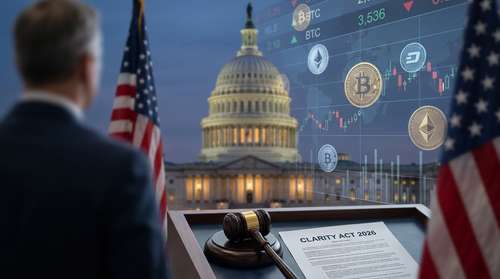
A high-stakes regulatory battle has reached the White House as the American Bankers Association (ABA) and major crypto firms clash over provisions in the pending Clarity Act. The conflict centers on whether crypto service providers should be permitted to pay interest on stablecoins, a move banks claim creates an unfair competitive advantage and systemic risk. Following a tense February 2 meeting mediated by White House officials, negotiations remain deadlocked, threatening to derail the most significant piece of crypto legislation of 2026.
The ‘Yield Loophole’ Derailing the Clarity Act
The current standoff revolves around a contentious provision in the Digital Asset Market Clarity Act of 2025 (commonly known as the Clarity Act). While the bill aims to provide a comprehensive market structure for digital assets, it has hit a wall over Section 404. This provision seeks to close what banks call the "affiliate loophole" left open by the GENIUS Act, signed into law in July 2025.
The GENIUS Act (Guiding and Establishing National Innovation for U.S. Stablecoins Act) successfully established a federal framework for payment stablecoin issuers, explicitly prohibiting them from paying interest directly to holders. However, it did not expressly ban third-party exchanges and custodians from offering "rewards" or "yields" funded by the underlying reserve assets. Banks argue this allows crypto platforms to function as unregulated high-yield savings accounts, bypassing the strict capital requirements imposed on traditional depository institutions.
Senate Banking Committee Chairman Tim Scott attempted to address this with Section 404, which would ban all digital asset service providers from paying yield solely for holding stablecoins. This move sparked an immediate revolt from the crypto industry, leading Coinbase CEO Brian Armstrong to withdraw support for the bill just days before a scheduled vote, effectively freezing the legislation in committee.
Banks Warn of $6.6 Trillion ‘Deposit Flight’ Risk
For the American Bankers Association (ABA) and the Bank Policy Institute (BPI), the issue is existential. In a joint letter to the Senate, banking lobbyists warned that allowing the stablecoin interest loophole to persist could trigger a massive exodus of capital from the traditional banking system. Their analysis suggests that up to $6.6 trillion in bank deposits could be at risk of migrating to yield-bearing stablecoin products.
The banking lobby argues that these deposits are the lifeblood of community lending. "If trillions of dollars shift from insured bank deposits to uninsured stablecoin wallets chasing yield, the capacity for local banks to fund small business loans and mortgages creates a hole in the economy that crypto cannot fill," the ABA stated. They contend that stablecoin issuers, who are required by the GENIUS Act to hold 1:1 reserves in Treasuries, are effectively siphoning liquidity out of the private lending market to park it in government debt.
Crypto Industry Cries Protectionism
On the other side of the aisle, crypto leaders view the proposed ban as a brazen attempt to legislate away competition. The Blockchain Association and major exchanges argue that passing yield on to consumers is a feature of technological efficiency, not a loophole. With interest rates remaining elevated in early 2026, they contend that consumers deserve to share in the returns generated by the assets backing their stablecoins.
"Banks are asking Congress to protect their profit margins at the expense of American savers," noted a spokesperson for the Crypto Council for Innovation. The industry argues that the GENIUS Act already mitigates risk through strict reserve audits and that banning third-party rewards stifles innovation. They point out that denying users a yield on their digital dollars renders the U.S. dollar less competitive against digital currencies from jurisdictions where yield is permitted.
White House Intervention and 2026 Outlook
The stalemate forced the White House to intervene earlier this week. In a closed-door meeting led by Crypto Czar David Sacks and advisor Patrick Witt, administration officials attempted to broker a compromise between the warring factions. However, sources indicate that neither side is willing to budge. The banks refuse to accept a regulatory regime that allows "shadow banks" to poach deposits, while crypto firms view the yield ban as a "kill switch" for their business models.
As of February 5, 2026, the Clarity Act remains in legislative limbo. Without a resolution to the interest yield debate, the broader regulatory clarity the industry has sought for years may be postponed indefinitely. For investors and users, the outcome will determine whether stablecoins remain purely transactional tools or evolve into the next generation of high-yield savings instruments.