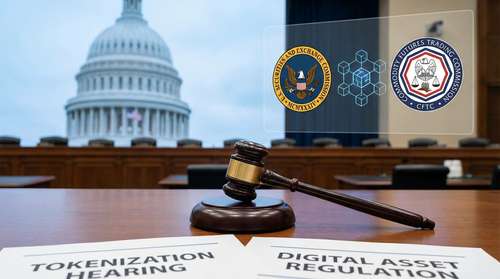
The global financial landscape is undergoing a seismic shift today, March 25, 2026, as lawmakers convene on Capitol Hill for the highly anticipated U.S. House tokenization hearing. Titled "Tokenization and the Future of Securities: Modernizing Our Capital Markets," the session arrives at a decisive moment for Wall Street and Silicon Valley alike. This pivotal congressional examination coincides with the official implementation of the first-ever SEC CFTC joint crypto rules, establishing a coordinated federal approach to the booming digital economy. For investors tracking the latest cryptovot crypto news, today's developments represent the transition of blockchain technology from speculative trading to foundational market infrastructure.
The Dawn of Unified Blockchain Financial Regulation
For years, the digital asset industry struggled under fragmented oversight and jurisdictional turf wars. That era effectively ends this week. The landmark SEC CFTC joint crypto rules, recently entered into the Federal Register, introduce a comprehensive five-category token taxonomy. This framework explicitly separates digital commodities, collectibles, tools, stablecoins governed under the GENIUS Act, and digital securities.
By signing a formal memorandum of understanding, the Securities and Exchange Commission and the Commodity Futures Trading Commission have finally aligned their oversight of financial markets. This unified approach to blockchain financial regulation removes the regulatory ambiguities that previously stifled innovation. Adding immediate momentum to the U.S. House tokenization hearing, the SEC also just approved Nasdaq’s rule change to allow the trading of tokenized securities on its platform during the Depository Trust Company’s (DTC) pilot program. This move alone acts as a massive catalyst for broad institutional digital asset adoption.
Examining the Legislative Docket
Inside Room 2128 of the Rayburn House Office Building, lawmakers are focused on two primary pieces of legislation aimed at modernizing American capital markets:
- The Modernizing Markets Through Tokenization Act: Requires regulators to conduct a joint study assessing whether additional guidance is necessary for tokenized securities and derivative products.
- The Capital Markets Technology Modernization Act: Provides the legal clarity necessary for broker-dealers and transfer agents to utilize blockchain-based record-keeping in compliance with federal standards.
The committee is hearing testimony from heavyweights across both traditional finance and the blockchain sector. Key witnesses include Kenneth Bentsen, CEO of the Securities Industry and Financial Markets Association (SIFMA), and Summer Mersinger, CEO of the Blockchain Association. The North American Securities Administrators Association (NASAA) also submitted a letter for the record, emphasizing that "a security remains a security" regardless of the underlying technology. Their combined insights are crucial for bridging the gap between legacy infrastructure and decentralized ledgers, laying the groundwork for comprehensive digital asset legislation 2026.
Paving the Way for Digital Asset Legislation 2026
While today's U.S. House tokenization hearing focuses heavily on structural integration, it acts as a precursor to even larger legislative moves. Today’s discussions set the stage for the Senate Banking Committee's upcoming April markup of the CLARITY Act. This broader package aims to codify the statutory boundaries between digital commodities and securities into federal law. As we analyze the trajectory of digital asset legislation 2026, the sequential momentum from agency agreements to congressional markups reveals a government finally ready to embrace Web3 architecture.
Fueling the Real-World Asset Tokenization Boom
The urgency on Capitol Hill directly reflects the reality of the private sector. Real-world asset tokenization has graduated from a theoretical concept to a massive economic driver. The appeal of placing physical and traditional financial assets on a blockchain lies in fractional ownership, instant 24/7 settlement, and automated compliance through smart contracts.
The RWA market recently crossed the $300 billion threshold, dominated by fiat-backed stablecoins, tokenized private equity, and on-chain U.S. Treasuries. As legacy institutions like the New York Stock Exchange and the DTCC modernize their systems to accommodate this demand, institutional digital asset adoption is moving at breakneck speed. Traditional financial players no longer view distributed ledgers as a threat, but rather as an essential upgrade for market efficiency. Through clear blockchain financial regulation, these institutions finally have the legal cover required to deploy trillions of dollars in capital on-chain.
A Turning Point for Capital Markets
We are witnessing the architectural rebuild of the global financial system. The combination of the SEC CFTC joint crypto rules and proactive congressional oversight provides the clearest signal yet that the United States intends to lead the next era of financial technology. For readers following cryptovot crypto news, the narrative has fundamentally changed. It is no longer a question of whether blockchain will integrate with traditional finance, but how quickly the transition will completely reshape global liquidity.
As real-world asset tokenization continues to scale and institutional digital asset adoption becomes the global standard, the policies forged this week will dictate the competitiveness of American capital markets for decades to come.