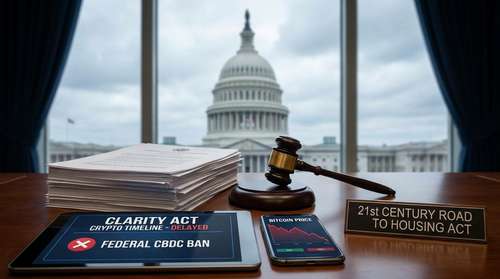
In a stunning reversal just hours before a scheduled Capitol Hill signing ceremony, President Donald Trump has abruptly stalled the widely supported 21st Century ROAD to Housing Act. While the move directly impacts national housing initiatives, the ripple effects are sending shockwaves through the digital asset industry. By holding the housing legislation hostage to force passage of the unrelated SAVE America Act, the administration has inadvertently placed a major federal CBDC ban in legislative limbo and severely threatened the narrow timeline for the CLARITY Act crypto bill.
Trump Upends Landmark Legislation Over SAVE America Act
The 21st Century ROAD to Housing Act achieved a rare feat in Washington: overwhelming bipartisan support. The comprehensive affordability package cleared the House of Representatives by a lopsided 358-32 margin, following an equally impressive 85-5 victory in the Senate. But on Wednesday, June 24, 2026, Trump took to Truth Social to cancel the ceremonial signing. He declared the housing package to be of minor importance compared to the SAVE America Act—a restrictive voter ID and proof-of-citizenship bill he considers a National Emergency.
For the digital asset sector, this political maneuvering comes at an incredibly precarious time. The delay not only pauses immediate policy wins but threatens to consume vital congressional floor time needed to establish clear crypto market regulation.
A Temporary Federal CBDC Ban Left in Limbo
While primarily focused on accelerating home construction and limiting institutional land grabs, the stalled bill carries a massive rider for the blockchain industry. Lawmakers successfully attached a four-year prohibition on the Federal Reserve creating or issuing a central bank digital currency.
This federal CBDC ban would extend through the end of 2030, effectively halting any momentum for a government-issued retail digital dollar. The provision aligns closely with existing Trump crypto policy; earlier this year, the president signed an executive order directing federal agencies to avoid establishing a CBDC unless mandated by Congress. By refusing to sign the very legislative package that would codify this restriction, the administration is inadvertently stalling one of the digital asset sector's most coveted victories.
Opponents of a retail digital dollar have long argued that a digitized greenback would hand the central bank unprecedented surveillance capabilities over citizens' private transactions. For now, until the standoff over the SAVE America Act is resolved, those systemic privacy concerns remain completely unaddressed.
The Ticking Clock for the CLARITY Act Crypto Bill
The collateral damage of this legislative roadblock extends far beyond the digital dollar debate. The CLARITY Act crypto package, broadly considered the most significant digital asset market structure framework proposed in a decade, is now facing a highly compromised path forward.
With the Senate calendar offering only about five weeks before Congress breaks for its summer recess, the window to advance complex digital asset legislation is rapidly closing. If the Senate is forced into a protracted, multi-day marathon debate over the SAVE America Act, or if lawmakers must scramble to override a potential pocket veto of the housing bill, the CLARITY Act could be squeezed off the schedule entirely. Policy analysts caution that this gridlock significantly narrows the odds of comprehensive crypto market regulation becoming law this year.
Navigating the Recent Bitcoin Price Drop
This sudden wave of political uncertainty arrives against the backdrop of a broader market pullback. While regulatory developments rarely drive immediate retail action on their own, the legislative delay certainly hasn't bolstered investor confidence.
Coinciding with the Capitol Hill drama, investors are currently navigating a frustrating Bitcoin price drop. As of late June, Bitcoin has slipped near the $62,771 mark, pulling the wider digital asset market down with it. The Crypto Fear & Greed Index has dipped firmly into fear territory, registering near 20. While macroeconomic pressures and equity weaknesses are the primary catalysts for the red charts, the stalling of highly favorable pro-crypto legislation removes a massive potential bullish catalyst from the equation.
What Comes Next for Crypto Market Regulation?
The immediate fate of the housing package and its embedded federal CBDC ban hinges on parliamentary procedure. Under the Constitution, Trump has a 10-day window (excluding Sundays) to either sign or veto the legislation. Because it passed with veto-proof majorities, Congress could override a formal rejection. Alternatively, the bill can automatically become law if the president simply takes no action while lawmakers remain in session.
However, the longer-term impacts on Trump crypto policy and the CLARITY Act are far more troubling for industry advocates. If the administration continues to use bipartisan consensus bills as leverage for controversial election mandates, the digital asset industry may find itself repeatedly caught in the crossfire.
You should keep a close eye on the Senate floor in the coming weeks. Whether lawmakers can somehow thread the needle to advance the CLARITY Act crypto framework before the August recess will likely determine the operational landscape of the United States digital economy for years to come.