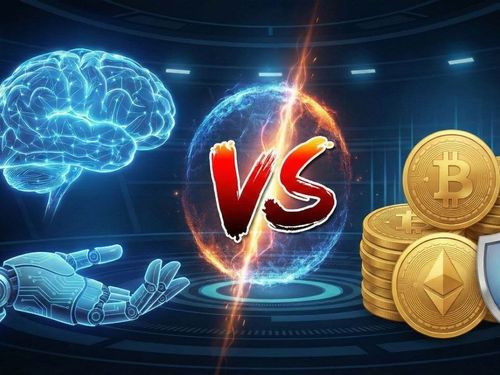
For years, "Artificial Intelligence" and "Blockchain" were the technology sector's two most dominant buzzwords, yet they ran on parallel tracks. Blockchain promised decentralization and mathematical truth, while AI promised efficiency and autonomous intelligence. Now, in 2026, these trajectories are colliding. The result is a paradox: AI is simultaneously the greatest threat to crypto security and its only hope for achieving true mass adoption.
The Threat: The Industrialization of Digital Crime
The primary concern regarding AI in crypto isn't the emergence of a singular "genius hacker," but the ability to execute crime on an industrial scale. In the past, a hacker might spend days hunting for a vulnerability in a Smart Contract. Today, AI tools can scan thousands of contracts in seconds, identifying "backdoors" overlooked by human developers and generating code exploits before the developers even have time to blink.
However, the more severe danger lies in the human element. "Social Engineering" has undergone a terrifying upgrade. The era of clumsy emails from a "Nigerian Prince" is over. Modern AI analyzes an investor's digital footprint, understands their linguistic patterns, and crafts a hyper-personalized phishing offer that appears completely legitimate. Add Deepfake technology to the mix, capable of simulating live video calls with crypto CEOs, and the industry maxim "Don't Trust, Verify" becomes nearly impossible for the average person to implement.
The Elephant in the Room: AI is Not Quantum
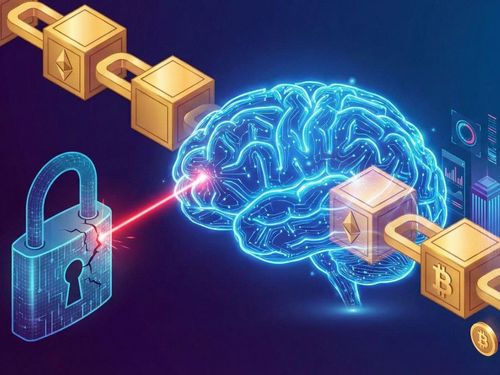
A common misconception is that AI will soon "crack Bitcoin" or decipher private keys. A critical distinction must be made here: AI is a master lockpicker; a Quantum Computer is a bulldozer.
Artificial Intelligence, however smart, is bound by the laws of mathematics and classical hardware. It excels at pattern recognition and finding flaws in human-written code, but it cannot break the underlying mathematical encryption (such as SHA-256) upon which the blockchain is built.
The real threat to the mathematics comes from Quantum Computing, which can perform calculations at speeds a standard computer couldn't achieve in a million years. This is precisely why the crypto industry is currently in an arms race to adopt "Post-Quantum Cryptography" (PQC). The goal is to fortify the walls before the bulldozer arrives, not because AI is threatening to knock them down.
The Hope: From the "Wild West" to the Credit Card of the Future
Despite the risks, AI is likely the missing piece in the puzzle of mass adoption. Crypto's biggest hurdle has never been the technology itself, but the nightmarish User Experience (UX). Long wallet addresses, the management of private keys, and the constant fear of irreversible errors have kept the general public at bay.
Over the next five years, AI is expected to serve as the "intermediary layer" that eliminates this complexity:
* Natural Language Interface: Instead of copying hexadecimal addresses (0x7a...), users will simply tell their wallet: "Send $50 to Joe." The AI will handle identity verification, select the most cost-effective network, and execute the action.
* The Personal Bodyguard: Before signing any transaction, an AI algorithm will run a simulation and warn the user in plain English: "Stop! This contract is attempting to drain your entire wallet, not just charge a one-time fee." This marks the end of the "I signed by mistake" era.

The New Economy: Fuel for Machines or Gold for the Masses?
How will this technological adoption impact the prices of the major currencies? The effect is expected to be dramatic, yet fundamentally different for the two giants:
Bitcoin (BTC)
The Accessibility Effect: For Bitcoin, AI doesn't change the essence ("Digital Gold") but rather the access to it. When AI wallets allow anyone to invest with a single voice command, removing all technical fear, the user base will expand by hundreds of millions. When massive demand meets a fixed, limited supply, the value is destined to rise.
Ethereum (ETH)
Fuel for the Autonomous Economy: Here, the potential is even more explosive. In the near future, billions of "AI Agents" (bots) will conduct transactions among themselves 24/7. A content-writing bot will pay a storage bot. They won't use banks; they will use smart contracts. Every such action requires "Gas," paid in ETH. This massive usage, combined with Ethereum's burn mechanism, could turn ETH into a scarce and highly sought-after commodity, much like oil in the industrial world.
Conclusion: Digital Coexistence
The convergence of AI and Crypto creates a binary reality: on one hand, it makes the network more dangerous for the unwary and the careless. On the other, it provides, for the first time, the tools that allow the average person to navigate this world with confidence and ease.
If the last decade was dedicated to building the Blockchain infrastructure, the coming decade belongs to the AI that will make it accessible to the masses. AI won't kill crypto; it is what will finally turn it into money.