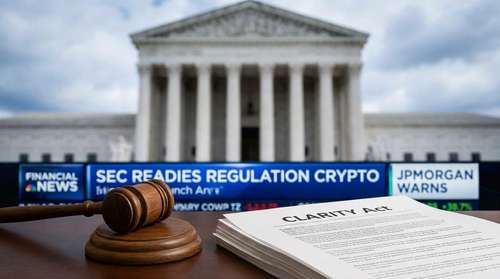
In a watershed moment for the digital asset industry, the U.S. House of Representatives has officially passed the Financial Innovation and Technology for the 21st Century Act (FIT21). This landmark legislation, approved with significant bipartisan support, marks the first time a chamber of Congress has successfully advanced a comprehensive regulatory framework for the cryptocurrency market. The bill’s passage signals a decisive shift toward regulatory clarity, aiming to end the jurisdictional tug-of-war between the Securities and Exchange Commission (SEC) and the Commodity Futures Trading Commission (CFTC).
Bipartisan Support Defies Political Divides
The FIT21 Act (H.R. 4763) cleared the House floor with a decisive 279-136 vote, showcasing a rare alignment between Republicans and Democrats on financial technology policy. Notably, 71 Democrats crossed party lines to join 208 Republicans in supporting the measure, defying opposition from the White House and SEC Chair Gary Gensler. This overwhelming margin suggests a growing consensus on Capitol Hill that the status quo of "regulation by enforcement" is no longer sustainable for the rapidly evolving digital asset sector.
Supporters of the bill, including House Financial Services Committee Chairman Patrick McHenry, argued that the legislation provides necessary "rules of the road" to keep innovation within the United States. By securing such a strong bipartisan mandate, the House has sent a powerful message to the Senate that crypto regulation is a legislative priority transcending traditional party platforms.
Defining the SEC vs. CFTC Jurisdiction
At the core of FIT21 is a clear delineation of regulatory roles based on the decentralized nature of a blockchain. The bill establishes a functional test to determine whether a digital asset is a security or a commodity:
- Digital Commodities: If a blockchain network is deemed "decentralized" and functional, the associated asset falls under the jurisdiction of the CFTC. The bill defines decentralization largely by the absence of a controlling entity with unilateral authority.
- Restricted Digital Assets: Assets running on non-decentralized networks remain under the purview of the SEC, ensuring that early-stage projects adhere to securities laws and disclosure requirements.
This framework addresses the industry's long-standing demand for a pathway to compliance. It allows projects that start as securities (during fundraising or development) to transition into commodities as they achieve sufficient decentralization, a process that was previously undefined under federal law.
Consumer Protections and Market Structure
Beyond jurisdictional lines, the Financial Innovation and Technology Act introduces robust consumer protection standards. Crypto exchanges and broker-dealers will be required to register with the appropriate federal agency—either the SEC or CFTC—and adhere to strict rules regarding the segregation of customer funds. This provision directly responds to market failures like the collapse of FTX, aiming to prevent the commingling of assets that put users at risk.
The legislation also mandates comprehensive disclosures from digital asset developers. Projects will need to provide transparency regarding their operation, ownership structure, and source code, empowering investors with the information needed to make educated decisions. By formalizing these requirements, FIT21 seeks to mature the digital asset market structure and weed out bad actors.
White House and Regulatory Pushback
Despite the bill's success in the House, it faces headwinds. Prior to the vote, the White House issued a Statement of Administration Policy expressing opposition, citing concerns that the bill lacks sufficient investor protections. SEC Chair Gary Gensler also voiced strong criticism, warning that the legislation could undermine decades of securities laws and create regulatory gaps.
However, the robust "Yes" vote—exceeding the two-thirds majority threshold often required for veto-proof legislation—demonstrates that many lawmakers view these concerns as addressable or secondary to the need for legislative action. The ball now moves to the Senate, where the future of the bill remains uncertain but increasingly difficult to ignore.
What’s Next for US Crypto Legislation?
The passage of FIT21 is a critical first step, but it is not the finish line. The bill must now be considered by the Senate, which has been slower to advance crypto-specific legislation. Industry stakeholders will be watching closely to see if the Senate Banking Committee takes up the measure or if a compromise version emerges. Regardless of the outcome in the upper chamber, the House's action has fundamentally altered the conversation, establishing a concrete baseline for how the U.S. government intends to treat digital assets in the future.