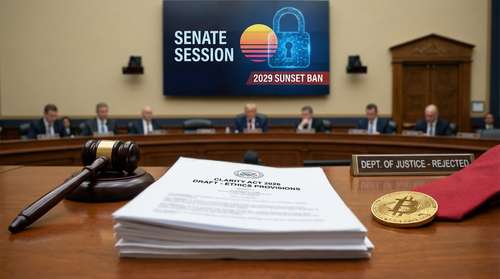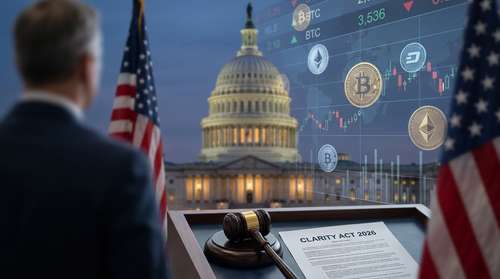
The U.S. Senate Banking Committee has officially postponed its high-stakes markup of the Digital Asset Market Clarity Act (CLARITY Act) following a sudden and decisive withdrawal of support from Coinbase CEO Brian Armstrong. In a move that sent shockwaves through Washington and Wall Street alike on Thursday, the industry leader criticized the bill's latest provisions as a "poison pill" that would effectively ban crypto platforms from offering rewards or interest on stablecoin holdings—a concession allegedly fueled by intense pressure from the traditional banking sector.
The 'Poison Pill': Why Coinbase Walked Away
For months, the CLARITY Act was hailed as the bipartisan breakthrough that would finally provide a comprehensive regulatory framework for the U.S. crypto market. However, the delicate coalition supporting the bill crumbled late Wednesday when Brian Armstrong announced that Coinbase could not support the legislation in its current form. The sticking point? A last-minute amendment that would prohibit digital asset service providers from paying "passive yield" on payment stablecoins.
"We'd rather have no bill than a bad bill," Armstrong wrote in a blistering statement on X (formerly Twitter). He argued that the new language would make the U.S. regulatory environment "materially worse than the current status quo" by stripping American consumers of their ability to earn interest on their assets. Armstrong warned that the provision was designed to protect traditional banks from competition rather than to protect consumers, stating, "Banks are worried they're going to have to start paying higher rates to customers to compete, so they're lobbying to ban the alternative."
Beyond the stablecoin rewards ban, Coinbase raised alarms over vague language that could amount to a de facto ban on tokenized equities and impose unworkable surveillance requirements on decentralized finance (DeFi) protocols. The abrupt reversal from the largest U.S. exchange left Senate Banking Committee Chairman Tim Scott (R-SC) with no choice but to delay the vote to allow for further negotiations.
The Banking Lobby's Fingerprints
The controversy centers on the growing friction between fintech innovation and traditional banking models. Banking lobbyists, including the American Bankers Association, have aggressively campaigned against stablecoin rewards, arguing that unregulated "shadow banks" shouldn't be allowed to offer high-yield deposit-like products without adhering to the same capital requirements as insured depositories.
According to Treasury analysis cited by banking groups, allowing unrestricted stablecoin yields could put up to $6.6 trillion in traditional bank deposits at risk of capital flight. This fear prompted the inclusion of strict "activity-based" limitations in the CLARITY Act, which would only permit rewards tied to specific behaviors like staking or payments, while banning passive interest. Critics like Consensys' Bill Hughes argue this distinction is economically flawed and serves only to entrench incumbent financial institutions at the expense of consumer choice.
A House Divided: Crypto Industry Split on Strategy
While Coinbase's withdrawal was the catalyst for the delay, the crypto industry is far from united in its opposition. In a notable divergence, Ripple CEO Brad Garlinghouse publicly reaffirmed his support for the CLARITY Act despite the controversial amendments. Garlinghouse described the legislation as a "massive step forward" that would finally clarify the jurisdiction between the SEC and CFTC, a long-sought goal for companies weary of regulation-by-enforcement.
"Ripple (and I) know firsthand that clarity beats chaos, and this bill's success is crypto's success," Garlinghouse stated, highlighting the desperate need to resolve the SEC vs CFTC crypto rules debate that has plagued the sector for years. This split highlights a strategic rift: some players are willing to accept restrictive stablecoin rules in exchange for market structure clarity, while others, like Coinbase, view the stablecoin economy as too vital to compromise.
What's Next for Crypto Legislation in 2026?
The postponement leaves the future of the CLARITY Act in limbo. Senate insiders report that Democrats and Republicans are scrambling to salvage the bill, with emergency meetings scheduled between industry representatives and committee staff this Friday. The challenge for Senator Scott will be finding a middle ground that satisfies the banking lobby's safety concerns without alienating the crypto platforms necessary to make the regulations workable.
If a compromise on the stablecoin rewards ban cannot be reached, the bill risks dying in committee, pushing any hope for significant crypto market structure reform into late 2026 or beyond. for now, the industry watches and waits, with Brian Armstrong's ultimatum echoing through the halls of the Capitol: innovation cannot be traded for mere legitimacy.