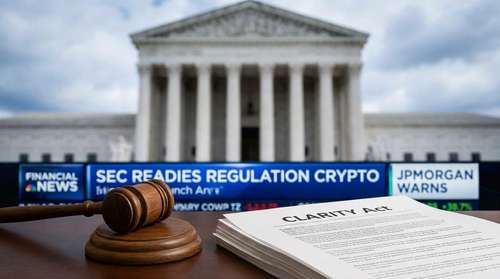
In a watershed moment for the integration of digital assets into Wall Street's infrastructure, the Securities and Exchange Commission (SEC) has effectively unlocked billions in potential capital efficiency for crypto markets. As of February 19, 2026, the SEC's Division of Trading and Markets issued a landmark clarification allowing broker-dealers to apply a mere 2% capital "haircut" to eligible USD payment stablecoins. This dramatic reduction from the previous, prohibitive 100% deduction signals a new era where stablecoins are treated on par with high-quality money market funds, paving the way for massive institutional adoption.
Breaking Down the 2% Haircut: A Regulatory Sea Change
For years, the SEC's Net Capital Rule (Rule 15c3-1) acted as a formidable dam holding back institutional floods. Under the old interpretation, broker-dealers holding stablecoins on their balance sheets were forced to take a 100% deduction. In practical terms, this meant that for every $100 million in USDC or other stablecoins a firm held, they effectively had $0 recognized capital for regulatory purposes. It was a capital-inefficient nightmare that made holding digital dollars prohibitively expensive for regulated entities.
The new guidance shatters this barrier. By classifying qualified payment stablecoins as having a "ready market," the SEC now permits a 2% haircut—meaning that same $100 million holding now counts as $98 million in net capital. This 98% efficiency rate aligns perfectly with the treatment of traditional money market funds, acknowledging that regulated, fully-backed stablecoins carry a risk profile comparable to cash equivalents rather than volatile speculative assets.
Defining "Qualified" Stablecoins
Crucially, not every token gets this gold-standard treatment. The guidance specifically applies to stablecoins that meet rigorous standards, effectively creating a two-tier market. To qualify for the 2% tier, a stablecoin must:
- Be denominated in U.S. dollars.
- Maintain 1:1 reserves in cash or short-term U.S. Treasuries.
- Be issued by a state-regulated money transmitter, trust company, or national trust bank.
- Provide regular, independent attestations of reserve assets.
The GENIUS Act Connection: Bridging the Gap to 2026
This regulatory pivot didn't happen in a vacuum. It serves as a critical bridge to the full implementation of the GENIUS Act (Guidance for Emerging New Innovation and Useful Stablecoins), signed into law by President Trump in July 2025. While federal regulators are racing toward a July 2026 deadline to finalize the Act's comprehensive framework, the SEC's Division of Trading and Markets moved proactively to align current enforcement with future law.
SEC Commissioner Hester Peirce, a long-time advocate for crypto regulatory clarity, championed the move in her statement titled "Cutting by Two Would Do." She noted that the previous 100% haircut was "unnecessarily punitive" given that compliant stablecoins are backed by the very same assets—Treasuries and cash—that back money market funds. This alignment ensures that broker-dealers don't have to wait for the final ink on GENIUS Act regulations to begin integrating stablecoins into their settlement and trading workflows.
Implications for Institutional Crypto Liquidity
The downstream effects of this decision will be profound for market structure. By making it capital-efficient to hold stablecoins, the SEC has effectively greased the wheels for:
1. Instant Settlement: Broker-dealers can now hold stablecoin inventory to facilitate 24/7 settlement of tokenized securities and crypto assets without destroying their balance sheet efficiency. This is a prerequisite for moving U.S. equities and bonds onto blockchain rails.
2. Enhanced Market Making: Market makers can provide deeper liquidity in crypto-to-fiat pairs, as holding the "fiat" leg (in the form of stablecoins) no longer incurs a massive capital penalty. This should lead to tighter spreads and less slippage for institutional investors.
3. Mainstream Adoption: Major Wall Street firms that were previously hesitant to touch stablecoins due to capital costs can now integrate them into their prime brokerage and custody offerings. We are likely to see a surge in "crypto-native" services offered by traditional financial giants throughout 2026.
Industry Reaction: A "Green Light" for Innovation
The response from the crypto sector has been overwhelmingly positive. Industry leaders view this as the "missing link" that connects the high-speed world of on-chain finance with the regulated, capital-constrained world of traditional banking. SEC Chair Paul Atkins described the move as a pragmatic step to modernize the agency's approach, recognizing that blocking stablecoin utility served neither investors nor the efficiency of capital markets.
However, the guidance also serves as a warning shot to unregulated issuers. By granting a massive competitive advantage to compliant, transparent stablecoins, the SEC is letting the market pick winners. Institutional capital will inevitably flow toward the tokens that offer this 98% capital efficiency, potentially marginalizing offshore or opaque stablecoins that cannot meet the rigorous reserve and audit standards required for the 2% haircut.
As we move closer to the full GENIUS Act implementation in mid-2026, this regulatory clarification stands as a clear signal: the U.S. is open for business, provided that business is built on a foundation of transparency, solvency, and compliance.