
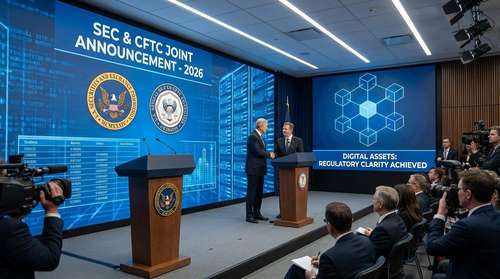
After more than a decade of legal ambiguity and enforcement-heavy tactics, the United States has fundamentally rewritten its approach to the digital economy. On March 18, 2026, the Securities and Exchange Commission (SEC) and the Commodity Futures Trading Commission (CFTC) released historic joint interpretive guidance officially categorizing the vast majority of digital assets as non-securities. This watershed moment delivers the SEC CFTC crypto clarity 2026 investors have long awaited, replacing years of regulatory friction with a transparent, actionable framework for the entire digital asset ecosystem.
Decoding the New Crypto Non-Securities Classification
The core of this groundbreaking crypto market regulatory update is a brand-new "token taxonomy" establishing five distinct asset categories: digital commodities, digital collectibles, digital tools, stablecoins, and digital securities. Under this official 68-page interpretation, only tokenized traditional assets—digital securities—are subject to federal securities laws.
By formally recognizing that digital commodities and stablecoins derive their value from market utility and supply-and-demand dynamics rather than corporate managerial efforts, regulators have effectively removed the existential threat hanging over the industry. SEC Chair Paul Atkins drove the point home during his public remarks, asserting that the agency is no longer the "securities and everything commission".
This move required unprecedented cooperation between historically territorial regulators. Just days prior, the agencies signed a comprehensive Memorandum of Understanding (MOU) to share data and coordinate oversight. CFTC Chairman Michael Selig echoed Atkins' sentiment, confirming his agency will administer the Commodity Exchange Act in perfect alignment with the new interpretation to prevent contradictory rule-making.
The End of Howey Confusion: Staking and Airdrops Non-Securities
Perhaps the most crucial aspect of the latest digital asset regulation news is the explicit protection granted to core blockchain operations. The joint guidance unambiguously declares that protocol mining, staking, and wrapping do not constitute securities transactions. Furthermore, token airdrops are officially excluded from the definition of investment contracts.
This specific SEC Paul Atkins crypto ruling is a massive victory for decentralized networks. For years, developers operated in fear that simply securing a proof-of-stake network or distributing governance tokens could trigger devastating enforcement actions under the 1946 Howey Test. James Moloney, director of the SEC's Division of Corporation Finance, aptly described the guidance as "the last chapter in the tale of Howey". By legally defining staking and airdrops non-securities, Washington has given American builders the green light to innovate, test, and deploy decentralized protocols without paralyzing compliance costs.
How SEC CFTC Crypto Clarity 2026 Drives Institutional Crypto Adoption
The immediate practical effect of this regulatory pivot is the dismantling of barriers preventing traditional finance from entering the blockchain arena. Wall Street banks, pension funds, and major asset managers previously cited regulatory uncertainty as their primary obstacle. With a definitive crypto non-securities classification now legally binding, compliance departments have the exact boundaries they need to greenlight extensive market participation.
We are already seeing the groundwork laid for unprecedented institutional crypto adoption. With stablecoins explicitly cleared of securities baggage—provided they align with the upcoming GENIUS Act standards—payment processors and traditional financial institutions can seamlessly integrate them into global settlement rails. Market analysts predict a rapid influx of capital into digital commodities, as the risk of sudden, retroactive enforcement has been virtually eliminated, making these assets viable for large-scale portfolio allocation.
The Upcoming Innovation Exemption
Beyond the immediate reclassification, Chair Atkins announced plans to introduce a "fit for purpose" startup exemption in the coming weeks. This proposed safe harbor provision will allow early-stage crypto companies to raise capital and build out their networks for a defined period while exempt from standard SEC registration requirements. This bridging mechanism ensures that the next generation of digital tools and platforms can launch domestically rather than fleeing to offshore jurisdictions.
What This Crypto Market Regulatory Update Means for the Future
Tuesday’s joint guidance represents a 180-degree turn in U.S. financial policy. Instead of utilizing outdated statutes as weapons against emerging technology, the government has provided a rational, harmonized rulebook. This regulatory update essentially hands the digital asset sector the blueprints to build compliant, sustainable businesses on American soil.
As global markets digest this news, one thing is abundantly clear: the era of "regulation by enforcement" has officially ended. By drawing distinct lines and confirming that most digital assets are simply not securities, the SEC and CFTC have secured the United States' position as a viable, highly competitive hub for the future of decentralized finance.