A Landmark SEC CFTC Crypto Agreement
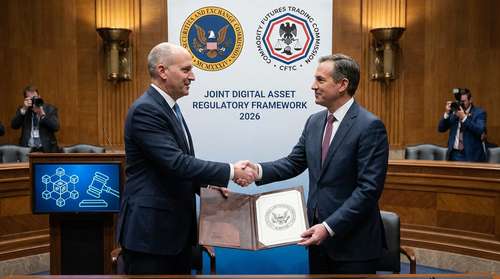
Decades of jurisdictional battles and enforcement-heavy tactics have culminated in a sweeping ceasefire on Wall Street. In a landmark move announced this week, the U.S. Securities and Exchange Commission (SEC) and the Commodity Futures Trading Commission (CFTC) signed a comprehensive Memorandum of Understanding. This historic SEC CFTC crypto agreement establishes a unified "fit-for-purpose" framework for digital asset regulation 2026, promising to replace rampant confusion with actionable rules for blockchain innovators and institutional investors.
For years, the digital asset industry has navigated a regulatory minefield. Firms routinely faced conflicting mandates, redundant registrations, and the persistent threat of parallel enforcement actions. By committing to coordinate rulemaking, supervision, and the deployment of new products, the two top financial regulators are signaling a major pivot toward modernizing the US crypto market structure.
The End of the Regulatory Turf War
The friction over whether specific digital assets should be classified as securities or commodities has long paralyzed institutional adoption in the United States. Regulators historically approached the sector through a fragmented, enforcement-first lens. That adversarial era appears to be drawing to a close under the current administration's push for financial innovation.
Spearheading this shift are Paul Atkins SEC Chairman and Michael Selig CFTC Chairman. Both leaders have publicly acknowledged that overlapping regulations stifled innovation and pushed valuable capital offshore to friendlier jurisdictions. During the joint announcement, Atkins noted that fragmented enforcement does not increase deterrence, but rather only increases market confusion. The new pact formally establishes a "Joint Harmonization Initiative" designed to streamline product definitions, clear settlement rules, and coordinate the supervision of trading platforms.
Dividing the Jurisdictional Workload
Instead of battling for control over the same assets, the agencies have mapped out a functional division of labor based on the joint "Project Crypto" task force. The SEC will retain primary oversight of initial primary market fundraising—such as Initial Coin Offerings (ICOs)—and tokens that operate strictly as investment contracts with centralized profit-sharing. Conversely, the CFTC is granted primary authority over the secondary market spot trading of digital commodities, which explicitly covers major network assets like Bitcoin and Ether.
Accelerating Crypto Regulatory Clarity
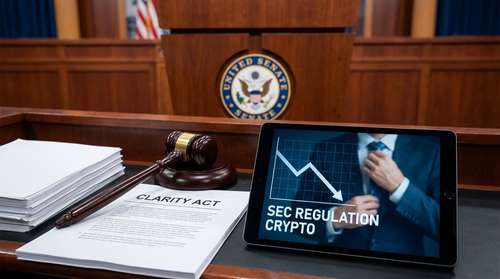
The timing of this inter-agency truce is no coincidence. Lawmakers on Capitol Hill have continuously struggled to finalize a comprehensive legal framework for the industry. While the House passed the bipartisan CLARITY Act in July 2025, the legislation remains stalled in the Senate amid complex debates over tokenized equities and stablecoin yields. Rather than waiting for legislative gridlock to clear, regulators chose to act administratively to deliver immediate crypto regulatory clarity.
One of the most tangible benefits of the SEC CFTC crypto agreement is the regulatory pathway it opens for modern financial "super-apps". By aligning their supervisory frameworks, the agencies are laying the groundwork for platforms to seamlessly offer traditional equities, digital commodities, and banking services within a single brokerage account. The agreement explicitly focuses on reducing the compliance burden for these dually-regulated firms, applying a "minimum effective dose" of regulation that Selig has fiercely advocated for since his confirmation in December 2025.
What Joint Agency Oversight Means for the Market
For financial institutions, asset managers, and decentralized finance (DeFi) builders, the practical implications of joint agency oversight cannot be overstated. Companies will no longer face the dreaded "regulatory pile-on," where a single operational misstep triggers simultaneous, independent investigations and fines from both regulatory bodies. The memorandum outlines strict procedures for sharing risk monitoring tools, market surveillance insights, and coordinated examination planning.
When an asset or service touches elements of both regulatory frameworks, firms will no longer be shuffled back and forth between agencies. Instead, SEC and CFTC staff are committed to conducting joint meetings to evaluate product applications, effectively creating a standardized, one-stop compliance route. This cross-market surveillance effort is intended to improve visibility across interconnected derivatives markets without duplicating the paperwork.
This coordinated oversight injects a massive dose of confidence into the American financial sector. Capital markets demand predictability, and the lack of a clear taxonomy has kept trillions of dollars in institutional capital on the sidelines. By drafting the SEC CFTC crypto agreement, the agencies have effectively handed the industry the blueprint it needs to mature. The days of regulation by enforcement are fading, making way for a unified market structure that aims to cement the United States as the undisputed global hub for digital finance.