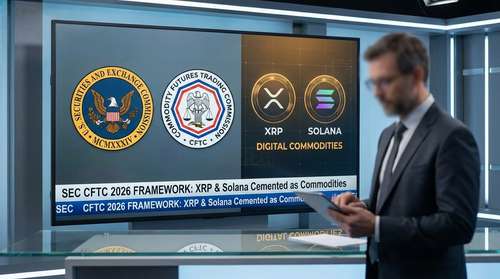
Today, the highly anticipated SEC CFTC 2026 Framework officially goes into effect, marking a monumental shift in how the United States regulates the cryptocurrency ecosystem. Following the initial March 17 interpretive release, this joint policy fundamentally alters the digital financial landscape by formally recognizing 16 major tokens—most notably XRP and Solana—as digital commodities. For investors, asset managers, and protocol developers alike, the long-standing era of regulation by enforcement has effectively ended. In its place, federal regulators have implemented objective rules that will heavily dictate the future of decentralized finance and domestic blockchain technology.
A Historic Milestone for Digital Asset Legal Status
The implementation of this sweeping taxonomy resolves over a decade of jurisdictional tug-of-war between federal agencies. Led by SEC Chairman Paul S. Atkins and CFTC Chairman Michael S. Selig, the regulatory bodies finalized a binding 68-page rule that explicitly details a five-category classification system. This structured framework formally separates digital commodities, tokenized securities, payment stablecoins, digital collectibles, and digital tools.
By classifying native assets based on their functional network operations rather than subjective managerial efforts, regulators have finally provided definitive digital asset legal status. As of today, the crypto market has a clear, legally binding baseline for what falls under the Commodity Exchange Act versus federal securities laws. The ruling ensures that digital commodities fall under the oversight of the CFTC, giving market participants the stability required to operate without fear of sudden enforcement actions.
Unpacking the Five-Part Taxonomy
Under the finalized SEC CFTC 2026 Framework, the distinction between a security and a commodity is no longer up for wild interpretation. The new guidelines establish that fungible assets deriving their value from market supply and decentralized network mechanics belong firmly under the CFTC's purview. Meanwhile, the SEC retains exclusive oversight over traditional financial instruments that are repackaged on-chain, such as tokenized stocks and bonds. Additionally, the guidance isolates payment stablecoins under the GENIUS Act, removing them from standard securities laws and providing a safe harbor for stablecoin yield seekers.
XRP Digital Commodity: The End of a Legal Era
Perhaps no community is celebrating today's effective date quite like the XRP ledger ecosystem. After enduring a grueling, multi-year legal battle that spanned four years and cost hundreds of millions of dollars in legal fees, the asset has received its final, binding classification. The permanent designation of XRP digital commodity status immediately removes the regulatory overhang that has heavily suppressed institutional adoption and limited exchange listings across the United States.
Market analysts are already predicting a significant influx of institutional capital. Banks and traditional payment providers that previously hesitated to integrate the underlying technology now have the definitive green light to build cross-border payment rails without fear of retroactive SEC litigation. Furthermore, with XRP officially recognized as a commodity, the path for spot XRP exchange-traded funds is now cleared of its primary legal roadblock, opening the door for massive institutional inflows.
Solana Regulatory Clarity Accelerates Institutional Adoption
Alongside XRP, the network token SOL has officially shed its previous regulatory baggage. Achieving Solana regulatory clarity is a massive catalyst for the high-throughput blockchain, which had previously faced intense scrutiny regarding its early tokenomics. The joint ruling confirms that SOL operates as a functional commodity within a decentralized network, entirely distinct from corporate securities.
This explicit classification clears the most significant legal hurdle for spot ETF applications. Wall Street asset managers who filed paperwork earlier this year can now aggressively push their Solana exchange-traded products forward. Beyond just the asset itself, the guidelines explicitly state that protocol staking is not a securities transaction. This specific provision provides a massive boost to the network's decentralized finance protocols and liquid staking providers, allowing institutional allocators to safely generate yield on their holdings.
New Crypto Compliance Standards and the Web3 Technical Roadmap
While the retail market remains heavily focused on the specific assets named, the broader implications for industry operations are equally profound. The federal agencies have rolled out comprehensive crypto compliance standards that permanently shield common on-chain activities. Protocol mining, airdrops, and token wrapping are explicitly protected from being automatically labeled as unregistered securities offerings.
For protocol builders and software engineers, this establishes a highly reliable Web3 technical roadmap. Startups can now architect decentralized applications, structure token generation events, and deploy smart contracts with a crystal-clear understanding of federal boundaries. By removing the legal ambiguity surrounding basic protocol functions, the framework allows American builders to innovate freely, ensuring that the next generation of internet infrastructure can be developed onshore.
What This Means for SEC Crypto News Today
If you are monitoring SEC crypto news today, the dramatic shift in regulatory tone is undeniable. The commission has pivoted from a highly defensive posture to a collaborative one, openly working alongside the CFTC to foster domestic innovation. As SEC Chairman Atkins noted, they are no longer the 'securities and everything commission'. As the SEC CFTC 2026 Framework takes root, the focus now shifts directly to capital markets and how quickly traditional financial institutions will deploy infrastructure to support these newly minted digital commodities.
The formal implementation of these rules is the strongest signal yet that the United States intends to remain a global hub for blockchain technology. With the most burdensome regulatory hurdles finally cleared, the next phase of institutional market expansion is officially underway, promising a more secure, transparent, and vibrant digital economy for everyone involved.