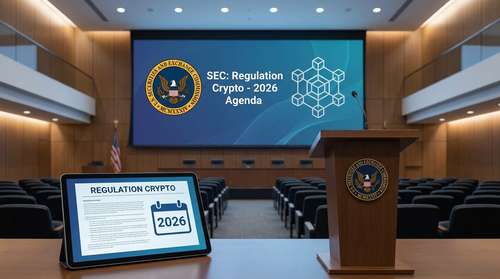
In a watershed moment for the global financial sector, the Securities and Exchange Commission (SEC) and the Commodity Futures Trading Commission (CFTC) have officially activated ‘Project Crypto,’ a landmark joint initiative designed to synchronize federal oversight of the digital asset market. Announced earlier this week by SEC Chair Paul Atkins and CFTC Chair Michael Selig, this unprecedented collaboration establishes a shared regulatory taxonomy and unified registration standards, effectively ending years of jurisdictional "turf wars" between the two agencies and providing a clear compliance roadmap for institutional investors. This move marks the most significant step forward in US crypto regulation 2026 has seen to date.
Ending the Era of Uncertainty: A New Regulatory Accord
For over a decade, the U.S. crypto market has been plagued by regulatory fragmentation, with agencies frequently clashing over whether specific digital assets constituted securities or commodities. ‘Project Crypto’ fundamentally alters this landscape by introducing a harmonized "Crypto Asset Taxonomy." Under this new framework, the agencies have agreed on clear definitions for digital commodities, digital collectibles, and digital tools—explicitly categorizing them outside the definition of securities, even when sold as part of an investment contract.
"We are moving from a posture of enforcement-first to one of coordination-first," stated SEC Chair Paul Atkins during the joint press conference in Washington, D.C. "By applying the minimum effective dose of regulation, we aim to repatriate innovation that has been forced offshore and ensure that American markets remain the gold standard for digital asset oversight."
Key Components of Project Crypto
The initiative is not merely a statement of intent but a comprehensive operational overhaul. The joint task force has outlined three immediate pillars of action that will reshape the industry:
- Unified Registration Pathway: A single, streamlined registration process for dual-registrant firms, allowing platforms to trade both digital securities and commodities without navigating duplicative compliance regimes.
- Innovation Exemption: A proposed "safe harbor" for early-stage blockchain projects, allowing them to develop decentralized networks for a set period without triggering full reporting obligations, provided they meet transparency requirements.
- Market Surveillance Sharing: Integrated data-sharing agreements to detect fraud and manipulation across both spot and derivatives markets, enhancing consumer protection.
Tokenized Securities Guidance and Onshore Derivatives
One of the most anticipated aspects of the initiative is the release of new tokenized securities guidance. The agencies have clarified the custody rules for registered investment advisers, finally permitting the wider adoption of blockchain-based record-keeping for traditional assets. Furthermore, CFTC Chair Selig announced the withdrawal of controversial 2024 proposals that limited event contracts, signaling a green light for regulated, onshore prediction markets and perpetual futures products. This regulatory thaw is expected to drive massive crypto institutional adoption as Wall Street firms finally receive the clarity needed to tokenize real-world assets (RWA) at scale.
Blockchain Market Harmonization: Bridging the Gap
The launch of Project Crypto comes at a critical juncture. With the "CLARITY Act" currently stalled in the Senate due to industry disagreements, the agencies are stepping in to provide an interim "codification" of rules. This blockchain market harmonization effort is designed to "future-proof" the industry against political shifts. By anchoring these reforms in existing statutory authority, Atkins and Selig aim to create a durable framework that survives election cycles.
"This is our generation's Shad-Johnson Accord," remarked Chair Selig, referencing the historic 1982 agreement that resolved jurisdictional disputes over stock index futures. "We are acknowledging that digital markets operate 24/7 and are inherently global. Our regulations must reflect that reality, not fight it."
Industry Reaction and Future Outlook
The response from the private sector has been overwhelmingly positive. Major U.S. exchanges and custodians, which had previously threatened to relocate operations to Europe or Asia, have hailed the SEC CFTC joint initiative as the "reset button" the industry desperately needed. Analysts predict that this regulatory clarity could unlock upwards of $500 billion in institutional capital previously sidelined by compliance risks.
As 2026 unfolds, all eyes will be on the implementation of these standards. While legislative battles in Congress may continue, ‘Project Crypto’ ensures that for the first time in history, the U.S. has a unified, coherent, and pro-innovation strategy for the digital economy.