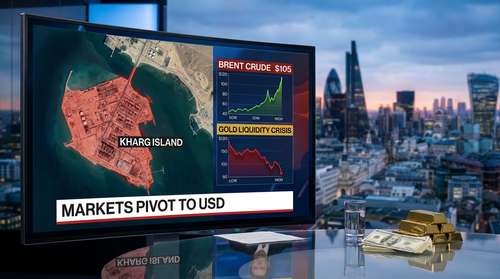
Global financial markets are reeling this Monday morning following unprecedented military escalation in the Middle East. Over the weekend, the United States launched targeted attacks against military installations on Iran's most critical energy export terminal, sparking immediate shockwaves across asset classes. The Kharg Island oil hub strikes have effectively choked a vital artery of global commerce, sending the Brent crude price March 2026 surging past $104 per barrel. However, the ripple effects extend far beyond the energy sector. As the US-Iran war financial impact deepens, a surprising dynamic is unfolding: a severe gold price liquidity crisis has taken hold. Institutional investors are rapidly liquidating traditional safe-haven assets, opting instead to stockpile US Dollars and driving unprecedented institutional stablecoin demand ahead of a critical Federal Reserve policy meeting.
Kharg Island Oil Hub Strikes and Market Disruption
Late Friday and into the weekend, US forces executed precision strikes against approximately 90 military targets on Kharg Island, a five-mile-long coral island in the Persian Gulf that handles roughly 90% of Iran's oil exports. While the White House noted that the energy infrastructure itself was left intact for now, the administration issued a stark warning: any further interference with maritime traffic would result in the complete destruction of those oil facilities.
This escalation has triggered a severe Strait of Hormuz market disruption. With the narrow waterway—responsible for the transit of nearly 20% of the world's daily oil supply—essentially paralyzed by the conflict, energy markets opened with a violent gap upward. By early trading on March 16, Brent crude futures eclipsed the $104.98 mark, while US West Texas Intermediate (WTI) climbed proportionally. Analysts warn that if the blockade continues, the global economy could face a sustained energy shortage.
The US-Iran War Financial Impact and Gold Sell-Off
Historically, geopolitical crises of this magnitude prompt a massive influx of capital into precious metals. Yet, the current environment is defying conventional wisdom. After an initial spike earlier in the conflict, precious metals are experiencing a violent sell-off, creating a profound gold price liquidity crisis. Rather than holding physical or paper gold, institutional funds are facing severe margin calls across their broader portfolios due to the sudden equity and energy volatility.
Equity Repricing and Margin Calls
The immediate catalyst for this precious metal dumping stems from a violent repricing in global equities. Large-cap technology stocks and heavily leveraged private credit markets have suffered steep declines as the conflict enters its third week. As portfolio values shrink, brokers issue margin calls, requiring funds to post additional cash collateral. Gold, being one of the most highly liquid assets on the board, is sold off rapidly—not because investors believe it has lost its intrinsic value, but simply because they need the cash to survive the trading week.
The Pivot to Digital Cash: Institutional Stablecoin Demand
With traditional safe havens being liquidated, capital is flowing directly into the US Dollar and its digital equivalents. The market is witnessing a record surge in institutional stablecoin demand. Major trading desks and hedge funds are parking billions in regulated stablecoins to maintain agile, blockchain-based liquidity. Tether's market capitalization has swelled to an astonishing $180 billion as capital flees volatile risk assets.
For multinational corporations and offshore entities navigating the Strait of Hormuz market disruption and tightening global sanctions, stablecoins offer immediate, borderless dollar exposure. This digital dollarization provides a crucial buffer for institutions that need to deploy capital rapidly. Furthermore, the banking sector is closely watching this trend, with several major financial institutions quietly accelerating their own blockchain settlement tools to capture the growing yield associated with these massive stablecoin reserves.
All Eyes on the Fed Interest Rate Decision 2026
This frantic repositioning is heavily compounded by macroeconomic timing. The liquidity crunch arrives just days before the highly anticipated Fed interest rate decision 2026, scheduled for this Wednesday, March 18. Prior to the Middle East escalation, Wall Street had mixed expectations regarding the Federal Open Market Committee's willingness to cut rates from the current 3.50% to 3.75% target range.
Now, the Brent crude price March 2026 surge has fundamentally altered the central bank's calculus. The sudden spike in energy costs threatens to reignite sticky consumer prices, effectively tying the hands of policymakers. Federal Reserve Chair Jerome Powell faces the unenviable task of balancing a looming supply-side inflation shock against a financial system desperate for liquidity. As traders brace for Wednesday's press conference, the interconnected web of the Kharg Island oil hub strikes, soaring energy prices, and the subsequent rush to the safety of the US Dollar will dictate global market momentum for the remainder of the quarter.