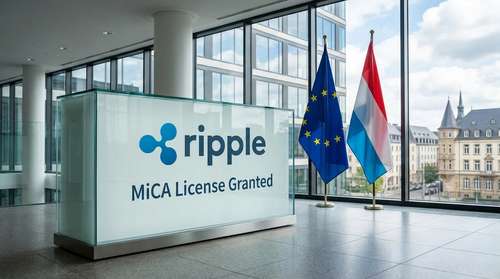
On July 6, 2026, the European digital asset landscape underwent a structural shift as the company behind the XRP Ledger secured a massive regulatory milestone. After receiving preliminary clearance in June, Ripple has officially been granted its full Ripple MiCA license. The authorization from Luxembourg's top financial watchdog places the payments infrastructure giant in an elite tier of fully compliant firms ready to operate across the continent.
This latest approval arrives just days after the critical July 1 transition deadline for the Markets in Crypto-Assets EU framework. Unlicensed entities now find themselves locked out of the bloc, while compliant enterprises hold a unified passport to all 30 European Economic Area (EEA) nations. For an industry historically defined by regulatory ambiguity, this signals a permanent pivot toward institutional legitimacy.
The Power Behind the Ripple CASP CSSF Luxembourg Authorization
Obtaining the Crypto-Asset Service Provider (CASP) authorization from the Commission de Surveillance du Secteur Financier (CSSF) was a deliberate, multi-step strategy. This Ripple CASP CSSF Luxembourg credential is not a standalone victory. It serves as the second half of a regulatory one-two punch, perfectly complementing the full Electronic Money Institution (EMI) license the company secured earlier this year.
When a firm wields both a CASP and an EMI license, the result is a formidable, end-to-end financial stack. European banks, enterprise clients, and fintech developers can now plug into a unified crypto payments infrastructure through a single integration. The EMI license provides the legal bedrock for electronic money services and stablecoin issuance, while the newly minted CASP authorization governs the broader universe of digital asset exchange, transfer, and custody.
Instead of navigating a fractured patchwork of regional rules, financial institutions finally have a singular, compliant gateway to handle fiat collection, crypto exchange, and global payouts simultaneously.
Scaling Ripple Institutional Crypto Services in a Post-Transition Era
The timing of this regulatory win is no accident. The expiration of the MiCA transitional window effectively drew a hard line in the sand for cryptocurrency regulation 2026. Service providers that failed to prepare are currently scrambling or halting operations. Ripple, on the other hand, is accelerating into the void left by non-compliant competitors.
"This CASP authorisation means Ripple enters the post-transitional MiCA era fully compliant and ready to scale," stated Cassie Craddock, Ripple's Managing Director for the UK and Europe, shortly after the July 6 announcement. Craddock emphasized that institutions across the region are actively seeking to build their digital asset pipelines alongside fully regulated partners.
With over $100 billion in payment volume already processed across 60 global markets, the firm is heavily leaning into enterprise adoption. Demand for robust Ripple institutional crypto services is poised to surge as traditional banks mobilize European capital into on-chain settlement rails, confident in the legal protections provided by the new EU rulebook.
Mastering EEA Crypto Compliance Through Single Passporting
Historically, expanding a crypto operation throughout Europe meant playing regulatory whack-a-mole. Companies had to secure disparate approvals in France, Germany, Italy, and beyond—a massive drain on corporate resources. Under the modernized framework, a license granted in one member state—in this case, the highly respected jurisdiction of Luxembourg—unlocks the entire bloc.
This passporting mechanism guarantees seamless EEA crypto compliance, completely removing the operational friction of country-by-country legal battles. It transforms a fragmented continent into a single addressable market of over 400 million consumers.
Clarifying XRP European Regulation and the Global Playbook
While the broader retail community might misinterpret this headline as an explicit approval for a specific token, the reality is far more structural. This authorization is a company-level credential. It does not dictate XRP European regulation on an asset-by-asset basis, but rather authorizes the service provider handling the asset transfer and custody infrastructure. MiCA licenses are awarded to companies, not to coins.
Ripple's executive team has consistently prioritized infrastructure and institutional trust over speculative hype. By working strictly within the boundaries of traditional finance, the firm has amassed a massive war chest of over 75 regulatory licenses globally. They refuse to build products in regulatory gray areas; instead, they are cementing their platforms directly into the recognized financial system.
The New Benchmark for Digital Assets
Securing definitive MiCA compliance alters the risk calculus for corporate blockchain adoption. Risk-averse multinational corporations and regional banks now have a verified partner to facilitate cross-border settlements without the looming threat of enforcement actions. Luxembourg's CSSF has successfully established itself as a critical hub for premier global firms seeking a foothold in Europe, providing rigorous oversight balanced with technological foresight.
As the second half of the year unfolds, the market will likely see a massive division between fully authorized enterprises and those struggling to catch up. For the compliant few holding a CASP golden ticket, the European continent is officially open for business.