Last November, while major US television networks were still hesitating over exit polls, a single chart on Polymarket had already painted the map a bright red. It wasn’t a survey, and it wasn’t a political pundit. It was money. Billions of dollars placed on the table by the crowd, creating the most accurate forecasting machine in history.
But focusing solely on the election misses the bigger picture. Prediction markets are facing their "iPhone moment." They aren't here to replace the casino; they are here to reinvent the stock market—this time, for everyone.
Beyond the "Sports Bros" Demographic
Until now, the betting world has been confined to a specific niche: mostly men, sports fans, and those who understand complex statistics. It is a massive market, but it has a ceiling.
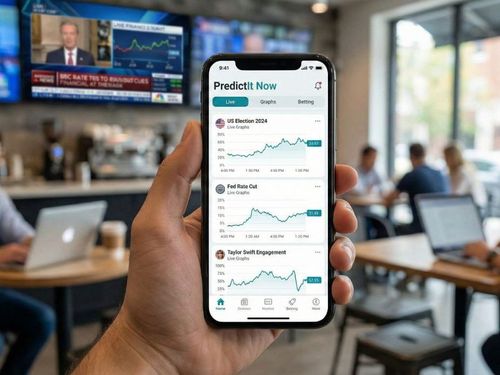
The revolution of prediction markets lies in the infinite expansion of the total addressable market. This is the shift from a niche product to a mass-market utility. Not everyone knows who the striker for Manchester City or the Quarterback for the Chiefs is, but everyone has an opinion on the world around them. Whether it’s the Federal Reserve cutting interest rates, Oppenheimer sweeping the Oscars, or Taylor Swift getting engaged, prediction markets are essentially the gamification of the news. They transform news consumption from a passive viewing experience into an active investment opportunity.

The New Stock Market: Trading the Narrative
A common mistake is comparing prediction markets to sportsbooks. The more accurate comparison is to the NASDAQ. Much like stock trading, which became accessible to the masses through apps like Robinhood, prediction markets offer the ability to trade "event contracts."
Critics often argue that these markets lack liquidity or require long waiting periods for a payout. However, the reality on the ground tells a different story. A sophisticated trader doesn’t need to wait six months for an election result to turn a profit. They trade on volatility. If breaking news drops and a contract price jumps from 40 cents to 60 cents, a trader can sell immediately for a 50% profit in minutes.
Furthermore, these markets have a built-in "immune system" that traditional stock markets often lack. When a "whale" tries to manipulate the market, the market corrects itself aggressively. In prediction markets, "dumb money" becomes easy prey for "smart money," pushing the price back to the statistical truth at record speed.
The "Long Tail" of Events
The greatest advantage these platforms have over traditional sports betting is inventory. In the Premier League or the NFL, there is a finite number of games per week. Reality, however, provides an infinite supply of events. This is the "Long Tail" principle: millions of micro-markets—from niche tech product launches to local weather patterns—creating a trading volume that could eventually dwarf traditional sports betting. There is no off-season; every day is a trading day.
The Hurdles to Mass Adoption
Despite the potential to conquer the world, the road ahead is paved with significant challenges. First is the regulatory hammer. Governments dislike markets they cannot control, and the UK Gambling Commission and US CFTC are still grappling with whether to classify these platforms as gambling or financial derivatives.
Second is the user experience barrier. To reach critical mass, these platforms must shed the complex "Bloomberg Terminal" aesthetic. To win over a general audience, the interface needs to be as intuitive as TikTok. Finally, there is the liquidity dilemma in ultra-niche markets, where the lack of buyers and sellers can freeze the order book, a problem that requires advanced automated market makers to solve.
The Future of Information
We are witnessing the birth of a new asset class. Prediction markets are not a passing trend; they are a tool that refines how humanity processes information. When you combine the wisdom of crowds, financial incentives, and real-time trading, you get a powerful "truth machine." The question is no longer "Will this succeed?" but rather: Who will be the company to crack the user experience and become the Robinhood of prediction markets?