
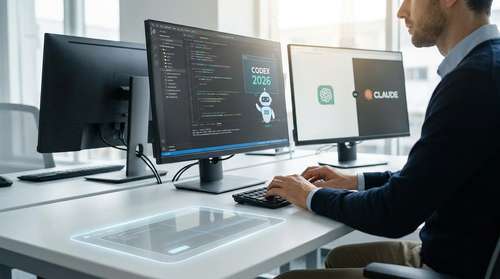
The competition for enterprise AI dominance has officially moved beyond the chat window and straight onto the user's desktop. In a direct bid to counter the surging adoption of Anthropic’s Claude Code, OpenAI has rolled out a sweeping OpenAI Codex upgrade 2026. This week’s release transforms Codex from a traditional development tool into a fully autonomous digital worker capable of operating a computer on its own.
The Dawn of Agentic Desktop Control
For the past year, software engineers have relied on AI coding assistant technology to accelerate their workflows, primarily through text-based auto-completion and bug detection. OpenAI is entirely discarding that reactive model. The centerpiece of the new Codex update is a feature dubbed "background computer use," which allows the AI to "see" your screen, move its own cursor, click, and type across any application.
Currently limited to macOS users, these autonomous AI agents run silently in the background. A developer can deploy multiple Codex agents to work in parallel on the same machine. You can have one agent iterate on complex frontend designs using a new built-in browser, while another navigates a proprietary enterprise application that lacks a public API—all without interfering with your active cursor or keyboard inputs.
OpenAI’s agentic AI doesn't just wait for immediate prompts. It can now schedule future tasks for itself, waking up days or even weeks later to resume long-term projects and check on deployment statuses. This represents a massive shift from single-session interactions to continuous, asynchronous collaboration.
Bridging the Gap Between Code and Clerical Work
OpenAI has equipped Codex with over 90 new plugin integrations, linking the platform directly to staple enterprise AI tools like GitLab, Jira, Microsoft Suite, and Slack. Rather than simply managing Git repositories, the system is pushing heavily into broader workplace AI automation.
The updated Codex can scan a user's Slack messages and Google Calendar events each morning to generate a prioritized daily to-do list, effectively absorbing light project management duties. Additionally, the integration of the new gpt-image-1.5 model means the agent can natively generate and iterate on visual mockups, slide deck graphics, and product concepts directly within the workspace.
Claude Code vs Codex: The Fight for the Enterprise
This aggressive product launch is a calculated defensive maneuver. Anthropic has enjoyed a comfortable lead in the developer space recently, with Claude Code capturing massive enterprise market share due to its superior reasoning and independent remote execution capabilities. The Claude Code vs Codex battle is no longer about who writes cleaner Python—it is about which ecosystem can best function as an independent engineering team member.
Anthropic set the standard earlier this year by allowing Claude to orchestrate complex multi-step workflows, manage cloud infrastructures, and control systems while developers were away from their desks. OpenAI’s new background execution and robust plugin architecture are designed to match Anthropic feature-for-feature, embedding Codex deeper into the daily rhythms of enterprise development teams.
While Claude Code has earned a reputation for its deep reasoning in complex legacy codebases, Codex is positioning itself as the ultimate desktop-integrated orchestrator. By capitalizing on its massive user base, OpenAI hopes to intercept Anthropic's enterprise momentum before organizations fully lock into the Claude ecosystem.
Sandboxing and Security in the Agentic Era
Granting an AI the ability to independently click, type, and execute code across a local machine naturally raises massive security concerns. To mitigate the risks of irreversible actions, OpenAI has implemented strict sandboxing protocols for the new Codex desktop app. The autonomous AI agents operate within isolated worktrees and require explicit user permissions before accessing the broader network or modifying sensitive system directories.
This framework ensures that while Codex can write a patch, test it in a local browser, and draft the release notes, it remains securely tethered to the constraints defined by enterprise IT policies.
A New Paradigm for Workplace AI Automation
To support this shift toward sustained autonomy, OpenAI has fundamentally reworked how Codex handles context. The application now features a persistent memory system, allowing it to reuse conversational context from past projects so developers don't have to repeatedly brief the AI on system architecture. It can independently handle GitHub pull request reviews, juggle multiple terminal tabs simultaneously, and establish SSH connections to remote devboxes.
While the macOS rollout begins immediately for logged-in ChatGPT account holders, OpenAI confirmed that advanced personalization features—such as context-aware suggestions and enterprise-wide memory sharing—will be arriving shortly for Enterprise and Education tiers. Due to regulatory compliance testing, EU and UK users will also have to wait a bit longer for the full desktop control features.
The software development lifecycle is being permanently rewired. As these platforms evolve from helpful autocomplete assistants to proactive delegates, the bottleneck in technology creation is shifting. The challenge for modern engineering teams is no longer writing the syntax itself, but acting as creative directors who manage a tireless fleet of digital workers.