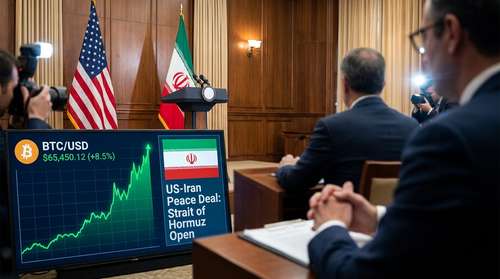
A dramatic Bitcoin price surge has sent shockwaves through the financial world, with the leading cryptocurrency reclaiming the $65,000 level for the first time in nearly two weeks. The sudden market shift arrives on the heels of a historic announcement from U.S. President Donald Trump, who confirmed that a comprehensive US Iran peace deal has been finalized. By immediately reopening vital global trade routes, this diplomatic breakthrough has triggered a cascade of bullish momentum across risk assets, driving BTC up from its recent sub-$60,000 lows.
The Trump Iran Agreement: Reopening Global Trade
The geopolitical landscape shifted late Sunday when President Trump took to Truth Social to announce that the war with Iran was officially ending. Mediated by Pakistan's Prime Minister Shehbaz Sharif, the finalized Trump Iran agreement brings an immediate halt to military operations across multiple fronts, including Lebanon. An official signing ceremony is slated for Friday in Switzerland.
For financial markets, the most critical component of the agreement is the end of the U.S. naval blockade and the immediate Strait of Hormuz opening. Trump declared the vital shipping lane open without tolls, emphatically telling the global shipping industry, 'Ships of the World, start your engines'. Because the Strait of Hormuz is a major artery for global energy supplies, its reopening immediately crushed the geopolitical risk premium that had been artificially inflating energy costs. Brent crude oil plummeted by more than 4% as traders aggressively priced in the restoration of regular oil flows.
BTC Over 65k: The Macroeconomic Domino Effect
This drop in crude oil prices provides the missing puzzle piece for understanding the current geopolitical crypto impact. For months, elevated energy prices have fueled sticky inflation, maintaining pressure on the U.S. Federal Reserve to hold interest rates higher for longer, effectively suffocating capital flow into digital assets. The sudden Middle Eastern de-escalation acts as a massive deflationary catalyst. By alleviating supply chain bottlenecks and energy shocks, the agreement gives risk assets the breathing room they desperately needed to thrive.
As oil tumbled on global exchanges, digital assets ignited. Bitcoin jumped over 3% in early Asian trading hours on Monday, tapping a local high of $65,642. The forceful move validates recent high-profile market predictions. Standard Chartered analyst Geoffrey Kendrick recently identified the $59,375 mark as a decisive cycle bottom. Interestingly, Kendrick explicitly named a genuine peace treaty as one of the primary catalysts required to signal that winter is over for digital assets. With the BTC over 65k milestone now achieved, institutional and retail traders alike are viewing this as a definitive macroeconomic pivot.
The Broad Crypto Market Reaction
The positive crypto market reaction wasn't limited to Bitcoin. The easing of global tensions sparked a widespread rally across the entire digital asset ecosystem. Ether (ETH) surged by roughly 3.7% to cross $1,731, while alternative tokens like Solana (SOL) and Ripple (XRP) recorded even more aggressive gains. This uniform upward momentum indicates that capital is forcefully flowing back into the risk-on sector after weeks of significant outflows from exchange-traded funds.
What This Means for Bitcoin's Next Resistance Levels
While the immediate relief rally is undeniable, analysts are closely watching technical levels to determine if the Bitcoin price surge can sustain its momentum. Technical chartists highlight that Bitcoin successfully held its 200-week simple moving average (SMA) as a foundational support level during the recent market turbulence.
According to Pratik Kala, a portfolio manager at Apollo Crypto, the next critical test lies just overhead. The key level to watch for Bitcoin is $67,000, which has a confluence of factors including volumes and moving averages, Kala noted. Breaking through this heavy resistance zone would inflict a massive blow to the lingering bearish thesis.
Furthermore, the timing of the diplomatic breakthrough provides a highly favorable backdrop heading into this week's critical Federal Reserve meeting, the first chaired by Kevin Warsh. A dovish tone from the Fed, combined with collapsing energy prices, could serve as a secondary booster rocket for digital equities.
Looking Ahead: The 60-Day Negotiation Window
Despite the euphoria surrounding the immediate end to hostilities, the market must remain vigilant. While the physical deliverables—the lifting of the U.S. naval blockade and the Strait of Hormuz reopening—are immediate, confirmed, and highly impactful for global trade, deeper diplomatic complexities remain unresolved. The broader issues of sanctions relief, the unfreezing of Iranian assets, and strict nuclear program oversight will be subject to a further 60-day negotiation window. Given the historical volatility of such frameworks, this two-month period leaves room for the kind of disputes that have whipsawed markets in the past.
For now, however, the digital asset space is celebrating a rare and powerful alignment of positive macro indicators. By drastically lowering the threat of inflation-inducing energy shocks, the historic peace deal has restored a robust risk appetite among investors. As global shipping lanes normalize and the threat of broader conflict recedes, the crypto market looks poised to leave its recent multi-week downtrend behind, confidently eyeing the $67,000 resistance zone and beyond.