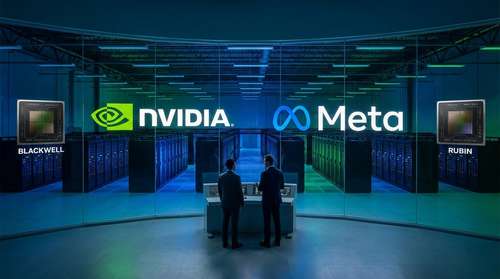
In a definitive move that cements the future of generative AI, Meta and NVIDIA have forged a landmark AI infrastructure pact that will reshape the global computing landscape. Announced this week, the multi-year, multi-generational strategic partnership involves the deployment of millions of NVIDIA’s next-generation Blackwell and Rubin GPUs across Meta’s global data center footprint. This agreement marks a pivotal shift in hyperscale computing, with Meta committing to a full-stack NVIDIA architecture—spanning GPUs, CPUs, and networking—to power its vision of delivering personal superintelligence to billions of users.
Massive Scale: Deploying Blackwell and Rubin GPUs
The headline of this deal is the sheer scale of the hardware procurement. Meta is not just purchasing accelerators; it is effectively reserving a significant portion of NVIDIA’s roadmap for years to come. The partnership ensures the immediate large-scale rollout of Blackwell GPUs, NVIDIA’s current flagship architecture designed to handle trillion-parameter models with unprecedented efficiency. However, the deal looks further ahead, securing Meta’s access to the future Rubin GPU architecture, which promises to deliver exponential leaps in compute density and bandwidth.
Jensen Huang, NVIDIA’s founder and CEO, emphasized the uniqueness of this collaboration, stating that "no one deploys AI at Meta’s scale." By integrating these advanced GPUs into its industrial-scale infrastructure, Meta aims to train Llama models of increasing complexity while simultaneously serving real-time AI inference to users across Facebook, Instagram, and WhatsApp. This dual focus on training and inference is critical as Meta transitions from being a social media giant to a leading AI powerhouse.
A Shift to Full-Stack: Grace CPUs and Spectrum-X Ethernet
Perhaps the most disruptive aspect of this announcement is Meta’s adoption of the full NVIDIA ecosystem, moving beyond just GPUs. For the first time, Meta will deploy NVIDIA’s Arm-based Grace CPUs at a massive scale for its production workloads. This decision signals a departure from traditional x86 server architectures, with Meta leveraging the tight integration between Grace CPUs and Blackwell GPUs to optimize performance per watt—a crucial metric as AI power consumption comes under scrutiny.
Revolutionizing Networking with Spectrum-X
To connect these millions of processors, Meta is also betting big on Spectrum-X Ethernet. Networking has historically been a bottleneck for hyperscale AI data centers, but NVIDIA’s Spectrum-X platform provides the low latency and high throughput required for massive GPU clusters to function as a single supercomputer. By integrating Spectrum-X switches into its Facebook Open Switching System (FBOSS), Meta is ensuring that its network fabric can keep pace with the blistering speed of its new compute silicon.
Building the Future of Hyperscale AI Data Centers
This partnership is the backbone of Meta’s aggressive infrastructure investment, with capital expenditures projected between $115 billion and $135 billion for 2026 alone. The goal is to build hyperscale AI data centers capable of supporting the "Meta Superintelligence Labs" initiatives. Mark Zuckerberg has described this roadmap as essential for creating AI agents that can reason, plan, and create on behalf of users. The inclusion of future technologies, such as the Vera CPU architecture slated for 2027, indicates that both companies are locking into a long-term co-design strategy.
The deal also includes provisions for security, with NVIDIA Confidential Computing being deployed to protect the privacy of WhatsApp users. As inference workloads grow, processing sensitive data securely at the edge and in the cloud becomes paramount. This collaboration ensures that Meta’s open-source ethos remains compatible with rigorous enterprise-grade security standards.
By standardizing on NVIDIA’s unified platform—from the Rubin GPU architecture down to the Spectrum-X Ethernet cables—Meta is reducing the complexity of its supply chain while maximizing performance. For the broader tech industry, this "pact" serves as a signal: the era of piecemeal AI infrastructure is over, replaced by tightly integrated, full-stack supercomputing designed for the next frontier of intelligence.