
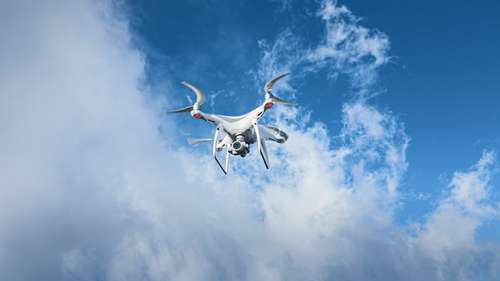
MOFFETT FIELD, Calif. – In a groundbreaking development for aviation security, NASA researchers have successfully demonstrated a new blockchain-based framework designed to protect global air traffic from increasingly sophisticated cyber threats. The tests, conducted this week at the NASA Ames Research Center in Silicon Valley, utilized an Alta-X drone to validate a system that could revolutionize how flight data is secured, verifying that NASA blockchain test initiatives are moving from theoretical research to operational reality.
Shielding the Skies: A New Era of Air Traffic Management Security
As the skies become more crowded with the advent of commercial drones and future Urban Air Mobility (UAM) vehicles, the need for robust air traffic management security has never been more critical. Current surveillance systems, while effective for tracking, often lack the encrypted verification layers necessary to prevent spoofing or data manipulation by bad actors. NASA’s latest demonstration addresses this vulnerability head-on by leveraging the immutable nature of distributed ledger technology.
During the flight tests, the team utilized an open-source permissioned blockchain framework—specifically Hyperledger Fabric—to create a secure, decentralized network for sharing flight data. Unlike traditional centralized databases that present a single point of failure, this new architecture ensures that critical telemetry and flight plan data cannot be altered without detection. "The system aims to keep air traffic management safe from disruption and protect data transferred between aircraft and ground stations from being intercepted or manipulated," NASA officials stated following the successful deployment.
The Mechanics of Aviation Data Integrity
The core of this innovation lies in its ability to maintain aviation data integrity through a "permissioned" network. In the demonstrated system, access is restricted to known, trusted entities—such as air traffic controllers, fleet operators, and the aircraft themselves. This contrasts sharply with public blockchains like Bitcoin; instead, NASA’s framework uses specific "channels" to ensure privacy and scalability.
Ronald J. Reisman, a senior aero-computer engineer at NASA Ames, has championed this approach, noting that the design allows for "aircraft privacy and anonymity while providing a secure and efficient method for communication." By utilizing these private channels, the system can securely transmit sensitive information—such as precise military flight paths or proprietary corporate routes—while still allowing the broader network to verify that the aircraft is legitimate and following its approved flight envelope.
Drone Telemetry Protection in Action
The practical application of this theory was put to the test using an Alta-X heavy-lift drone. As the aircraft flew over the Moffett Field testing grounds, it transmitted real-time telemetry—including altitude, speed, and position—to a ground control station via the blockchain network. This exercise provided the first real-world validation of drone telemetry protection using this specific architecture.
The system successfully flagged authorized data packets while rejecting simulated "spoofed" data introduced by the research team to test the network's resilience. This capability is essential for preventing "man-in-the-middle" attacks, where a hacker might attempt to feed false coordinates to a ground controller or hijack a drone's command link. The NASA Ames blockchain test proved that the ledger could handle the high-speed data throughput required for live aviation operations without inducing dangerous latency.
Future-Proofing for Decentralized Airspace Management
This successful test marks a pivotal step toward fully decentralized airspace management. As NASA looks toward a future populated by autonomous air taxis and high-altitude cargo drones, the centralized control models of the past decades will likely become bottlenecks. A blockchain-based infrastructure allows for a more fluid, automated, and secure exchange of data between thousands of simultaneous aircraft without overwhelming human controllers.
The implications extend beyond just drones. The blockchain infrastructure security principles validated this week could eventually be retrofitted onto commercial airliners and general aviation aircraft, creating a unified, global standard for secure communication. By replacing trust in a central server with cryptographic proof, NASA is laying the groundwork for an aviation ecosystem where safety is mathematically guaranteed.
"For aviation and airspace operations to remain safe, users need to be able to trust that data is reliable and transparent," the project leads emphasized. With this week's successful flight campaign, that trust has taken a significant leap forward, moving the industry closer to a secure, automated future in the clouds.