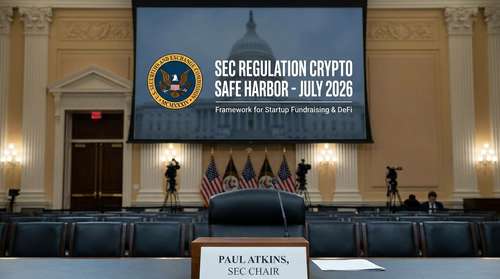
The cryptocurrency landscape is navigating a perfect storm of macroeconomic headwinds and landmark regulatory shifts. In the last 24 hours, the market experienced a staggering $100 billion sell-off after the Federal Reserve opted to hold interest rates steady at 3.5%. As the crypto market crash today triggered sweeping liquidations, Bitcoin hastily retreated below the critical $71,000 support level. Yet, amidst the financial turbulence, a historic regulatory breakthrough emerged. Delivering on the highly anticipated SEC crypto guidance 2026, agency leadership officially unveiled a comprehensive regulatory structure, effectively closing the book on the United States' deeply controversial era of 'regulation by enforcement'.
The Fed Interest Rate Crypto Impact: Why Bitcoin Retreated
The sudden market downturn was directly catalyzed by the Federal Reserve's latest Federal Open Market Committee meeting. Officials unanimously decided to pause rate cuts, keeping the benchmark interest rate anchored at 3.5%. The resulting Fed interest rate crypto impact was swift and unforgiving. With borrowing costs remaining elevated, risk-on assets plummeted across the board, wiping $100 billion off the total cryptocurrency market capitalization in a matter of hours.
Analyzing the Bitcoin price March 2026 data reveals a highly volatile reaction to the central bank's persistently cautious tone. After confidently rallying to test new resistance levels earlier in the month, Bitcoin sharply lost its footing. The flagship cryptocurrency slipped below the vital $71,000 support threshold as institutional traders and retail investors rushed to scale back their leveraged positions. Financial analysts note that while core inflation has cooled significantly over the past year, the Fed's reluctance to initiate aggressive rate reductions continues to pressure capital-intensive markets. This environment of prolonged higher rates inherently strengthens the U.S. dollar, sparking a widespread deleveraging event across the digital asset ecosystem.
Paul Atkins SEC Chair News: A New Era for Digital Assets
While traders grapple with immediate macroeconomic pressures, the domestic regulatory outlook has never been clearer. Making headlines across the global financial sector, the latest Paul Atkins SEC chair news officially confirmed the rollout of a transformative policy document that fundamentally rewrites the rules of engagement for cryptocurrency firms. Chair Atkins, stepping decisively away from his predecessor's highly criticized approach, introduced a landmark digital asset classification framework.
This long-awaited guidance provides the institutional clarity that blockchain developers, venture capitalists, and asset managers have desperately demanded. Building on the momentum of 'Project Crypto'—a joint initiative between the SEC and the CFTC—the regulatory bodies are actively harmonizing rules. By clearly defining what constitutes a security versus a commodity or network utility token, the SEC is laying the groundwork for compliant innovation within American borders. Industry advocates argue this framework will stem the ongoing exodus of crypto enterprises moving to more favorable jurisdictions overseas.
Breaking Down the Five-Tier Digital Asset Classification Framework
Under the new SEC rules, digital assets will no longer face a subjective or blanket interpretation of the decades-old Howey Test. The newly minted five-tier system evaluates and categorizes tokens based on their network decentralization, functional utility, and underlying economic realities:
- Tier 1: Pure Commodities: Fully decentralized legacy networks, notably Bitcoin, falling completely outside SEC security jurisdiction and overseen by the CFTC.
- Tier 2: Decentralized Utility Tokens: Assets powering functional blockchain ecosystems with sufficiently distributed governance, meaning no central entity controls the protocol's destiny.
- Tier 3: Centralized Investment Contracts: Tokens issued primarily to raise capital by an identifiable core development team or foundation, which will be treated strictly as regulated securities.
- Tier 4: Payment and Stablecoins: Fiat-pegged or algorithmically stabilized assets designed exclusively for transactional commerce, subject to specific reserve transparency and auditing requirements.
- Tier 5: Infrastructure and Privacy Assets: Specialized cryptographic tokens requiring bespoke anti-money laundering (AML) frameworks and targeted compliance disclosures.
Implications for the US Strategic Bitcoin Reserve
The unprecedented convergence of a tight monetary policy and transparent regulatory guidelines sets a fascinating stage for the nation's broader geopolitical and economic strategy. The SEC's explicit classification of Bitcoin as a Tier 1 pure commodity seamlessly aligns with aggressive legislative pushes on Capitol Hill, such as Senator Cynthia Lummis's BITCOIN Act, to expand the US strategic bitcoin reserve. With the paralyzing fog of regulatory ambiguity officially removed, federal agencies and the Treasury now possess a clear, legally sound pathway to acquire, custody, and hold Bitcoin on the national balance sheet.
Following the Executive Order established in March 2025, the U.S. government already holds over 328,000 BTC, largely from asset forfeitures. Advocates for the reserve argue that accumulating decentralized assets is a necessary hedge against global currency debasement. A formally classified Tier 1 asset removes the bureaucratic red tape that previously stalled sovereign-level accumulation discussions, paving the way toward the proposed 1 million BTC goal.
Although the immediate market reaction to the Fed's 3.5% rate hold was undeniably brutal for portfolio valuations today, the establishment of the five-tier SEC system represents a monumental victory for the industry's long-term structural viability. As the dust settles on this massive market shakeout, the digital asset space is uniquely positioned to rebuild on a rock-solid foundation of legal certainty. The era of regulatory guesswork is over, bringing traditional finance one vital step closer to full-scale cryptocurrency integration.