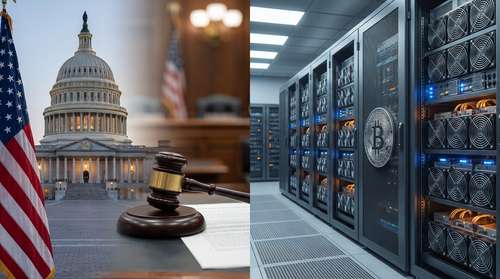
The global race for digital asset dominance took a dramatic turn on Monday when U.S. Senators Cynthia Lummis (R-WY) and Bill Cassidy (R-LA) introduced the highly anticipated Mined in America Act. This landmark piece of Bitcoin mining legislation represents the most aggressive push to date to decouple the American cryptocurrency industry from foreign hardware dependencies. Aimed squarely at bolstering US crypto mining security, the bill proposes sweeping changes that include transitioning miners away from Chinese-made equipment and officially codifying the Strategic Bitcoin Reserve into federal law. For stakeholders watching crypto policy 2026 unfold, this is a watershed moment that signals a shift from regulatory skepticism to active government industrial support.
Decoupling from China: A National Security Imperative
Despite the United States currently controlling roughly 38% of the global Bitcoin hash rate—more than double that of its closest competitor, Russia—the underlying infrastructure tells a more vulnerable story. An estimated 97% of the Bitcoin mining hardware powering American facilities is manufactured by companies tied to foreign adversaries, primarily Chinese tech giants Bitmain and MicroBT. This glaring imbalance is the central target of the new legislation.
Senator Cassidy framed the hardware dependency not just as a national security threat, but as an untapped economic opportunity. By shifting production stateside, lawmakers hope to anchor a new wave of blue-collar manufacturing jobs tied to heavy data center infrastructure. The urgency of this supply chain shift was highlighted vividly during a late 2024 disruption, where thousands of imported ASIC machines were temporarily seized at U.S. ports by Customs and Border Protection. That incident sent shockwaves through domestic mining operations and exposed how easily foreign supply chains could be weaponized or interrupted.
Much like the 2022 CHIPS and Science Act sought to onshore semiconductor fabrication after pandemic-era shortages, the Mined in America Act treats digital asset mining as a critical domestic industry that demands sovereign supply chains and fortified energy grids.
Inside the 'Mined in America' Certification Program
To incentivize the massive transition required by the industry, the bill directs the Department of Commerce to launch a voluntary certification program for domestic mining pools and facilities. Operations that successfully earn the prestigious 'Mined in America' label will unlock lucrative access to existing federal energy and rural development programs. These incentives are designed to offset the initial capital costs of transitioning. However, the perks come with a strict, non-negotiable mandate: certified facilities must commit to a hard timeline for phasing out all adversary-linked mining equipment.
Building Better Bitcoin Mining Hardware Stateside
Recognizing that an immediate ban on foreign rigs would cripple the domestic industry and hand the hash rate back to overseas competitors, the legislation takes a measured, developmental approach. The act recruits the National Institute of Standards and Technology (NIST) alongside the Manufacturing Extension Partnership to actively assist U.S. manufacturers.
Their mandate is clear: research, design, and scale secure, next-generation, energy-efficient mining rigs that can consistently outcompete foreign models. This collaborative federal effort aims to jumpstart a domestic hardware renaissance, ensuring miners have viable, American-made alternatives before the phase-out deadlines hit. By focusing on energy efficiency, the initiative also aligns with broader goals of stabilizing local power grids during peak demand hours.
Codifying the Strategic Bitcoin Reserve
While supply chain sovereignty is the bill's operational focus, its macroeconomic implications are equally massive. The legislation explicitly codifies the Strategic Bitcoin Reserve, officially cementing President Donald Trump's March 2025 executive order into permanent federal law. Rather than indiscriminately liquidating the roughly 328,000 BTC historically seized in various law enforcement actions over the years, the Treasury Department will be mandated to hold the asset securely as a permanent, appreciating national reserve.
For Senator Cynthia Lummis, who has long championed the integration of digital assets into the federal balance sheet, this provision is the crown jewel of legislative efforts. By treating Bitcoin similarly to strategic oil reserves or national gold stockpiles, lawmakers are signaling a profound shift in how the U.S. views decentralized currency. The reserve is intended to offset national debt risks, create a sovereign financial buffer, and ensure the United States remains the undisputed global capital for digital assets.
Industry Backing and the Road Ahead
The introduction of the Mined in America Act has already garnered strong, vocal support from key industry advocates and mining executives. Dennis Porter, CEO of the Satoshi Action Fund, praised the bill for directly addressing foreign vulnerabilities, noting that it will build a virtuous cycle of domestic manufacturing, certified mining operations, grid-strengthening energy infrastructure, and a pipeline to the Strategic Bitcoin Reserve.
If passed, the legislation will fundamentally reshape the economics of crypto mining. As publicly traded miners navigate fluctuating hash prices and the skyrocketing energy demands of artificial intelligence data centers, federal support for energy-efficient, American-made operations could provide a much-needed competitive edge. The Mined in America Act sets a decisive tone for the future, declaring that the next era of digital finance will not only be regulated in America but physically built, secured, and powered by it.