
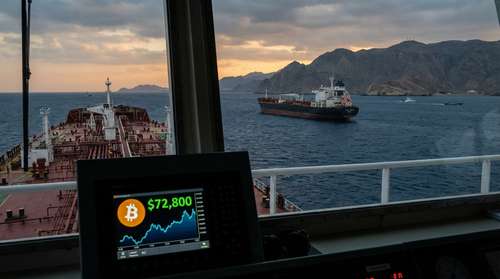
In a historic collision of global energy markets and digital assets, Iran is now demanding Iran Bitcoin tolls from oil tankers navigating the world's most critical maritime chokepoint. Amidst a fragile two-week ceasefire with the United States, Tehran's Revolutionary Guard has essentially converted physical control of a key transit route into a decentralized settlement regime, sending shockwaves through international shipping corridors. Following the news, the global market reacted violently, with the Bitcoin price in April 2026 surging to test the $72,800 resistance level.
The Mechanics of Bitcoin Oil Payments
The newly enforced transit regime requires shipping operators to navigate a strict digital checkpoint before entering the Persian Gulf. Hamid Hosseini, spokesperson for Iran's Oil, Gas and Petrochemical Products Exporters' Union, confirmed that vessels are now subjected to individual reviews. Under the Strait of Hormuz Management Plan, tanker operators must email Iranian authorities detailed cargo manifests, crew lists, and destination ports up to 96 hours before arrival.
Once approved, the regime levies a toll of $1 per barrel of crude oil on board, while empty tankers are reportedly allowed to pass freely. The payment window is deliberately tight. According to Hosseini, vessels are given 'a few seconds to pay in bitcoin, ensuring they can't be traced or confiscated due to sanctions'. Operators who fail to comply face immediate rejection or hostile engagement. Recent English-language radio broadcasts intercepted in the Gulf warned that ships attempting to cross the strait without prior Iranian approval 'will be destroyed'.
Nationality Tiering and Naval Escorts
Passage is severely restricted, capped at roughly 10 to 15 ships per day—a steep decline from the 110 to 150 vessels that traditionally transited the strait daily. Iran has instituted a five-tier nationality ranking system to determine exact access. Ships from nations considered friendly, such as China and India, reportedly receive expedited processing, whereas tankers linked to the United States or Israel are denied passage entirely. Once the Bitcoin oil payments are settled, vessels receive a one-time passcode and an armed naval escort to ensure compliance during the transit.
Strait of Hormuz Crypto Demands and Trade Sanctions
This unprecedented move brings Strait of Hormuz crypto adoption into the realm of sovereign-level coercion. For decades, the United States has leveraged dollar dominance to enforce crypto trade sanctions and isolate Tehran from the global banking system. By forcing maritime trade into a decentralized ledger, Iran is aggressively exploiting the unseizable nature of digital currency to bypass traditional financial rails.
Interestingly, the Iranian government specifically mandated Bitcoin over tokenized fiat. While stablecoins like USDT and USDC are frequently used for cross-border settlements, their corporate issuers maintain the technical ability to freeze wallets linked to illicit activities or designated entities. In fact, Tether has previously blocked billions in illicit funds, including wallets connected to state actors. A fully loaded supertanker carrying two million barrels of crude must now transfer approximately $2 million in pure, censorship-resistant BTC directly to sovereign wallets, executing settlements outside the reach of the U.S. Office of Foreign Assets Control.
Bitcoin Price April 2026: BTC Surges to $72,800
The geopolitical shock immediately spilled over into digital asset markets. As institutional desks and shipping insurers scrambled to price in the implications of this major crypto geopolitical news, Bitcoin experienced a massive liquidity squeeze. Moving violently away from its recent consolidation, the asset ripped through multiple resistance zones, pushing the Bitcoin price in April 2026 up to $72,800.
This aggressive rally triggered over $427 million in short liquidations across major derivatives exchanges. The integration of Bitcoin into the physical infrastructure of global oil trade fundamentally alters its fundamental value proposition. No longer just a speculative asset or a hedge against domestic inflation, it is now acting as an unavoidable payment rail for roughly 20% of the world's seaborne crude oil.
Looking Ahead: Global Trade and Blockchain Regulation 2026
The intersection of maritime law, energy transit, and decentralized networks will heavily influence blockchain regulation 2026. Large commercial shipping conglomerates and Protection and Indemnity clubs now face a brutal compliance nightmare. Paying a multi-million dollar Bitcoin toll to an Iran-linked wallet constitutes a direct violation of international sanctions, yet refusing to pay effectively traps millions of barrels of oil outside the global market.
With hundreds of vessels currently queued in the Gulf waters, the area has been described by maritime observers as a floating parking lot. As diplomats desperately attempt to solidify the fragile U.S.-Iran ceasefire, the digital toll booth remains a highly contentious sticking point. If this system proves durable, it could inspire other heavily sanctioned regimes to weaponize their strategic geographic positions, permanently reshaping how global commodities and cryptocurrency interact.