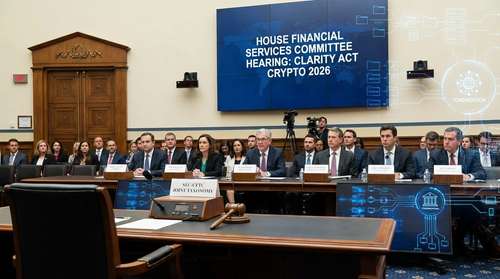
The legal architecture of American capital markets is experiencing a structural overhaul today. At 10:00 AM EDT on March 25, 2026, the House Financial Services Committee convenes for a highly anticipated session titled "Tokenization and the Future of Securities". The hearing lands at a decisive moment for US crypto legislation in March 2026, arriving just days after a historic SEC CFTC joint crypto taxonomy and a breakthrough Senate agreement on the pending CLARITY Act. Together, these developments are dismantling a decade of regulatory gridlock and opening the floodgates for institutional blockchain adoption.
Tokenization is no longer a fringe experiment. With the Real World Assets (RWA) market eclipsing $12 billion, Washington is finally building the statutory infrastructure to handle blockchain-based capital. Today's session in the Rayburn House Office Building is specifically designed to address how traditional financial instruments can transition to programmable, on-chain rails without sacrificing investor protections or market stability.
The SEC CFTC Joint Crypto Taxonomy: 16 Tokens Cleared
The momentum driving today's tokenization of securities hearing stems directly from an unprecedented regulatory truce. On March 17, the Securities and Exchange Commission and the Commodity Futures Trading Commission published a landmark 68-page joint interpretive release. This document officially divides the digital asset market into five distinct categories: digital commodities, digital collectibles, digital tools, stablecoins, and digital securities.
Most crucially, the agencies explicitly named 16 major crypto assets as digital commodities rather than securities. The list includes heavyweights like Bitcoin (BTC), Ethereum (ETH), Solana (SOL), and XRP, alongside networks such as Avalanche, Chainlink, Cardano, and Polkadot. Even highly active community tokens like Dogecoin and Shiba Inu were included, proving that high-activity assets are now part of the regulated landscape regardless of their origins.
SEC Chairman Paul S. Atkins recently remarked that the joint taxonomy returns the agency to its core mission, noting that most crypto assets are not inherently securities. The release clarifies that while a token itself may be a commodity, the manner in which it is sold can still create an investment contract under the Howey test. However, it explicitly acknowledges that investment contracts can expire once a network becomes sufficiently decentralized. By defining the boundaries of digital commodities vs securities law, regulators have provided the exact baseline institutions need to custody and trade digital assets safely. CFTC Chairman Michael S. Selig echoed the sentiment, emphasizing that American builders finally have a stable, predictable environment to operate in.
Inside the House Financial Services Committee Hearing Tokenization
Today's House Financial Services Committee hearing tokenization focus is strictly about modernizing capital market plumbing. Just as the transition to electronic trading revolutionized finance in the 1990s, lawmakers now view blockchain settlement as the inevitable next phase of global finance.
Testifying before the committee, Blockchain Association CEO Summer Mersinger argues that applying tokenization to traditional equities and bonds creates faster settlement times, transparent auditing, and highly efficient collateral management. She emphasizes that tokenized securities are still securities, but the infrastructure beneath them eliminates the siloed, batch-based systems markets have relied on for decades.
The timing of the session is striking. It comes less than a week after the SEC approved Nasdaq's proposal to allow tokenized securities to trade on the same order book as traditional shares, proving that the technological convergence between decentralized finance and Wall Street is already underway.
Real World Assets RWA Regulation and TradFi
For major banking institutions, Real World Assets RWA regulation is the linchpin for future growth. Tokenizing bonds, commercial paper, and real estate requires stablecoin infrastructure to execute automated, atomic settlements. Without a unified legal framework, banks have hesitated to deploy capital on-chain. The convergence of the SEC's new taxonomy and congressional hearings signals to asset managers that the compliance guardrails are finally taking shape, paving the way for massive liquidity injections into the RWA sector.
Breaking the Standoff: CLARITY Act Crypto 2026
While administrative guidance provides immediate relief, permanent market structure requires congressional action. The Digital Asset Market Clarity Act—widely known as the CLARITY Act—is the legislative engine designed to codify these recent agency interpretations into federal law. After passing the House in July 2025 with strong bipartisan support, the bill stalled in the Senate over a bitter proxy war regarding stablecoin yields.
Traditional banks feared that yield-bearing stablecoins would trigger massive deposit flight, essentially acting as unregulated savings accounts. Conversely, crypto firms maintained that yield is an essential component of decentralized infrastructure. That stalemate finally broke on March 20, when Senators Thom Tillis (R-NC) and Angela Alsobrooks (D-MD) struck a tentative bipartisan compromise. The new text allows stablecoins to offer rewards based on active user participation—such as lending, staking, and trading—but prohibits yield on idle balances sitting in wallets.
This compromise unblocks the CLARITY Act crypto 2026 momentum just in time for today's critical House hearing. With the stablecoin yield dispute resolved, the Senate Banking Committee is actively preparing for a markup session in late April. Lawmakers are now racing against the clock to finalize the bill before the midterm election cycle entirely consumes Washington's attention. If successful, this coordinated push across agencies and chambers will permanently enshrine the token taxonomy and secure the United States' leadership in the next generation of financial technology.