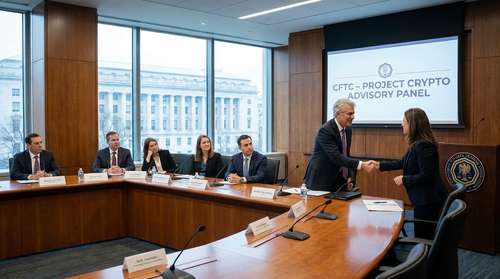
The landscape of American financial regulation shifted seismically on Friday as the Commodity Futures Trading Commission (CFTC) officially unveiled its 35-member Innovation Advisory Committee (IAC). In a move that signals the end of the hostile "regulation by enforcement" era, CFTC Chairman Michael Selig appointed industry heavyweights—including Ripple CEO Brad Garlinghouse and Solana founder Anatoly Yakovenko—to spearhead the agency's ambitious CFTC Project Crypto advisory panel. This historic assembly of crypto-native executives and traditional finance leaders is tasked with executing "Project Crypto," a joint initiative with the SEC designed to modernize federal oversight and ignite a "Golden Age" of digital asset innovation in the United States.
Project Crypto: A Unified Front for Digital Asset Oversight
The formation of the IAC marks the concrete operationalization of Project Crypto, a harmonization framework announced earlier this year by Chairman Selig and SEC Chairman Paul Atkins. For years, the crypto industry has been caught in a jurisdictional tug-of-war between the two powerful regulators. This new advisory body aims to dissolve those ambiguities by bringing the architects of the technology directly into the policy-making room.
Chairman Selig, who replaced the Technology Advisory Committee with this enhanced body, described the launch as an "energizing moment" for the agency. "The IAC’s work will help ensure the CFTC’s decisions reflect market realities so the agency can future-proof its markets and develop clear rules of the road," Selig stated during the announcement. Unlike previous committees that were often criticized for being tokenistic, the IAC has a clear mandate: to assist in drafting the legislative and regulatory standards that will allow tokenized securities, derivatives, and decentralized protocols to flourish on U.S. soil.
Industry Titans Take the Wheel: Ripple and Solana Joins the Fold
The composition of the committee reads like a "Who's Who" of the cryptocurrency sector, validating the industry's long-standing demand for representation. The inclusion of Ripple and Solana on the CFTC committee is particularly symbolic. Brad Garlinghouse, whose company fought a grueling legal battle with the SEC for years, now finds himself advising the federal government on market structure. His appointment is widely seen as a vindication for Ripple and a bullish signal for the clarity of XRP’s regulatory status.
Joining Garlinghouse are other luminaries including Coinbase CEO Brian Armstrong, Uniswap Labs CEO Hayden Adams, and Chainlink co-founder Sergey Nazarov. The presence of Adams is notable, suggesting a willingness by regulators to grapple with the nuances of Decentralized Finance (DeFi) rather than attempting to force it into incompatible traditional molds. Furthermore, the inclusion of Anatoly Yakovenko underscores the CFTC's recognition of high-throughput blockchains as critical financial infrastructure, not just speculative assets.
Bridging the Gap with Traditional Finance
Crucially, the panel is not an echo chamber for crypto maximalists. The CFTC Project Crypto advisory panel also includes executives from Wall Street stalwarts such as Nasdaq, CME Group, and the Depository Trust & Clearing Corporation (DTCC). This hybrid structure is designed to foster interoperability, ensuring that the new digital asset legislative update integrates seamlessly with existing financial plumbing. The goal is a unified market where tokenized collateral can move as fluidly as traditional securities.
The Rise of Prediction Markets and "Future-Proofing"
In a departure from previous administrations, the new committee explicitly embraces controversial but growing sectors like prediction markets. The appointments of Shayne Coplan (Polymarket) and Tarek Mansour (Kalshi) indicate a 180-degree turn from the regulatory hostility seen in 2024. Under the "Project Crypto" mandate, the CFTC appears ready to normalize event contracts as legitimate hedging tools rather than illicit gambling.
This shift aligns with the broader crypto regulation news in February 2026, which has seen the Trump administration push for the U.S. to reclaim its title as the global hub for financial technology. By validating these platforms, the CFTC is signaling that it intends to regulate novel derivatives through transparency and disclosure, rather than prohibition.
Implications for the "Golden Age" of US Crypto
The launch of the IAC is more than a bureaucratic shuffle; it is a declaration of intent. For investors and builders, the Brad Garlinghouse CFTC appointment and the broader committee formation suggest that the regulatory headwinds that depressed valuations and stifled innovation are dissipating. Chairman Selig’s vision of a "Golden Age" relies on the premise that clarity breeds capital formation.
As the committee begins its work, the industry expects a rapid acceleration in policy proposals, specifically regarding the treatment of DAO governance tokens and the use of stablecoins as qualified collateral in derivatives markets. With Project Crypto now fully staffed with the industry's brightest minds, the path to a comprehensive U.S. digital asset framework has never looked clearer.