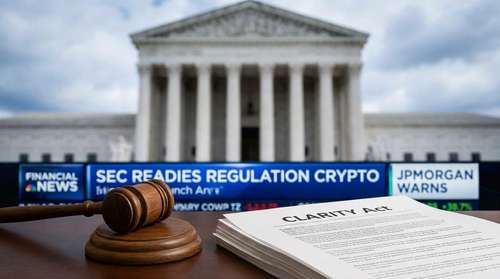
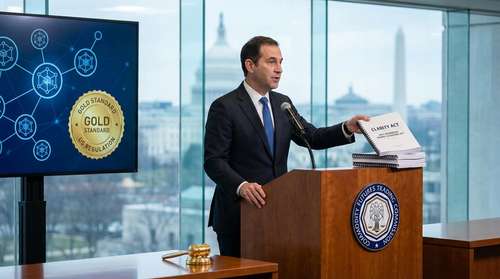
CFTC Chairman Michael Selig declared on Wednesday regarding the pending Cryptocurrency Market Structure Act that the United States is on the verge of establishing a global "gold standard" for digital asset regulation. In an interview on February 4, 2026, Selig predicted that the landmark legislation—often referred to as the CLARITY Act—is on track to reach the President's desk within the next few months, signaling a definitive end to the era of "regulation by enforcement" that has plagued the industry for years.
A New Era of Digital Asset Legislation
Speaking on Fox Business, Selig emphasized that the legislative package currently moving through Congress represents the most significant overhaul of financial regulations since the Dodd-Frank Act. The bill, formally known as the Cryptocurrency Market Structure Act, aims to provide a clear "token taxonomy" that explicitly distinguishes between digital commodities and securities. This distinction has been the central point of contention in the ongoing SEC vs CFTC jurisdiction battle.
"The goal is just to get some clarity. It's been too long with these markets just languishing, and they've fled offshore," Selig stated. "Our country's best builders, entrepreneurs, and innovators are really, for the first time, looking at a system where we can have clarity, clear rules of the road, and a token taxonomy so we know what's a security and what's not."
The CLARITY Act Crypto News: Path to the President's Desk
The legislative momentum has accelerated significantly in early 2026. Following the House's passage of the Digital Asset Market Clarity Act (CLARITY Act) in July 2025, the Senate Agriculture Committee advanced a companion version of the bill on January 29 by a vote of 12-11. The legislation defines "digital commodities" as fungible digital assets that transfer peer-to-peer without intermediaries, placing them firmly under the CFTC's oversight.
While the bill cleared the Agriculture Committee largely along party lines, it still faces a final reconciliation process with the Senate Banking Committee before a full floor vote. However, Selig remains optimistic about the timeline, projecting that the unified bill could be ready for the President's signature "in the next couple of months." This urgency aligns with the administration's stated goal of cementing the U.S. as the "crypto capital of the world."
Defining the Token Taxonomy
One of the bill's most critical features is its rigorous classification system. Under the proposed crypto token taxonomy, assets that are sufficiently decentralized and functional are treated as commodities. This classification triggers a new registration regime for exchanges and broker-dealers, allowing them to legally trade spot digital assets in the U.S. under CFTC supervision. Assets that rely on the managerial efforts of a central entity for value would remain under SEC jurisdiction.
Harmonizing SEC vs CFTC Jurisdiction
The prediction of a "gold standard" is bolstered by a newfound spirit of cooperation between America's top financial regulators. Selig's comments follow a joint appearance with SEC Chair Paul Atkins earlier this week, where both leaders pledged to harmonize their agencies' approaches through "Project Crypto." This initiative marks a sharp departure from the previous administration's adversarial stance.
"We're not going to be a merit regulator as the prior administration sought to do," Selig noted, referencing the aggressive enforcement actions of the past. "We're going to set the rules of the road and we're also going to defend our authority in court where necessary."
This harmonization is vital for US crypto regulation 2026. For years, crypto firms have operated in a legal gray zone, often receiving Wells Notices from the SEC for activities they believed were compliant. The new market structure bill aims to replace these ad-hoc enforcement actions with a comprehensive disclosure and registration framework tailored to the unique properties of blockchain technology.
Stopping the Offshore Flight
The urgency behind the digital asset legislation stems from a bipartisan recognition that the U.S. is losing its competitive edge. By providing legal certainty, the CLARITY Act is designed to reverse the "offshore flight" of capital and talent to jurisdictions like the EU, which implemented its MiCA framework years ago.
With the "GENIUS Act" for stablecoins already signed into law in late 2025, the Market Structure Act is the final pillar needed to complete the U.S. regulatory wall. If Selig's prediction holds true, 2026 will be remembered as the year the United States finally embraced the digital asset economy with open, albeit regulated, arms.