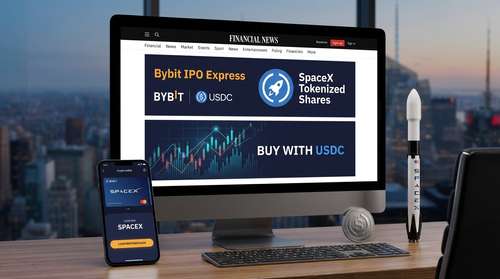
Retail investors have historically watched from the sidelines as institutional giants scooped up prime shares during blockbuster initial public offerings. That barrier to entry is officially crumbling. Today, June 7, 2026, global cryptocurrency exchange Bybit rolled out Bybit IPO Express, a pioneering platform that enables eligible users to subscribe to primary market equity offerings using digital assets. Debuting with Elon Musk's highly anticipated aerospace venture, the service allows users to secure tokenized SpaceX shares at the initial offering price, effectively merging traditional capital markets with crypto-native infrastructure.
Bridging Traditional Finance and Crypto with Real-World Assets RWA
The integration of traditional finance and blockchain technology is accelerating, driven by the massive demand for Real-World Assets RWA. Bybit's latest product launch represents a significant evolution in this space. Powered by Payward Services' xStocks, the new subscription model bypasses the need for legacy brokerage accounts. Instead of navigating geographic restrictions and steep capital requirements, global retail participants can seamlessly allocate funds via their existing exchange wallets.
Bybit tokenized equities are designed to maintain a strict one-to-one backing with the underlying regulated equity exposure. The assets are held in regulated broker-dealer custody, ensuring that the tokens traded on-chain accurately reflect real ownership stakes. This framework fundamentally alters how new public companies interact with global capital, providing immediate borderless liquidity to assets that were previously siloed within domestic banking systems.
The Mechanics: How to Buy SpaceX with Crypto
Participating in a primary offering typically requires deep banking relationships and massive capital commitments. The new system simplifies this complex process. Investors looking to buy SpaceX with crypto can now do so through a straightforward subscription timeline built directly into the exchange's interface.
The operational roadmap for the inaugural launch requires specific participation windows:
- Registration and Subscription (June 7 - June 11, 2026): Eligible users commit their capital within the specified price range. Bybit facilitates the SpaceX IPO USDC integration, meaning participants temporarily lock their stablecoins to request an allocation.
- Pro-Rata Allocation (June 11 - June 12, 2026): Because early demand typically outweighs supply, the platform calculates distribution based on the total committed funds. Any unused USDC is automatically refunded directly to user accounts without penalty.
- Open Market Spot Trading (June 12, 2026): The newly minted tokens officially go live on the spot market, enabling continuous 24/7 trading for those who wish to expand or liquidate their positions.
Leveling the Playing Field in High-Demand Markets
The choice of Elon Musk's aerospace manufacturer for this debut is highly strategic. Demand for the company's public market debut is reaching historic levels. Recent roadshow data indicates an overwhelming $150 billion in investor demand against a $75 billion capital raise target. Under normal circumstances, this severe oversubscription would guarantee that retail traders receive zero primary allocation, forcing them to buy on the secondary market at heavily inflated premiums.
Bybit IPO Express subverts this established hierarchy. Offering primary access at the official issue price democratizes a wealth-generation mechanism that Wall Street has fiercely protected for decades. While regulatory guardrails and VIP tier limits still apply in certain regions, the overall system dramatically widens the funnel for international participation.
The Competitive Landscape of SpaceX Tokenization
Bybit is not navigating this territory alone. Rival exchange Kraken has similarly opened up subscription access to clients across more than 110 countries utilizing the same xStocks infrastructure. This coordinated push by top-tier centralized exchanges underscores a broader industry pivot. Platforms are racing to position themselves as comprehensive financial hubs rather than isolated digital asset trading venues.
Navigating the Regulatory and Operational Landscape
While the technological achievement of bringing pre-listing equities on-chain is substantial, the regulatory implications are equally profound. The framework relies heavily on compliant architecture provided by entities like Payward Services. Because the digital tokens are backed one-for-one by regulated assets, the operation must satisfy strict jurisdictional requirements regarding securities distribution and custody. Bybit enforces rigorous Know Your Customer (KYC) protocols and geographic restrictions, acknowledging that borderless technology must still operate within international compliance boundaries.
Traditional brokerages are taking note. For decades, legacy financial institutions have held a monopoly on primary allocations, utilizing high-demand IPOs as a tool to reward their most lucrative private banking clients. The emergence of blockchain-agnostic frameworks threatens this exclusivity. If retail liquidity can pool effectively via crypto-native settlement rails, companies preparing to go public may increasingly allocate portions of their offerings to decentralized and centralized crypto platforms, bypassing traditional underwriters entirely.
The Future of On-Chain Equity
As the June 12 trading date approaches, financial analysts are closely watching how this dual-market liquidity will behave. The continuous nature of cryptocurrency markets means price discovery for the tokenized representations will occur in real-time, potentially revealing the true market premium faster than traditional stock exchanges.
SpaceX tokenization is likely just the beginning. If the infrastructure handles the intense volume and regulatory scrutiny of this high-profile launch, it sets a direct precedent for future blockbuster tech listings. Retail capital will no longer be an afterthought in the lifecycle of a public company—it will be an active, integrated component from day one.