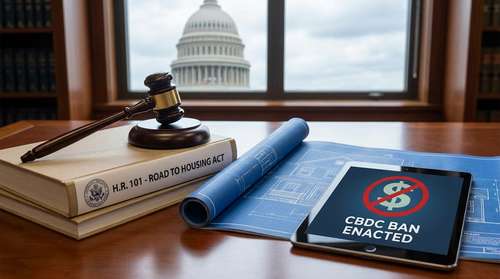
At the stroke of midnight on Saturday, July 11, 2026, the sweeping 21st Century ROAD to Housing Act officially entered the federal registry, bringing with it a highly anticipated US CBDC ban. The comprehensive legislation took effect automatically after the constitutionally mandated 10-day window expired without President Donald Trump's signature. While the package primarily targets systemic housing shortages and corporate homeownership, a strategic policy rider embedded within the text enacts a strict digital dollar prohibition, freezing any Federal Reserve efforts to issue a retail central bank digital currency through the end of the decade.
Inside the Digital Dollar Prohibition
For the digital asset industry, the most critical element of this legislative package is the explicit pause placed on a government-backed digital currency. Under the newly enacted central bank digital currency law, the Federal Reserve is legally barred from creating or issuing a retail CBDC directly to citizens or indirectly through intermediaries until at least December 31, 2030.
The restriction effectively shelves years of exploratory research by the Federal Reserve, which had previously researched the feasibility of a digital dollar. Lawmakers backing the ban, including key architects like Representative French Hill (R-AR), argued that a programmable government currency would inherently threaten financial privacy and grant federal agencies unprecedented surveillance capabilities over individual spending habits. While some hardline opponents of a digital dollar—including Texas Senator Ted Cruz—voted against the broader package precisely because the ban was not permanent, the four-year moratorium provides an enormous structural buffer for the private sector.
The Politics: Why the Trump Housing Bill Lacked a Signature
The mechanism by which the ROAD to Housing Act 2026 became law is a rare maneuver in modern executive politics. Despite heavy bipartisan support—passing the Senate 85-5 and the House 358-32—President Trump abruptly canceled a planned June signing ceremony. He deliberately allowed the bill to sit on his desk, triggering an automatic enactment once the 10-day constitutional window (excluding Sundays) elapsed at 12 a.m. on July 11.
Trump withheld his signature in a calculated protest against the Senate's refusal to pass the SAVE America Act, an unrelated election security measure focused on nationwide voter identification requirements. In social media statements leading up to the deadline, the president dismissed the impending Trump housing bill enactment as secondary to his election security demands. He refused to attach his name to the legislation, despite his administration previously praising the bill's core initiatives to increase housing supply. The result is a historic piece of economic legislation passing into law through sheer expiration rather than a ceremonial executive endorsement.
Private Stablecoins Secure a Wide-Open Runway
The suspension of a sovereign digital currency dramatically alters the landscape for crypto market regulation and private enterprise. By removing the immediate threat of a retail CBDC, the law delivers a massive regulatory boost to private stablecoin issuers and the broader blockchain ecosystem.
Companies issuing dollar-pegged tokens no longer have to worry about competing against Federal Reserve stablecoins or a deeply integrated government alternative for at least the next four years. This legislative clarity gives private stablecoins a clear runway to cement their status as the dominant medium for digital payments, smart contract settlements, and global dollarized remittances. Institutional adoption is likely to accelerate now that the looming specter of a government monopoly has been sidelined. Traditional financial institutions and crypto-native firms can deploy capital into decentralized finance networks with greater confidence, knowing the federal government will not unexpectedly launch a competing product that instantly crowds out private innovation.
Beyond Crypto: Shaking Up the US Housing Market
While the crypto market is intensely focused on the CBDC ban, the primary thrust of the 21st Century ROAD to Housing Act aims to fundamentally restructure American real estate. The legislation implements the most aggressive federal restrictions on corporate homeownership in US history.
Large institutional investors—statutorily defined as entities with investment control of 350 or more single-family homes—are now strictly prohibited from purchasing existing single-family houses. Though the law carves out exemptions for new 'build-to-rent' community developments, those properties must ultimately be sold to individual homebuyers within a seven-year window. Violators face steep civil penalties of up to $1 million per infraction or three times the purchase price. By streamlining environmental reviews under the National Environmental Policy Act (NEPA) and curbing Wall Street's appetite for single-family housing stock, lawmakers hope to dramatically expand the supply of accessible homes for ordinary buyers.
Looking Ahead to 2030
As the ROAD to Housing Act 2026 takes immediate effect across the country, the countdown begins for both real estate developers and crypto innovators. The financial technology sector has secured a critical, albeit temporary, victory. Industry advocates are already drafting strategies to make the US CBDC ban permanent long before the 2030 sunset provision arrives. For now, the private digital asset market operates with unprecedented statutory protection against central bank competition, marking a profound shift in American monetary policy that arrived quietly, right at the stroke of midnight.