
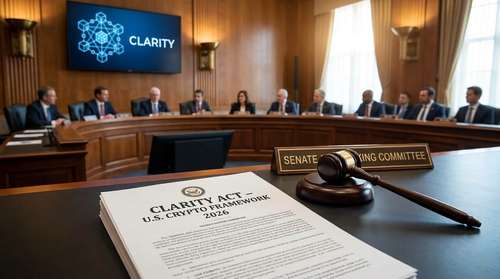
After months of closed-door negotiations and stalled progress, the Senate Banking Committee is officially moving toward a critical markup phase for the CLARITY Act. This landmark digital asset legislation represents the most ambitious attempt to build a comprehensive US crypto framework to date. According to a recent client note from JPMorgan, congressional leaders have narrowed the bill down to just a handful of unresolved issues. This momentum signals that the defining piece of crypto regulation 2026 is closer than the broader market anticipates. If passed, the legislation will untangle years of jurisdictional chaos between federal regulators, paving a clear runway for massive institutional crypto adoption across the financial sector.
Ending the SEC and CFTC Jurisdictional Deadlock
For years, digital asset markets have operated under a cloud of regulatory uncertainty, plagued by overlapping enforcement actions and a lack of statutory guidelines. The Digital Asset Market CLARITY Act of 2025 (H.R. 3633) fundamentally changes this dynamic by formally splitting oversight between the nation's top financial watchdogs.
Under the latest draft, the Commodity Futures Trading Commission (CFTC), led by Chairman Michael Selig, gains primary jurisdiction over "digital commodities" operating on mature, decentralized networks. Meanwhile, the Securities and Exchange Commission (SEC), under Chairman Paul Atkins, retains authority over digital securities and investment contracts.
This explicit division ends the era of regulation by enforcement that has heavily dominated SEC crypto news for the past half-decade. Anticipating the bill's passage, both agencies recently issued unprecedented joint guidance establishing a comprehensive "token taxonomy". This framework categorizes blockchain assets into distinct buckets: digital commodities, digital collectibles, digital tools, payment stablecoins, and digital securities. By officially recognizing that non-security crypto assets can be separated from initial investment contracts once a network becomes decentralized, the government is providing financial institutions with the functional, legally sound roadmap they have demanded.
The Stablecoin Breakthrough and Industry Support
The CLARITY Act previously hit a massive roadblock earlier this year over the treatment of yield-bearing stablecoins. Traditional banks expressed heavy concern that allowing stablecoin issuers to pass yields directly to users would trigger a massive exodus of deposits from traditional banking institutions.
However, the political winds shifted dramatically over the past week. On April 10, Coinbase CEO Brian Armstrong publicly reversed his previous opposition to the bill, urging lawmakers that it was finally time to advance the legislation. His endorsement followed a critical Wall Street Journal op-ed by Treasury Secretary Scott Bessent, who challenged the banking sector's fears of deposit flight and publicly pressured Congress to finalize the rules.
Unleashing Institutional Crypto Adoption
The resolution of the stablecoin debate acts as a massive catalyst for the market. JPMorgan analysts pointed out on April 15 that the Senate Banking Committee negotiations have whittled down a messy list of over a dozen open questions to just two or three manageable issues involving decentralized finance (DeFi) oversight and minor token classifications. With these statutory guardrails falling into place, traditional financial titans can finally move off the sidelines, triggering a new, unprecedented wave of institutional crypto adoption. Furthermore, the SEC recently advanced its complementary "Regulation Crypto" proposal, which would create a startup exemption for entrepreneurs to raise capital safely while the broader rules take effect.
A Closing Window for Digital Asset Legislation
Despite the renewed momentum, the path forward is a rapid race against the political clock. Chairman Tim Scott and the Senate Banking Committee must quickly finalize the markup text to secure a floor vote before the legislative calendar shuts down ahead of the midterm elections.
If the markup faces severe delays or "poison pill" amendments, the effort could easily stall for the remainder of the year. Senator Cynthia Lummis put the stakes into stark perspective during remarks on April 10, warning that this is likely the last real opportunity to pass the CLARITY Act until at least 2030.
A failure to act could drive domestic crypto companies to jurisdictions with already established rules, such as Singapore or the United Arab Emirates. But with Treasury Secretary Bessent openly calling for the Senate Banking Committee to send the bill to the President's desk, the sheer political will behind this digital asset legislation has never been higher. The coming weeks will determine whether the United States ultimately solidifies its position as a highly regulated, global hub for blockchain innovation.