After years of industry-wide uncertainty and regulation by enforcement, the U.S. Securities and Exchange Commission (SEC) has officially proposed a monumental change to how digital currencies are governed. In a joint move with the Commodity Futures Trading Commission (CFTC) on March 17, 2026, the agencies introduced a comprehensive digital asset framework that outright excludes the vast majority of top-tier cryptocurrencies from being classified as securities. This landmark SEC crypto regulation update fundamentally rewrites the rules of engagement for blockchain builders, investors, and exchanges alike.
A Historic SEC Regulatory Shift for the Crypto Ecosystem
For more than a decade, legal ambiguity stifled stateside blockchain innovation. Founders operated under constant fear of surprise enforcement actions. The latest guidance formally marks the end of that era, delivering a sweeping SEC regulatory shift that market participants have demanded for years. By openly clarifying the crypto securities status of top assets, regulators are providing the concrete guardrails needed for domestic companies to scale safely.
The New Five-Part Digital Asset Framework
At the core of the joint interpretation is a newly established five-tier taxonomy. The agencies now classify blockchain tokens into distinct categories based on their underlying utility and economic realities. These buckets include digital commodities, digital collectibles, digital tools, stablecoins, and digital (or tokenized) securities.
This methodical approach eliminates the broad-brush tactic previously used by enforcement divisions. For instance, payment stablecoins compliant with the GENIUS Act are formally recognized as non-securities. Digital collectibles, primarily covering NFTs linked to art or music, and digital tools like Ethereum Name Service domains, also escape the stringent reporting requirements of traditional equities.
Digital Commodities Lead the Pack
Perhaps the most crucial aspect of this updated interpretation of US crypto laws is the explicit designation of major networks as "digital commodities". Regulators confirmed that assets intrinsically tied to a functional network's operation—deriving value from market dynamics rather than the managerial efforts of a central issuer—are categorically not securities.
Tokens officially recognized under this non-security umbrella include Bitcoin, Ether, Solana, Cardano, and XRP. Regulators went a step further, explicitly listing Avalanche, Polkadot, Chainlink, and Dogecoin as digital commodities. Furthermore, the SEC clarified a long-debated concept regarding the asset lifecycle: even if a token was initially sold under an investment contract to fund early development, it does not remain a security in perpetuity. Once a network matures to the point where purchasers no longer rely on the essential managerial efforts of the original creators, the asset sheds its securities classification entirely.
Bitcoin Price Rally Reclaims $71,000 Resistance
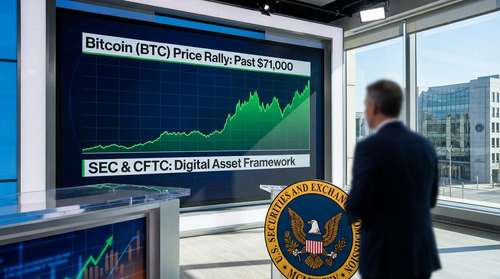
Markets wasted no time reacting to the lifting of this massive regulatory cloud. A fierce Bitcoin price rally ignited almost immediately, pushing the flagship cryptocurrency past heavy resistance to reclaim the $71,000 level this week. Short sellers who had bet on continued regulatory hostility were caught off guard, leading to over $810 million in liquidations across derivatives platforms.
Trading volumes across major exchanges surged by 41% over the last few trading sessions. While easing geopolitical tensions provided some broader macroeconomic relief, trading desk analysts attribute the bulk of this sustained buying pressure directly to the clarified regulatory environment. With the threat of sudden delistings effectively neutralized for digital commodities, sidelined capital is aggressively re-entering the market. Observers note that the clarity around the termination of investment contracts provides a massive psychological boost, lifting the valuation ceiling for the entire sector.
Accelerating Institutional Crypto Adoption
The ripple effects of the new SEC and CFTC parameters extend far beyond retail speculation. Clear definitions are the exact catalyst required to trigger the next massive wave of institutional crypto adoption.
For years, major asset managers, pension funds, and traditional banking entities hesitated to interact with alternative Layer-1 networks due to compliance risks. Now that the agencies have drawn a hard line distinguishing digital commodities from unregistered securities, institutional compliance departments have the green light they need. Wall Street is actively pivoting, with internal risk models being updated to accommodate broader baskets of digital assets beyond just Bitcoin and Ethereum. Prime brokerages can now confidently structure derivative products and custody solutions for a wider range of tokens without fear of drawing SEC subpoenas.
What This Means for US Crypto Laws Going Forward
While this interpretation provides immediate relief, the regulatory evolution continues. The SEC and CFTC's united front, bolstered by a formal Memorandum of Understanding, signals a collaborative government approach that drastically reduces the risk of conflicting regulatory positions.
Critically, the agencies also addressed secondary network functions. Activities like protocol mining, staking on Proof-of-Stake networks, and token airdrops have received highly favorable clarifications, with regulators stating these administrative activities typically do not involve the sale of securities.
Market participants finally have a roadmap to compliance. Instead of fighting an uphill battle against ambiguous legal precedents, digital asset enterprises can redirect their capital toward technological development and user acquisition. By replacing fear with a structured compliance pathway, the United States is positioning itself to reclaim leadership in the global digital economy.