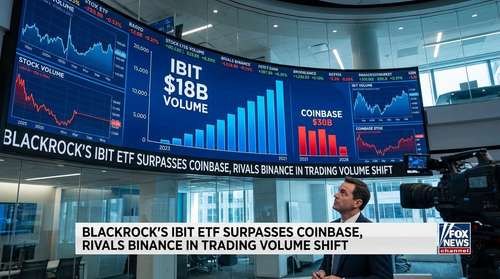
The barrier between traditional finance and the digital asset sector is dissolving much faster than analysts previously expected. On April 3, 2026, new market data revealed that BlackRock IBIT volume has surged to an astonishing $16 billion to $18 billion in daily trading. This historic milestone effectively doubles the spot market activity seen on Coinbase and positions the regulated ETF as a direct competitor to Binance for global crypto liquidity dominance.
The Crypto Market Structure Shift Accelerates
Data provided by analytics firm Kaiko, and further highlighted by industry observers like Frank Chaparro, paints a staggering picture of Wall Street's growing dominance over digital assets. For the first time, a regulated investment wrapper is consistently beating crypto-native platforms at their own game. When examining the Bitcoin ETF vs Coinbase dynamic, the numbers are hard to ignore. While Coinbase processes a respectable $6 billion to $8 billion in daily spot volume, BlackRock's iShares Bitcoin Trust (IBIT) is moving more than twice that amount.
This massive liquidity drain towards regulated products marks a definitive crypto market structure shift. Investors no longer need to rely entirely on traditional cryptocurrency exchanges to gain deep, liquid exposure to Bitcoin. Instead, major institutional allocators are choosing the safety, regulatory clarity, and seamless execution of exchange-traded funds. The evolution underscores a fundamental maturation in how digital assets are traded globally.
Challenging Binance for Global Liquidity Dominance
Perhaps the most surprising revelation from the April 2026 data is how closely IBIT is rivaling the industry's undisputed heavyweight. For years, Binance has served as the anchor for global crypto trading. However, the current Binance liquidity 2026 landscape is facing unprecedented competition. BlackRock's daily turnover of $18 billion places the fund's liquidity profile directly on par with Binance's core spot trading activity.
This is a monumental achievement for a fund that only launched two years prior, proving that Wall Street infrastructure can handle the massive throughput required by top-tier digital assets. The fact that a single U.S.-regulated vehicle can stand toe-to-toe with the world's largest offshore exchange is a testament to how aggressively traditional finance is capturing the digital asset narrative.
What is Driving Institutional Crypto Trading?
The explosion in volume comes directly on the heels of a massive rebound in spot Bitcoin ETF flows. Following a difficult start to 2026—where Bitcoin suffered a 23.8% decline in the first quarter, marking its worst Q1 since 2018—March brought a swift reversal. U.S. spot Bitcoin ETFs successfully ended a four-month dry spell by pulling in $1.32 billion in fresh capital during the month.
This renewed confidence heavily favored BlackRock. The asset management giant currently commands roughly 70% of the market share among all U.S. spot Bitcoin ETFs, boasting over $53 billion in Assets Under Management (AUM). Institutional players are shifting their strategies, preferring to execute large block trades through BlackRock's ETF rather than navigating the fragmented order books of decentralized platforms or overseas exchanges. It is a clear validation for the demand for regulated digital assets among corporate treasuries, pension funds, and major family offices.
The Tangible Benefits of Regulated Wrappers
Why are deep-pocketed traders pivoting so aggressively? The primary catalyst is risk mitigation. Direct exposure to cryptocurrencies traditionally required maintaining accounts on dedicated crypto exchanges, which carry inherent custodial and regulatory uncertainties. By utilizing a spot ETF, institutional crypto trading desks can gain precise price exposure while leaving custody and compliance to the world's largest asset managers.
Furthermore, trading through traditional brokerage accounts allows institutions to utilize existing infrastructure, streamlining their accounting, tax reporting, and auditing processes. The extraordinary liquidity provided by BlackRock's IBIT ensures that these large players can enter and exit multi-million dollar positions without causing severe price slippage—a luxury previously only available on platforms like Binance.
Looking Ahead: The Future of Crypto Exchanges
As IBIT's daily activity continues to dwarf platforms that were once the primary gateways to Bitcoin, traditional exchanges face a pivotal crossroads. Companies like Coinbase are rapidly pivoting toward expanding their prime brokerage services, custody solutions, and institutional derivatives offerings to maintain their competitive edge. However, the core spot trading market is undeniably migrating toward Wall Street infrastructure.
Whether this momentum sustains throughout the rest of April 2026 will largely depend on macroeconomic signals, including the Federal Reserve's next move on interest rates and the overall stability of the broader digital asset market. But one fact remains abundantly clear: BlackRock has successfully engineered a liquidity black hole. By matching the scale of crypto's biggest native platforms, IBIT has proven that Bitcoin has fully, and permanently, arrived in the mainstream financial system.