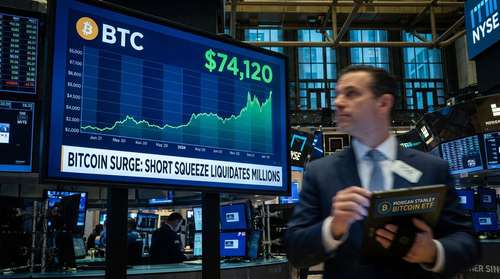
Bitcoin violently woke up the financial markets on April 14, 2026, executing a ruthless vertical climb that caught bearish traders completely off guard. This fierce momentum sent the leading digital asset past the $74,000 mark, defining the ultimate Bitcoin price surge 2026. As risk appetite flooded back into the system, leveraged speculators faced a brutal reality check, sparking a chain reaction of forced buying that fundamentally altered the market structure for the week.
The Anatomy of Massive Bitcoin Market Liquidations
The sheer velocity of the move came down to mechanics rather than just organic spot buying. When traders betting against the asset are forced to cover their positions, they must buy back in at market price. This dynamic created an explosive crypto short squeeze today, effectively vaporizing bearish bets and adding fuel to an already aggressive institutional rally.
The data paints a striking picture of the carnage in the derivatives market. Over a 24-hour window, approximately $530 million in leveraged positions were liquidated across the cryptocurrency ecosystem. Unsurprisingly, bearish traders took the absolute brunt of the hit. Roughly 80% of that total—or $425 million—stemmed entirely from short positions.
How the Squeeze Unfolded
Market data reveals that around 177,000 individual traders found themselves on the wrong side of the trade. The aggressive BTC 74k breakout triggered a cascade effect: as prices ripped higher, margin calls forced exchange liquidations, which in turn forced more buying, creating a self-fulfilling loop. Over $300 million in crypto shorts were wiped out in a concentrated 12-hour window alone around the spike, making this the most aggressive forced buying event the market has seen since early March.
The total cryptocurrency market capitalization has swelled to approximately $2.62 trillion, with Bitcoin commanding a dominant 58.6% share of the ecosystem. Ethereum also benefited from the renewed risk appetite, gaining about 7.5% on the day to push into the upper $2,300s, reflecting a broad-based digital asset recovery rather than an isolated technical pump.
Morgan Stanley Bitcoin ETF Ignites Institutional Firepower
While the derivatives market provided the spark, genuine institutional demand supplied the underlying structural support. The timeline aligns perfectly with the recent debut of the Morgan Stanley Bitcoin ETF (ticker: MSBT), which launched on the NYSE Arca on April 8. Pricing aggressively with a 0.14% fee, the bank has effectively opened the floodgates for its 16,000 advisors—who manage trillions in client assets—to allocate capital directly into spot Bitcoin.
Morgan Stanley's entrance is particularly disruptive because it directly challenges established leaders like BlackRock's IBIT and Fidelity's FBTC, which collectively hold over $74.3 billion in net inflows. The product hit $34 million in day-one volume, proving immediate traction. This landmark launch represents a massive leap in institutional crypto adoption, providing a frictionless on-ramp for traditional investors who were previously hesitant to interact with digital assets.
But Wall Street banks weren't the sole catalyst. Institutional buyers have been quietly accumulating. Corporate demand remains unbothered by recent macroeconomic uncertainty, evidenced by Michael Saylor's STRC recently raising a staggering $1.15 billion in a single day strictly for Bitcoin purchases.
A Favorable Regulatory Backdrop
Institutions are also finding comfort in unexpected regulatory clarity. The SEC and CFTC's joint guidance issued in March 2026 formally classified both Bitcoin and Ethereum as digital commodities. By stripping away the legal ambiguity that historically sidelined major allocators, regulators gave traditional finance the green light to deploy capital at scale. Traders are now closely eyeing the SEC roundtable on the CLARITY Act scheduled for April 16, which could either validate this breakout or trigger short-term profit-taking.
Testing the Formidable BTC 75k Resistance
Despite the euphoria surrounding the squeeze, technical analysts are advising caution. Bitcoin is currently staring down the BTC 75k resistance zone, a psychological and structural barrier that has proven notoriously difficult to crack.
During today's session, Bitcoin reached as high as the $74,000 range before momentum slightly cooled off. A key metric causing hesitation is the Relative Strength Index (RSI), which has spiked to 72.8. A reading above 70 traditionally signals overbought conditions, suggesting that the immediate impact of the short-term squeeze catalyst may be fading.
Market mechanics currently present a dual narrative. On the downside, order book data indicates a massive cluster of liquidity sitting between $65,000 and $71,000. This lower boundary contains roughly four times more concentrated liquidity than the upside targets, meaning that any sudden macroeconomic shock could draw the price downward like a magnet.
However, the immediate trend remains technically constructive. Bitcoin recently secured its first daily close above the April 2025 bottom in six weeks, stringing together three consecutive closes above its 50-day simple moving average. If the bulls can maintain the pressure and successfully clear the $75,000 ceiling, the next technical target sits comfortably at $78,000. Conversely, if the asset loses its footing and fails to break out, a sharp drop back to the $70,000 support zone is expected. The coming 48 hours will dictate whether this aggressive rally transitions into a sustained macro trend or simply resets the board.