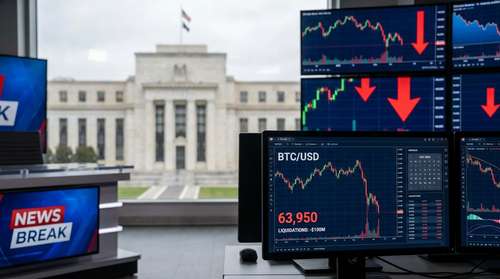
The final days of the first quarter have brought unparalleled volatility to digital assets. As we evaluate the Bitcoin price March 2026 landscape, the world's leading cryptocurrency is fiercely defending the $66,500 baseline. Following a grueling weekend of aggressive sell-offs, the total cryptocurrency market capitalization is currently attempting to stabilize at $2.38 trillion. This dramatic recalibration is not happening in a vacuum; it is the direct result of escalating global tensions that have sent shockwaves across all risk-on asset classes, forcing a brutal re-evaluation of near-term price targets.
US-Iran Conflict Market Impact Keeps the Fed Hawkish
The immediate catalyst for the ongoing cryptocurrency market crash 2026 is the rapidly deteriorating geopolitical landscape. Over the last 48 hours, the intensifying U.S.-Iran conflict has triggered a severe 'risk-off' reflex among global investors. Energy markets are surging as supply chain anxieties mount, and the resulting inflation fears have dramatically altered the macroeconomic playbook.
Just weeks ago, equities and crypto markets had confidently priced in potential Federal Reserve interest rate cuts for the spring. Now, sticky inflation projections driven by the Middle East turmoil have entirely sidelined any dovish pivot from central bankers. Higher-for-longer interest rates traditionally siphon liquidity away from speculative assets, pushing both retail and institutional participants toward traditional safe havens like gold and short-term Treasuries. The correlation between surging oil futures and Bitcoin's localized weakness has never been more apparent than during Monday morning's trading session.
Compounding the pressure on digital assets is the surging strength of the U.S. Dollar. The DXY has rallied sharply as international capital flees to the perceived safety of the greenback amidst the Middle Eastern unrest. A stronger dollar historically creates fierce headwinds for dollar-denominated assets like Bitcoin. This double-edged sword of geopolitical uncertainty and currency strength has created a perfect storm for the current market contraction.
Historic Capitulation: Crypto Fear and Greed Index 8
Market sentiment has officially plunged into the darkest depths of capitulation. As of March 30, the Crypto Fear and Greed Index 8 reading flashes "Extreme Fear," marking one of the most severe metric drops in recent trading history. A single-digit score is exceptionally rare, historically materializing only during black swan events or massive macro-driven capitulations. It indicates sheer panic selling from retail traders who are aggressively offloading spot positions and abandoning leverage.
However, seasoned contrarian investors often view these historically depressed sentiment levels as prime exhaustion points. When the emotional pendulum swings so violently toward fear, the sellers eventually run out of ammunition, creating asymmetric upside opportunities for those with capital ready to deploy.
Bitcoin Support Levels Today: The Battle for $66,500
From a technical perspective, all eyes are glued to the order books to see if current floors can withstand the macroeconomic pressure. Analyzing the critical Bitcoin support levels today, the $66,500 to $66,000 zone is serving as the ultimate line in the sand. If bearish momentum breaks this threshold on high volume, analysts warn of a potential cascading liquidation event that could swiftly test the $62,000 macro support line.
Despite the pervasive panic narrative dominating social media, on-chain data reveals a fascinating divergence beneath the surface. While short-term holders are liquidating positions at a loss, there is undeniable evidence of institutional crypto accumulation. Large-scale wallet entities—often referred to as 'whales'—and Wall Street-backed spot ETFs are actively absorbing the selling pressure. Wealth managers appear to view the mid-$60K range as a strategic discount rather than a structural breakdown, quietly dollar-cost averaging into the weakness.
This accumulation is largely driven by long-term mandates. Corporate treasuries and sovereign wealth funds that recently entered the space are not trading on 48-hour geopolitical news cycles. Instead, they are capitalizing on the retail panic to secure large block allocations at lower cost bases. The steadfast holding patterns of these institutional giants provide a crucial shock absorber that simply did not exist during the market downturns of previous cycles.
The Path Forward: Bitcoin Price Prediction $150K Intact?
It is easy to lose perspective during a sudden market drawdown, but zooming out paints a distinctly different macro picture. Several prominent financial institutions are resolutely maintaining their bullish long-term frameworks. While the immediate geopolitical climate is fraught with uncertainty, the structural supply dynamics of Bitcoin continue to provide fundamental buoyancy.
Forecasts previously established by analysts, including the highly discussed Bitcoin price prediction 150k targets for this cycle, remain active models for late 2026. Experts argue that the current consolidation phase, while painful for over-leveraged traders, is a necessary shakeout. Once the geopolitical dust settles and inflation metrics stabilize, the delayed Federal Reserve rate cuts will eventually materialize, potentially unleashing a wave of sidelined liquidity back into digital assets.
For now, market participants must navigate the turbulence with strict risk management as the U.S.-Iran situation develops. Traders should monitor the immediate overhead resistance at $68,200, a reclaim of which would signal initial momentum reversal. Until then, survival and capital preservation remain the name of the game in a market dictated by global headlines. The next few daily closes will be absolutely critical in determining whether the $66,500 support acts as a resilient springboard for an April recovery, or the trapdoor to a deeper, protracted correction.