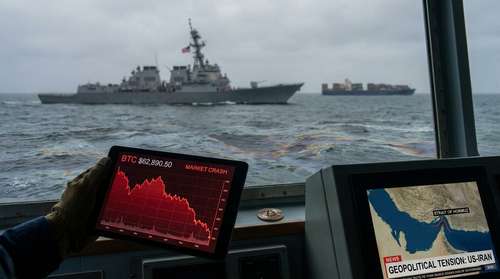

The cryptocurrency landscape shifted violently this weekend, marking the most severe Bitcoin price crash March 2026 has seen thus far. In a matter of minutes, the premier digital asset plunged to a three-week low of approximately $68,625. The catalyst was a sudden geopolitical escalation, specifically an ultimatum delivered by US President Donald Trump threatening Iranian power plants over a Hormuz blockade. This international flashpoint not only sent shockwaves through traditional equities but also triggered catastrophic BTC liquidations today, wiping out hundreds of millions in over-leveraged long positions and instantly transforming the market sentiment from greedy to fearful.
For weeks, traders have monitored escalating tensions in the Middle East, but few anticipated the scale of the resulting financial tremor. This weekend's events serve as a stark reminder that digital assets remain highly sensitive to macroeconomic and geopolitical developments, severely punishing those who fail to hedge their portfolios appropriately against headline risk.
The Strait of Hormuz Crypto Shock Explained
The market instability began late Saturday when the White House issued a severe warning to Tehran regarding a potential oil blockade. Citing threats to regional stability, Trump's administration delivered a forceful ultimatum, threatening targeted strikes on key Iranian energy and infrastructure sectors. Traditional energy markets immediately priced in the risk of severe supply chain disruptions, but the ensuing Strait of Hormuz crypto shock proved uniquely aggressive.
Historically, Bitcoin has occasionally acted as a safe-haven asset during times of global uncertainty. However, in this instance, the Trump Iran crypto market impact was distinctly negative. Institutional investors quickly liquidated risk-on assets, seeking the immediate liquidity of cash and Treasury yields over the volatility of digital currencies. The swift movement of capital out of the cryptocurrency sector highlights how deeply interwoven institutional crypto investments have become with traditional geopolitical risk models.
Over $232 Million Erased: Analyzing the Liquidations
As news of the diplomatic breakdown crossed international wires, trading algorithms and retail investors alike rushed for the exits. The resulting sell-off was merciless. Within a chaotic 30-minute window, derivatives markets witnessed a staggering $232 million in forced liquidations. The overwhelming majority of these were long positions held by traders aggressively betting on a continued rally toward the $80,000 threshold.
Keeping up with cryptocurrency market volatility news requires understanding leverage, and this weekend's wipeout was a textbook example of a liquidation cascade. When the price began to dip, it triggered stop-losses and margin calls, forcing exchanges to automatically sell off traders' collateral. This automated selling pressure drove the price down further, triggering yet another wave of liquidations in a vicious cycle that ultimately broke the back of the bulls.
Data aggregator metrics confirmed the brutal reality of the cascade. Tens of thousands of individual traders were liquidated during the 30-minute flash crash, highlighting the extreme concentration of highly leveraged positions that had accumulated during the recent bullish consolidation phase. Those operating with 50x or 100x leverage saw their accounts zeroed out before they could even open their trading applications to assess the damage. This massive flush of open interest leaves the derivatives market significantly deleveraged, which historically paves the way for a more organic, spot-driven price discovery process once the initial panic subsides.
Losing the Bitcoin Support Level $70k
The most significant technical damage inflicted by this geopolitical flare-up was the definitive breach of the Bitcoin support level $70k. For the better part of three weeks, the $70,000 mark had served as a psychological and technical fortress. Bulls had defended this line fiercely, treating it as a reliable springboard for future price discovery.
Piercing the $70,000 armor without any meaningful resistance fundamentally alters the immediate technical outlook. Trading volumes during the descent were exceptionally high, confirming the conviction behind the institutional sell-off. Market analysts are now recalibrating their charts, noting that the rapid descent to $68,625 leaves a considerable technical vacuum, with little historical support before the $65,000 territory.
Bitcoin Price Prediction Q1 2026: Navigating the Fallout
As the dust settles on this intense trading session, investors are urgently seeking clarity on the Bitcoin price prediction Q1 2026. The landscape has fundamentally shifted. While early year forecasts heavily weighted the positive impact of halving economics and institutional ETF inflows, geopolitical risk has now boldly asserted itself as the dominant driver of short-term price action.
Wall Street desks that manage large crypto portfolios are already adjusting their risk parameters. Analysts note that if the diplomatic situation in the Middle East de-escalates quickly, Bitcoin could see a swift relief rally back above $70,000 as sidelined capital re-enters the market. The fundamentals of network adoption remain strong, and sudden dips are frequently treated as buying opportunities by long-term holders and institutional whales.
Conversely, if the US-Iran standoff intensifies into direct military conflict, further downside testing is highly probable. Based on current volume nodes, the next crucial technical floors rest at:
- $65,200: The first line of defense based on late February consolidation zones.
- $62,000: A major psychological level and 50-day moving average intersection.
- $58,500: The worst-case scenario target for a full-scale capitulation event.
For now, the priority for traders is capital preservation. Until the geopolitical climate stabilizes and the threat of an escalating blockade in the Middle East is neutralized, the cryptocurrency market will likely experience outsized reactions to every breaking news alert. Investors are advised to maintain strict stop-losses, reduce leverage, and prepare for continued turbulence as this unprecedented global scenario unfolds.