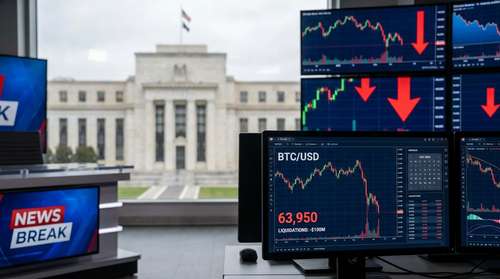
The cryptocurrency market is facing a brutal reality check this weekend. A convergence of massive derivatives settlements and mounting macroeconomic fears has triggered the severe Bitcoin price crash March 2026 investors had been dreading. In the span of just 48 hours, digital asset markets have seen a violent recalibration, resulting in over $450 million in leveraged trading positions being wiped out. This cascade of crypto options expiry liquidations was largely catalyzed by a staggering $14 billion BTC options settlement that hit the Deribit exchange early Friday morning. With BTC prices plunging toward a weekly low of $66,000, the broader digital asset landscape is currently navigating one of its most turbulent and unpredictable periods of the entire year.
The Mechanics Behind the $14 Billion BTC Options Settlement
Friday's derivative event was not just another date on the trading calendar. It represented the absolute largest quarterly expiration event of 2026, wiping out nearly 40% of the total open interest on Deribit in a single hour. Going into the week, the options max pain price—the exact level where the highest number of contracts expire entirely worthless, causing maximum financial loss for buyers and maximum profit for institutional sellers—was sitting heavily at $75,000.
Because the spot price was trading well below this $75,000 magnet, options writers and market makers were forced to aggressively adjust their market exposure. This intense mechanical price pressure, known as delta hedging, forced aggressive selling of both spot Bitcoin and perpetual futures. As a direct result, the market witnessed extreme crypto market volatility today, tearing through leveraged long positions and creating a rapid snowball effect of forced selling. Derivatives traders who anticipated a smooth, uninterrupted climb toward new all-time highs found themselves on the wrong side of the tape, ultimately fueling the $450 million market-wide liquidation event.
Spot ETF Outflows 2026: Institutional Investors Hit the Brakes
Compounding the intense derivatives pressure is a sudden, stark reversal in institutional sentiment across the traditional finance sector. For the first time this year, the market recorded simultaneous net outflows across Bitcoin, Ethereum, and Solana spot exchange-traded funds. On Thursday alone, prior to the Friday settlement, spot Bitcoin ETFs logged a steep $225.5 million in net outflows, breaking a long streak of steady institutional accumulation.
BlackRock's flagship IBIT fund accounted for the lion's share of this institutional retreat, bleeding over $201.5 million in a single trading session. Bitwise's BITB and Ark & 21Shares' ARKB also posted notable negative flows, shedding $18.6 million and $5.35 million respectively. Meanwhile, Ethereum products faced similar downward pressure, with Fidelity's FETH and Grayscale's Ether Mini Trust losing millions. This coordinated wave of spot ETF outflows 2026 signals a broader de-risking effort by traditional finance players. After pouring billions into digital assets throughout February and early March, Wall Street asset managers are stepping back to reassess the landscape amid deteriorating global macroeconomic conditions.
Crypto Geopolitical Risk Impact Accelerates the Sell-Off
Technical factors and institutional ETF selling only tell half the story of this market correction. The crypto geopolitical risk impact has reached a boiling point over the last two days. Escalating tensions in the Middle East, specifically the looming deadlines surrounding the US-Iran diplomatic window, have sent immediate shockwaves through global financial markets.
As crude oil prices spike past crucial resistance levels and U.S. Treasury yields climb higher, investors are rapidly fleeing risk-on assets in favor of traditional safe havens. Despite its long-standing narrative as digital gold and an uncorrelated hedge against fiat inflation, Bitcoin has visibly struggled to maintain a defensive posture during this geopolitical crisis. The broader macroeconomic uncertainty, combined with fears that the Federal Reserve may delay highly anticipated rate cuts due to oil-driven inflation, has driven the Bitcoin Fear & Greed Index down to a bone-chilling reading of Extreme Fear. This panic has accelerated the exodus from alternative cryptocurrencies, plunging the total crypto market capitalization well below the $2.1 trillion mark.
The Battle for the Bitcoin $66k Support Level
All eyes in the trading community are now glued to the technical charts as analysts assess the structural damage. The immediate focus is the critical Bitcoin $66k support level. Having decisively lost the vital $69,000 to $71,000 consolidation zone, BTC dipped down into the $65,900 range before attempting to establish a fragile baseline. This current floor represents a major psychological and structural threshold for the market, aligning closely with key moving averages.
Technical indicators paint a cautious picture. The asset recently sliced through the 0.236 Fibonacci retracement level at $67,054, turning previous support into a daunting new ceiling. If the Bitcoin $66k support level fails to hold under the weight of weekend trading volumes, analysts warn that the next robust line of defense doesn't appear until the $63,000 to $60,000 liquidity zone. Conversely, a swift, high-volume recovery above $67,500 could indicate that the worst of the options-induced supply shock has finally been absorbed by deep-pocketed whales and opportunistic buyers.
While the immediate short-term outlook seems undeniably grim, post-expiry periods historically offer a much-needed market reset. With the $14 billion overhang and subsequent crypto options expiry liquidations now officially cleared from the derivatives market, the synthetic supply and demand distortions that plagued price action all week have evaporated. In the wake of the Bitcoin price crash March 2026, the coming days will thoroughly test whether organic spot buying can overcome the ongoing macroeconomic headwinds, or if the current downtrend will carve out even deeper lows for the spring trading quarter.