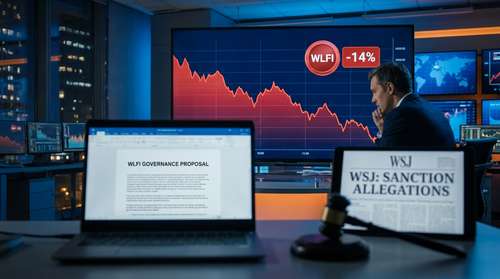
The cryptocurrency markets are reeling after a turbulent week for the Trump family's decentralized finance venture, World Liberty Financial. Just days after a bombshell Wall Street Journal report linked the project's partners to sanctioned entities, the team pushed forward with a highly polarizing WLFI governance proposal. The controversial move to structure a four-year World Liberty Financial token unlock has sparked fierce backlash from early investors. As a result of the compounding crises, the asset suffered a steep 14% drop to fresh all-time lows of $0.062, making this one of the most closely watched developments in Trump crypto news 2026.
Sanction Allegations Fuel the WLFI Price Crash Today
On April 28, the Wall Street Journal published an investigative piece alleging that World Liberty Financial partnered with individuals tied to a U.S.-sanctioned scam network. The report detailed a collaboration announced in late 2025 with a blockchain network called AB. The partnership was originally designed to integrate World Liberty's USD1 stablecoin into AB's decentralized finance and payments ecosystem. However, AB had deep ties to a planned blockchain theme resort in Timor-Leste.
The U.S. Treasury had previously blacklisted three individuals involved in that resort project for their connections to a massive Southeast Asian fraud syndicate accused of running violent scam compounds and orchestrating multi-billion dollar pig butchering schemes. Although World Liberty Financial's legal team stated they were completely unaware of these connections during their due diligence phase and only learned of the ties in January 2026, the market reaction was unforgiving.
This geopolitical and compliance nightmare directly triggered the WLFI price crash today, sending the token tumbling by 14% down to $0.062. For institutional investors and retail traders seeking safe havens, the revelation highlights critical vulnerabilities in due diligence practices within the broader digital asset space.
Inside the Controversial World Liberty Financial Token Unlock
Rather than pausing operations to address the public relations fallout, the project's leadership initiated what they described as the most significant WLFI governance proposal in the protocol's history. Voting officially went live on April 29 and is scheduled to close on May 6.
At the core of the debate is a sweeping plan to manage the protocol's massive supply overhang. Approximately 75 billion tokens are currently restricted in a lockbox. Under the newly proposed terms, the holdings are split into two primary camps:
- Founders and Advisors: Allocated 45 billion tokens, this group faces a mandatory 10% burn (4.5 billion tokens), a strict two-year cliff, and a subsequent three-year vesting period stretching to 2031.
- Early Presale Supporters: Controlling roughly 17 billion tokens, this cohort would face a two-year cliff followed by a phased release ending in 2030.
Through decentralized autonomous organization voting, token holders must decide whether to accept these extended timelines. The sheer scale of the World Liberty Financial token unlock cannot be understated. With only a fraction of the 100 billion maximum supply currently in circulation, the threat of future inflation has heavily suppressed buyer demand. By burning a portion of the protocol fees and establishing a rigid vesting timeline, the core team hopes to create artificial scarcity. Yet, critics within the decentralized finance community argue that pushing such an aggressive redesign without broader consensus undermines the fundamental ethos of decentralized finance.
High-Profile Lawsuits and Internal Friction
The push to implement the WLFI governance proposal has generated massive internal friction. Tensions reached a boiling point when Tron founder Justin Sun publicly slammed the maneuver as financial extortion. After making a substantial early investment in the project, Sun discovered his wallet had been blacklisted by the protocol, completely revoking his ability to participate in the critical vote.
Sun subsequently filed a lawsuit against the firm, turning an internal governance dispute into a public legal battle. The protocol's leadership justified the blacklisting by citing alleged misconduct by Sun, while Eric Trump publicly dismissed the lawsuit as ridiculous. The optics of freezing assets belonging to major stakeholders heavily contradict the foundational principles of permissionless blockchain ecosystems. For many observers tracking Trump crypto news 2026, the situation exposes the harsh reality of centralized control masked within decentralized wrappers. If the smart contract code permits arbitrary wallet freezes, the protocol's claim of being a neutral financial layer becomes highly questionable.
Looming Risks of a DeFi Regulatory Investigation
The convergence of a crashed token price, lawsuits from heavy-hitting investors, and allegations involving sanctioned international entities presents a complex compounding threat for the project. Industry analysts reading the latest insights on cryptovot finance suggest that the fallout might not be limited to negative price action alone. The Treasury Department's Office of Foreign Assets Control and other regulatory bodies have been tightening their grip on digital asset compliance over the last two years.
Indirect exposure to blacklisted entities is often enough to trigger a formal DeFi regulatory investigation. Regulators are paying closer attention to crypto partnerships, especially those involving prominent public figures. While World Liberty Financial maintains that it cut ties once the sanctions were fully understood, the broader implications for decentralized platforms are immense.
Moreover, the SEC continues to monitor token distribution events that heavily favor insiders. With 75% of presale proceeds reportedly tied to the founding entities, any subsequent moves to alter tokenomics could be viewed through a regulatory lens. If the ongoing governance vote fails to stabilize the ecosystem, or if lawmakers escalate their scrutiny over the compliance failures outlined by the Wall Street Journal, the protocol will face a steep uphill battle to restore liquidity and trust.