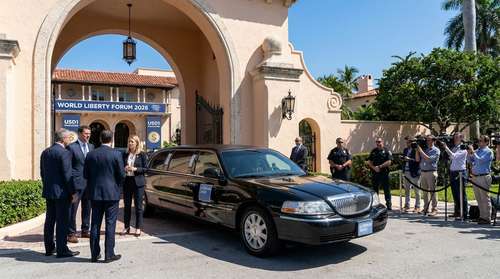
PALM BEACH, FL — A convoy of black SUVs and security details descended on Mar-a-Lago today as the World Liberty Forum 2026 kicked off, marking a controversial convergence of Wall Street power, federal regulatory authority, and the First Family’s private crypto empire. Hosted by World Liberty Financial (WLF), the decentralized finance project backed by President Donald Trump and his sons, the summit has drawn a who’s-who of global finance, including Goldman Sachs CEO David Solomon, Nasdaq CEO Adena Friedman, and NYSE President Lynn Martin.
The closed-door gathering, billed as a think tank on the "future of American financial dominance," comes at a pivotal moment for the industry. World Liberty Financial’s flagship product, the USD1 stablecoin, has surged in adoption, recently surpassing $5 billion in circulation to become the fifth-largest stablecoin globally. However, the presence of sitting federal regulators—including CFTC Chairman Michael Selig and SBA Administrator Kelly Loeffler—alongside the very executives they oversee has ignited a fresh firestorm over government ethics and potential conflicts of interest.
The Mar-a-Lago Convergence: TradFi Meets DeFi
For years, traditional finance (TradFi) executives kept a cautious distance from the volatile world of cryptocurrency. Today’s attendance at the Mar-a-Lago finance summit signals a definitive shift. David Solomon of Goldman Sachs and Adena Friedman of Nasdaq are reportedly leading discussions on integrating blockchain rails with legacy banking infrastructure. Their participation is seen by market analysts as a tacit endorsement of WLF’s growing influence.
"This isn't just a crypto meetup; it's a coronation," said one attendee speaking on condition of anonymity. "When you have the heads of the NYSE and Goldman breaking bread with the President's sons over a stablecoin protocol, the lines between 'fringe' and 'finance' have effectively dissolved."
While the agenda ostensibly focuses on "modernizing markets," insiders suggest the real topic is the rapid institutionalization of World Liberty Financial news-making products. The project has moved aggressively beyond its DeFi roots, with recent reports indicating plans for a foreign exchange remittance platform dubbed "World Swap."
USD1: The $5 Billion Elephant in the Room
Central to today’s discussions is the meteoric rise of the USD1 stablecoin. Launched in March 2025, the dollar-pegged token has vacuumed up liquidity, bolstered by high-yield incentives and strategic partnerships. Notably, recent disclosures revealed that nearly 87% of the USD1 supply is concentrated on Binance, a detail that has raised eyebrows among risk compliance officers.
The stablecoin's growth is inextricably linked to the Trump brand. Marketing materials describe USD1 as a tool to "Make Crypto Great Again" by ensuring U.S. dollar dominance in digital markets. However, the mechanics of the venture—where the Trump family is contractually entitled to 75% of net proceeds—mean that the President's private wealth is now directly correlated with the success of a financial product regulated by his own appointees.
Foreign Capital Inflows
Compounding the scrutiny are reports of significant foreign investment. Just prior to the inauguration, entities linked to the Abu Dhabi royal family reportedly acquired a major stake in the ecosystem, and earlier this year, crypto entrepreneur Justin Sun purchased $75 million in WLFI governance tokens. Sun’s subsequent removal from an SEC litigation list has become a focal point for critics citing crypto regulation ethics violations.
A "Constitutional Minefield": The Ethics Debate
The World Liberty Forum 2026 has provided ammunition for government watchdogs who argue the administration is leveraging public office for private gain. Representative Ro Khanna (D-CA) launched a formal investigation earlier this month, questioning whether foreign investments in WLF are influencing U.S. export policies on AI and technology.
"We are witnessing a conflict of interest on a scale that tests the very limits of the Emoluments Clause," stated intense criticism from Senator Elizabeth Warren’s office. The concern is that the presence of regulators like CFTC Chair Michael Selig creates an "imprimatur of state sanction" for a private family business. Selig, a Trump appointee, has previously argued for a "light-touch" regulatory approach, a philosophy that appears to be paying dividends for the industry gathered in Palm Beach today.
The Regulatory Revolving Door
Despite the optical headwinds, the mood inside the Mar-a-Lago ballroom is reportedly jubilant. For the crypto industry, the summit represents the ultimate victory: validity. With the Goldman Sachs CEO crypto strategy now aligning with the administration's vision, the sector anticipates a golden era of deregulation.
WLF spokesman David Wachsman defended the event, stating it is about "deepening relationships and extending U.S. dollar dominance." Yet, as limousines idle on South Ocean Boulevard, the question remains: Is this the future of American innovation, or the normalization of a new oligarchy? For now, the market seems to have voted with its wallet—USD1 is trading at a premium, and the titans of Wall Street are eager for a seat at the table.