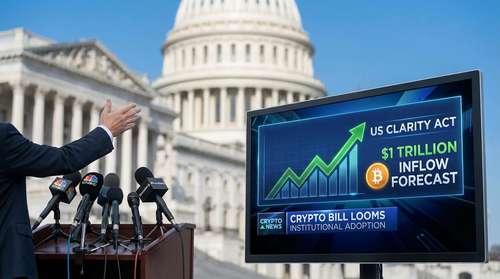
The cryptocurrency market is vibrating with anticipation as the legislative path for the Clarity Act (Digital Asset Market Clarity Act) clears a major hurdle. Prediction markets have witnessed a dramatic shift in sentiment over the last 48 hours, with odds of the bill’s passage surging to over 90% before the second quarter of 2026. This potential regulatory breakthrough, combined with the Ethereum Foundation’s newly unveiled 2026 roadmap, has institutional analysts forecasting a —trillion-dollar inflow— of sidelined capital that could permanently redefine the industry’s traditional four-year cycle.
Clarity Act Breakthrough: White House Pushes for March Resolution
After months of legislative purgatory in the Senate Banking Committee, the Clarity Act has found new life. Sources close to the negotiations report that the White House has set a hard deadline of March 1, 2026, to resolve the contentious —stablecoin yield— dispute that has stalled progress. This provision, which debatably classified yield-bearing stablecoins as securities, has been the primary deadlock between banking lobbyists and crypto-native firms.
Ripple CEO Brad Garlinghouse, in a statement to Fox Business on February 20, expressed unprecedented confidence, citing a "90% probability" that the bill will be signed into law by late April. The market has responded in kind; political prediction markets like Polymarket flipped bullish on February 21, pricing in a near-certainty of passage. This legislative green light is widely viewed as the final key to unlocking institutional coffers, with White House advisor Patrick Witt noting that "trillions of dollars" are currently waiting for this specific regulatory signal to deploy.
Ethereum 2026 Roadmap: Scaling to 100 Million Gas
Parallel to the legislative momentum, the Ethereum Foundation dropped a bombshell update this week with its Ethereum 2026 roadmap. Moving beyond vague promises, the new technical charter focuses on three concrete pillars: "Scale, Improve UX, and Harden L1." The most headline-grabbing development is the commitment to increase the gas limit to 100 million—a massive leap from current levels that aims to accommodate institutional-grade throughput directly on the base layer.
This technical roadmap is designed to support the very institutions the Clarity Act aims to attract. By prioritizing quantum resistance and "native account abstraction" (removing the need for complex seed phrases), Ethereum is positioning itself not just as a crypto platform, but as a compliant settlement layer for global finance. Analysts at Bitwise argue this roadmap is the "missing link" that allows traditional asset managers to build directly on Ethereum without relying on cumbersome Layer 2 bridges for every transaction.
Institutional Adoption & The "Supercycle" Thesis
The convergence of clear rules and scalable tech is fueling the "Supercycle" narrative—the idea that crypto will break its historic four-year boom-bust pattern. With institutional crypto adoption moving from pilot phases to full production, the dampening effect of constant capital inflows could smooth out volatility. Grayscale’s latest report suggests 2026 will mark the "death of the cycle," replaced by a secular bull market driven by utility rather than speculation.
RWA Tokenization: The $11 Billion Bridge
While Bitcoin grabs headlines, the quiet revolution is happening in RWA tokenization (Real World Assets). February 2026 has been a watershed month for this sector, with the market cap of tokenized U.S. Treasuries smashing through the $11 billion ceiling. The catalyst? BlackRock’s strategic move on February 12 to integrate its BUIDL fund with Uniswap’s protocol, effectively merging the world's largest asset manager with the world's largest decentralized exchange.
This integration allows for 24/7 instant settlement of treasury-backed assets, a feature traditional markets cannot offer. Furthermore, Solana is on the verge of becoming the third chain to host over $1 billion in tokenized RWAs, driven by inflows from Ondo Finance and renewed institutional interest. This isn't just a niche experiment anymore; it is the early infrastructure of a modernized global financial system.
Bitcoin Price Forecast 2026: Analysts Eye $250k
What does this mean for price? With the Bitcoin price forecast 2026 models being updated to reflect this "regulatory unlocking," targets are shifting upward. Standard Chartered and other major desks are now eyeing a $200,000 - $250,000 range for Bitcoin by year-end, contingent on the Clarity Act's passage in Q2. The rationale is simple: the approval of the Clarity Act would allow corporate treasuries to hold Bitcoin without the punitive accounting standards that have historically deterred them.
As the industry braces for what could be its most pivotal month in history, the message from Washington and Wall Street is unified for the first time: the era of ambiguity is ending, and the era of integration is beginning.