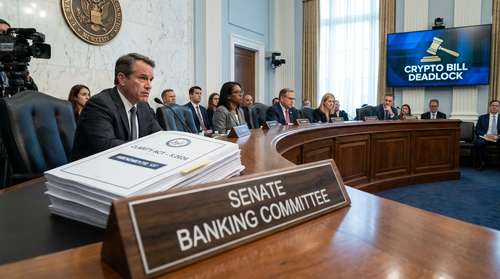
WASHINGTON — The long-awaited Senate Banking Committee markup of the Digital Asset Market Clarity Act (CLARITY Act) collapsed into legislative gridlock this week, as a record-breaking 137 amendments brought the proceedings to a sudden halt. Committee Chairman Tim Scott (R-SC) was forced to indefinitely delay the vote on Tuesday, marking a stunning reversal for a bill that — just days ago — appeared poised to become the first comprehensive regulatory framework for the U.S. cryptocurrency industry.
CLARITY Act Markup 2026: The 'Poison Pill' Amendments
What was intended to be a streamlined markup session turned into a chaotic standstill as senators from both parties introduced a flood of last-minute changes. Sources on Capitol Hill confirm that the sheer volume of proposals — 137 in total — effectively paralyzed the committee's ability to move forward. The deadlock centers on two radioactive issues that have fractured the fragile coalition between Wall Street banks and crypto natives: a strict federal ban on stablecoin interest and sweeping new reporting mandates for Decentralized Finance (DeFi) protocols.
"We are seeing a convergence of banking lobbyists and privacy advocates, ironically uniting to stop this bill for completely different reasons," said a senior aide to the Senate Banking Committee who requested anonymity. "The CLARITY Act markup 2026 was supposed to be the finish line. Instead, it’s looking like a graveyard."
The Stablecoin Interest Ban: Banks vs. Innovation
The most contentious amendments target the so-called "yield loophole." Traditional banking lobbyists have aggressively pushed for language that would strictly prohibit stablecoin issuers — and third-party exchanges — from offering yield or interest on stablecoin deposits. They argue that without these bans, unregulated tech firms could siphon trillions from the regulated banking system by acting as shadow banks.
However, the crypto industry views this stablecoin interest ban as an existential threat. Major players like Coinbase have publicly withdrawn support for the bill in recent days, arguing that the amendments effectively criminalize competition. Coinbase CEO Brian Armstrong took to social media, warning that the revised text would hand traditional banks a monopoly on yield-bearing assets while driving American digital innovation offshore. The stalemate leaves the Senate Banking Committee crypto bill in limbo, with neither side willing to concede.
DeFi Surveillance and the 'Total Access' Mandate
Beyond stablecoins, the Digital Asset Market Clarity Act amendments introduced harsh new surveillance tools for the DeFi sector. One controversial provision would require developers of decentralized protocols to register as financial institutions, forcing them to collect user identity data — a technical impossibility for many autonomous smart contracts. Privacy advocates and industry leaders have dubbed this the "Total Access" mandate, warning it would give government agencies unrestricted access to private financial records without a warrant.
Ranking Member Elizabeth Warren (D-MA) has remained a fierce critic of the original text, arguing it didn't go far enough to protect consumers. "We cannot create a tokenization loophole that allows the next FTX to operate under a veneer of legitimacy," Warren stated during the brief committee session. Her bloc of amendments seeks to tighten these DeFi reporting requirements even further, adding to the legislative logjam.
SEC vs CFTC Jurisdiction 2026: The Unresolved War
At its core, the CLARITY Act aims to finally resolve the SEC vs CFTC jurisdiction 2026 turf war. The bill proposes assigning the Commodity Futures Trading Commission (CFTC) primary oversight over "digital commodities" (like Bitcoin and Ethereum), while leaving the Securities and Exchange Commission (SEC) with authority over "ancillary assets" deemed investment contracts.
However, the new amendments threaten to unravel this delicate compromise. Former SEC officials have warned that the current definitions are too vague, potentially stripping the SEC of its enforcement power over thousands of smaller tokens. With the crypto regulatory deadline 2026 looming — a self-imposed target by GOP leadership to pass legislation before the midterms — the failure to define these boundaries could doom the bill for the rest of the legislative session.
What’s Next for US Crypto Legislation News?
Chairman Scott has not yet announced a new date for the markup, leaving the industry in a state of high anxiety. For now, the US crypto legislation news cycle is dominated by uncertainty. If the committee cannot whittle down the 137 amendments into a consensus package by early February, the CLARITY Act may share the fate of its predecessors: a bold ambition stifled by the complexity of rewiring the global financial system.