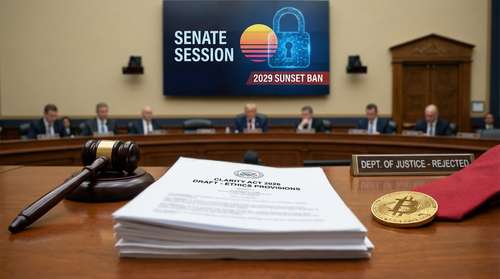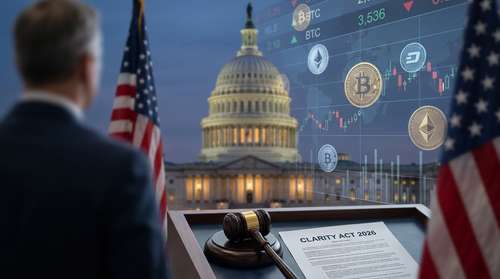
The U.S. Senate Banking Committee has officially delayed the highly anticipated markup of the Digital Asset Market Clarity Act (CLARITY Act 2026), throwing the future of comprehensive crypto regulation into uncertainty. The postponement, announced late Wednesday by Committee Chairman Tim Scott (R-SC), came just hours after major industry players—led by Coinbase—withdrew their support for the bill. At the heart of the collapse is a fierce 'red line' conflict over stablecoin rewards regulation, pitting the banking lobby against the crypto industry in a battle for the future of digital finance.
The Stablecoin 'Red Line' That Halted the Bill
While the CLARITY Act aimed to provide a unified framework for the digital asset sector, negotiations crumbled over a specific provision regarding interest on stablecoins. Traditional financial institutions have aggressively lobbied for strict bans on stablecoin rewards regulation, arguing that allowing crypto platforms to offer yield on idle stablecoin balances creates "de facto" unregulated deposit accounts that threaten to drain liquidity from the banking system.
For the crypto industry, however, this prohibition was a non-starter. Coinbase CEO Brian Armstrong publicly voiced his opposition, stating the company would "rather have no bill than a bad bill." The stakes are financial as well as ideological; analysts estimate that stablecoin distribution rewards account for nearly $1 billion in annual revenue for major exchanges. The proposed legislation would have effectively severed this revenue stream, handing a competitive advantage back to traditional banks.
Coinbase and Brian Armstrong Lead Opposition
The sudden withdrawal of support by America's largest exchange was the catalyst for the delay. In a move that reportedly left White House officials "furious," Coinbase Brian Armstrong regulatory opposition became the defining narrative of the week. Armstrong took to social media to outline why the current draft failed the industry, citing not just the stablecoin issue, but also what he termed a "de facto ban on tokenized equities" and overly restrictive measures on decentralized finance (DeFi).
"We cannot support a bill that protects the banking oligopoly at the expense of American innovation," Armstrong noted in a statement that resonated across the sector. This bold stance has drawn a line in the sand: the crypto industry is no longer willing to accept "regulatory clarity" if it comes with existential compromises.
Jurisdictional Battles: SEC vs. CFTC
Beyond the stablecoin dispute, the Senate Banking Committee crypto bill also struggled to resolve the perennial tug-of-war between regulators. A core promise of the CLARITY Act was to settle the SEC vs CFTC jurisdiction bill debate once and for all. However, the latest draft was criticized for allegedly weakening the Commodity Futures Trading Commission (CFTC) and making it "subservient" to the Securities and Exchange Commission (SEC).
Critics argue that the bill's language would have forced most digital assets—including many previously considered commodities—under the strict purview of the SEC. This "erosion" of CFTC authority was another major factor in the industry's decision to walk away, fearing that it would entrench an enforcement-heavy regime rather than foster a new market structure.
DeFi and Privacy Concerns
The draft legislation also faced backlash for its treatment of software developers. Privacy advocates warned that the bill's US crypto market structure legislation provisions could impose impossible compliance burdens on open-source developers, effectively outlawing many forms of non-custodial DeFi protocols in the United States.
Political Fallout and Market Reaction
The delay has sent ripples through Washington and Wall Street. Senator Cynthia Lummis (R-WY), a long-time advocate for the industry, expressed being "deeply disappointed" by the breakdown in negotiations, while Chairman Scott framed the pause as a necessary step to continue "good faith" discussions. Meanwhile, crypto regulation news today is dominated by speculation on whether a compromise is even possible in an election year.
Despite the legislative chaos, the crypto market has remained surprisingly resilient. Bitcoin has held steady near the $95,000 mark, suggesting that traders had already priced in the likelihood of a legislative stalemate. However, the path forward for the CLARITY Act remains murky. Without a concession on the stablecoin rewards issue, the bill—and the regulatory certainty it promised—may remain in limbo indefinitely.