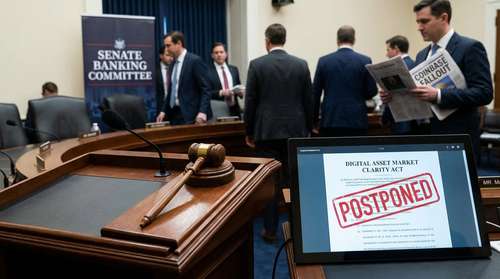
The U.S. Senate Banking Committee has delivered a stunning blow to the crypto industry this morning, indefinitely sidelining the landmark Digital Asset Market CLARITY Act. In a move that has sent shockwaves through digital asset markets, Committee Chairman Tim Scott (R-S.C.) announced the legislative calendar would immediately pivot to prioritize the Trump administration’s urgent housing affordability package. The decision, coming just days after a high-profile withdrawal of support from Coinbase, has left crypto market regulation 2026 in a state of precarious limbo.
The 'Housing Pivot': Why Crypto Was Sidelined
Sources close to the Senate Banking Committee confirm that the sudden shift—dubbed the 'Housing Pivot' by Capitol Hill insiders—was driven by intensified pressure from the White House to address the national housing crisis. With inflation metrics stabilizing but rent prices remaining stubbornly high, the administration has reportedly demanded immediate legislative action to restrict large institutional investors from purchasing single-family homes.
"The mandate from the top is clear: housing first, everything else second," said one senior aide familiar with the negotiations. This reprioritization has effectively bumped the Digital Asset Market CLARITY Act off the docket for January, with hearings unlikely to resume before late February or March. For an industry that had pinned its hopes on regulatory certainty early in the new year, the delay is a bitter pill to swallow, exacerbating the current Bitcoin price stagnation as the asset struggles to reclaim the $98,000 support level.
Coinbase Stablecoin Reward Controversy Explodes
While the housing pivot provided the political cover for the delay, insiders suggest the bill was already on life support following a blistering fallout with industry heavyweight Coinbase. The conflict centers on the Coinbase stablecoin reward controversy, which erupted earlier this week when CEO Brian Armstrong publicly accused banking lobbyists of sabotage.
At the heart of the dispute is a last-minute provision added to the CLARITY Act that would effectively ban crypto platforms from offering yield or "rewards" on stablecoin holdings. The American Bankers Association (ABA) has aggressively lobbied for this ban, arguing that interest-bearing stablecoins pose a systemic risk by encouraging deposit flight from traditional regional banks.
The 'Rug Pull' Allegation
Coinbase, which relies heavily on stablecoin revenue, viewed the provision as an existential threat. "This is a legislative rug pull," Armstrong stated in a fiery post on X (formerly Twitter) shortly before withdrawing Coinbase's support for the bill. "We spent months negotiating a framework for US digital asset legislation that protects consumers, only to have the banking lobby insert a poison pill at the eleventh hour." Without the backing of the largest U.S. exchange, the bill's bipartisan coalition began to fracture, making the pivot to housing an easier political choice for Chairman Scott.
Crypto vs Banking Lobby: The War for 2026
The collapse of the CLARITY Act talks highlights the intensifying trench warfare of the crypto vs banking lobby. As traditional financial institutions race to tokenize assets, they are simultaneously working to erect regulatory moats around their core deposit businesses. The banking sector's successful push to block stablecoin yields suggests that despite the pro-innovation rhetoric of the 119th Congress, traditional finance still holds the upper hand in Washington.
"The banks are terrified of a world where users can hold dollars on a blockchain and earn 4-5% yield without a bank account," notes regulatory analyst Sarah Vhane. "They framed this as a safety issue, but let's be honest—it's about protecting their cheap funding source. The Senate Banking Committee ultimately sided with the incumbents."
Market Reaction and What Lies Ahead
The market response has been swift and bearish. Bitcoin and Ethereum both tumbled nearly 4% on the Senate Banking Committee crypto news, reflecting renewed anxiety over the U.S. regulatory environment. Traders who had priced in the passage of the CLARITY Act by Q1 2026 are now unwinding positions, fearing that the window for passing comprehensive market structure legislation may be closing as the mid-term election cycle approaches.
For now, the industry is left waiting. While Chairman Scott has promised to revisit the bill "once the housing package is addressed," the loss of industry consensus and the aggressive stance of the banking lobby suggest the path forward will be anything but clear. Until the deadlock over stablecoin rewards is resolved, the U.S. crypto market remains stuck in a holding pattern, hostage to the broader battles of the traditional financial system.