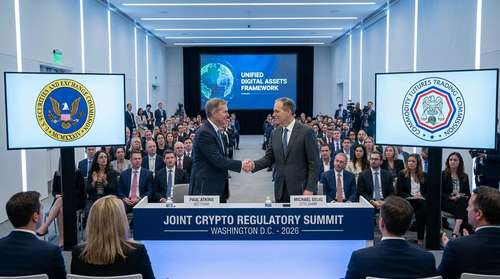
In a watershed moment for the U.S. digital asset industry, Securities and Exchange Commission (SEC) Chairman Paul Atkins and Commodity Futures Trading Commission (CFTC) Chairman Michael Selig are convening today for a historic joint summit at CFTC headquarters. The event, titled "Harmonization: U.S. Financial Leadership in the Crypto Era," was rescheduled to this afternoon following a severe winter storm in Washington, D.C. It marks the first formal step toward ending the decade-long jurisdictional conflict between the two powerful regulators and fulfilling the administration's promise to make America the "crypto capital of the world."
A New Era of Regulatory Harmonization
Today's summit, which will feature a fireside chat between Atkins and Selig, is expected to unveil a unified framework for digital asset oversight. For years, the industry has been caught in the crossfire of a turf war, with the SEC and CFTC often asserting conflicting authorities over the same assets. This "regulation by enforcement" era appears to be drawing to a close.
Sources close to the agencies indicate that the chairmen will announce a formal "innovation exemption" program. This long-awaited policy would create a "compliance buffer"—a safe harbor period allowing crypto startups to launch and decentralize their networks under limited oversight before triggering full registration requirements. "For too long, market participants have navigated boundaries that are unclear in application and misaligned in design," Atkins and Selig said in a joint statement prior to the event.
Senate Markup of Digital Commodity Intermediaries Act
The regulatory summit coincides with critical legislative action on Capitol Hill. The Senate Agriculture Committee is holding a markup session today for the Digital Commodity Intermediaries Act (DCIA). Rescheduled alongside the summit due to the weather, this bill represents the legislative half of the new market structure.
While the bill is led by Committee Chairman John Boozman, it builds on bipartisan foundations established in previous congressional sessions. The legislation aims to grant the CFTC exclusive jurisdiction over "digital commodities"—assets like Bitcoin and Ethereum that do not function as securities. Key amendments expected to be debated today include proposals from Senator Amy Klobuchar regarding retail participant protections and provisions from Senator Dick Durbin on crypto ATM fraud.
The End of the 'Post-Chevron' Ambiguity
The timing of these twin events is significant. Following the Supreme Court's reversal of the Chevron deference doctrine, federal agencies can no longer rely on broad interpretations of old laws to regulate new technologies. This legal reality has forced regulators and lawmakers to collaborate on clear, statutory definitions.
Chairman Selig, who previously served as chief counsel to the SEC's Crypto Task Force, is uniquely positioned to bridge the gap. His "minimum effective dose" philosophy on regulation aligns with Atkins' goal to reduce the compliance burden for legitimate innovators while maintaining market integrity. The DCIA would formalize this division, giving the CFTC the clear statutory mandate it needs to police the spot markets for digital commodities.
Industry Reaction: Cautious Optimism
The crypto market has reacted positively to the coordinated efforts, with major digital assets seeing a slight uptick in early trading Thursday. Industry leaders view the summit as a signal that the U.S. is finally moving from a posture of hostility to one of strategic embrace.
"This is the clarity we've been begging for," said one policy executive at a major U.S. exchange. "Seeing the SEC and CFTC chairs on the same stage, speaking the same language, changes the entire risk calculation for building in America."
However, challenges remain. The Senate Ag bill still faces a complex path through a divided Congress, and the specifics of the "innovation exemption" will need to be rigorously tested. But as the summit kicks off at 2:00 PM ET today, the message from Washington is clearer than it has been in a decade: the regulatory war is over, and the work of building a functional market structure has begun.