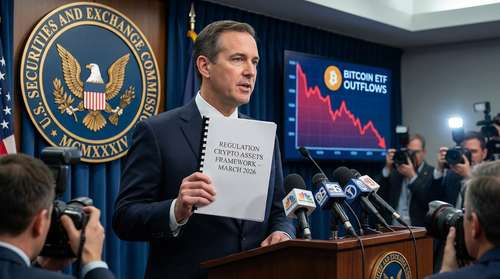
The U.S. digital asset landscape underwent a seismic shift this week. During the DC Blockchain Summit on March 17, 2026, Paul Atkins SEC Chairman officially introduced the SEC Regulation Crypto Assets framework. This landmark policy pivot is designed to permanently replace the agency's controversial era of regulation by enforcement with a cooperative, transparent rulebook. Yet, in a stark reminder of cryptocurrency's vulnerability to global macroeconomic headwinds, this historic regulatory victory arrived exactly as escalating Middle East tensions triggered massive Bitcoin ETF outflows.
Ending the SEC vs Crypto Industry Battle
For years, token issuers and exchanges operated under a cloud of legal ambiguity, often learning the rules of the road through punitive agency lawsuits. The new digital asset compliance framework changes that dynamic entirely. Issued jointly with the Commodity Futures Trading Commission (CFTC) and its Chairman Michael Selig, the interpretation delivers long-awaited crypto regulatory clarity 2026.
Paul Atkins did not mince words when describing the agency's operational pivot. We are not the Securities and Everything Commission, anymore, he stated, signaling a definitive retreat from the aggressive posture of the previous administration. By aligning with the CFTC through a formal Memorandum of Understanding, the commission aims to foster domestic innovation rather than driving it offshore. This joint initiative fundamentally redefines how federal regulators interact with decentralized technologies.
Inside the Regulation Crypto Assets Framework
At the core of the SEC Regulation Crypto Assets initiative is a highly anticipated token taxonomy that segments digital assets into five distinct categories. The guidance explicitly clarifies that the following are not considered securities:
- Digital commodities: Tokens deriving value from decentralized, functional networks.
- Digital collectibles: Non-fungible tokens (NFTs) and related digital art.
- Digital tools: Utility tokens used strictly for platform operations.
- Payment stablecoins: Fiat-pegged assets regulated under the newly enacted GENIUS Act.
Under this interpretation, only digital securities—traditional financial instruments that have been tokenized—remain under strict federal securities laws. Furthermore, the framework explicitly notes that standard industry practices like airdrops, protocol mining, and staking do not inherently constitute securities transactions.
The Investment Contract Safe Harbor
Perhaps the most critical relief for developers is the introduction of a safe harbor outlining how an investment contract actually ends. Previously, the SEC viewed almost all token sales as perpetual securities. The new guidance acknowledges that once a project team fulfills its promised managerial efforts or officially abandons the project, the asset can shed its security status.
Additionally, Atkins previewed targeted relief measures, including a startup exemption allowing up to four years of time-limited registration for early-stage crypto entrepreneurs, alongside a broader fundraising exemption permitting up to $75 million in capital formation over a 12-month period.
Bitcoin ETF Outflows Spike Amid Middle East Tensions
Despite the overwhelmingly positive crypto market news March 2026 delivered on the regulatory front, digital asset prices faced severe downward pressure from traditional macroeconomic forces. Bitcoin tumbled below the critical $70,000 psychological support level, hitting an intraday low of roughly $68,450.
The sell-off was triggered by a sudden escalation in Middle East conflicts, including reports of a missile strike on a major Qatari liquefied natural gas facility. The resulting surge in energy prices reignited inflation fears across global trading desks. Compounding the geopolitical stress, the Federal Reserve maintained a hawkish stance on interest rates. Chairman Jerome Powell cited stubborn inflation metrics, and revised economic projections indicated that multiple Fed officials now anticipate zero rate cuts for the remainder of 2026.
This intense risk-off environment immediately impacted institutional investment vehicles. US spot Bitcoin ETF outflows broke a seven-day streak of robust accumulation. Funds bled $163.5 million on Wednesday alone, largely driven by heavy selling in the Fidelity Wise Origin Bitcoin Fund, which shed $104 million. The bleeding continued Thursday with an additional $90.2 million exiting the market. The institutional retreat wasn't limited to Bitcoin; Ethereum ETFs also logged roughly $56 million in net outflows, pulling the total crypto market capitalization down heavily.
A Maturing Digital Asset Compliance Framework
The convergence of extreme market volatility and a foundational policy overhaul highlights the dual reality of modern cryptocurrency markets. While geopolitical shocks, energy disruptions, and hawkish central bank policies continue to dictate short-term price action, the structural foundation of the U.S. crypto economy has never been stronger.
The bitter SEC vs Crypto industry conflict that defined the early 2020s is officially thawing. By establishing clear boundaries, recognizing the end of investment contracts, and aligning with commodity regulators, Chairman Atkins has built a critical bridge for developers while Congress finalizes comprehensive bipartisan legislation like the CLARITY Act. For institutional and retail investors alike, the fundamental rules of engagement are finally set in stone.