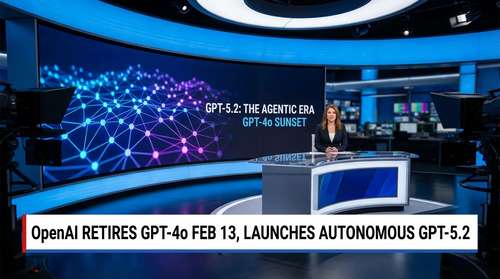
February 1, 2026 – The era of conversational AI is officially evolving into the age of action. In a defining move for the artificial intelligence industry, OpenAI has confirmed that it will retire its beloved GPT-4o and GPT-4.1 models on February 13, 2026. This strategic sunsetting marks the end of the "chatbot" phase and clears the runway for GPT-5.2, a powerhouse model designed not just to talk, but to act as the standard-bearer for autonomous AI agents.
The End of the Omni Era: GPT-4o Retirement Details
OpenAI’s announcement has sent ripples through the tech community. Effective February 13, access to GPT-4o, GPT-4.1, and the lightweight GPT-4.1 mini will be discontinued for consumer users of ChatGPT. While the move is technically a consolidation of resources, it symbolizes a much larger philosophical shift. GPT-4o (Omni) was celebrated for its warmth, speed, and multimodal fluidity, becoming a favorite for creative ideation and casual conversation.
However, maintaining legacy architectures has become a bottleneck. With the release of GPT-5.2 in December 2025, OpenAI is pivoting its entire infrastructure toward models capable of deep reasoning and agentic behavior. The company stated that while GPT-4o was a milestone in human-AI interaction, the future belongs to systems that can execute complex, multi-step workflows without constant human hand-holding. Developers using the API will have a grace period, but the message is clear: migrate to the 5.2 series or get left behind.
GPT-5.2 Features: The Engine of Autonomous AI Agents
If GPT-4o was a brilliant conversationalist, GPT-5.2 is a high-powered executive assistant. Released in response to Google’s formidable Gemini 3, GPT-5.2 introduces a bifurcated architecture with "Instant" and "Thinking" variants. The "Thinking" variant is the game-changer, boasting a massive context window and the ability to self-correct during complex tasks like coding or legal research.
This model is purpose-built for the emerging sector of autonomous AI agents. Unlike its predecessors, GPT-5.2 doesn't just generate text; it plans. It can independently browse the web, verify facts, write and test code, and interact with third-party applications with a success rate that dwarfs the GPT-4 generation. This capability is crucial for the new wave of "agentic" applications where users expect their AI to complete entire jobs—booking travel, managing portfolios, or debugging software—rather than just offering advice.
Agentic Commerce: AI That Buys
The most lucrative application of this new intelligence is agentic commerce. OpenAI, in collaboration with Stripe, is rolling out the Agentic Commerce Protocol (ACP), a framework allowing GPT-5.2 agents to securely execute financial transactions. Imagine telling your AI, "Book a flight to Berlin under $600," and having it not only find the flight but securely purchase it using your authorized credentials. This shift from information retrieval to transactional execution is predicted to drive trillions in economic value by 2030.
Infrastructure Wars: Stargate and Decentralized AI
Powering these autonomous agents requires unprecedented compute. OpenAI’s Project Stargate, a $500 billion infrastructure initiative backed by SoftBank and Oracle, is currently under construction in Texas. This massive investment aims to secure the 10-gigawatt capacity needed to run the next generation of models. However, this centralization of power has reignited the debate around decentralized AI infrastructure.
As AI agents become capable of spending money and managing digital lives, trust becomes paramount. Critics argue that consolidating the world's most powerful agentic models in a few centralized data centers creates a single point of failure and control. This has led to a surge in interest for AI blockchain integration. Decentralized protocols are emerging as a counter-narrative, offering transparent, verifiable, and permissionless networks where AI agents can operate without a central overlord. While OpenAI pushes for the efficiency of Stargate, the crypto-AI sector is betting that users will eventually demand the security and sovereignty of blockchain-based agent networks.
What This Means for the Industry
The retirement of GPT-4o is more than a software update; it is a forced evolution. By removing the safety net of older, familiar models, OpenAI is pushing the world into the deep end of agentic AI. For businesses, the mandate is to adapt to GPT-5.2 features immediately. For consumers, it means saying goodbye to a friendly chat companion and welcoming a powerful, if slightly more utilitarian, digital agent.
As we approach the February 13 deadline, the industry watches with bated breath. Will the transition be smooth, or will the loss of GPT-4o’s unique "personality" alienate the user base? One thing is certain: the age of passive AI is over. The age of the autonomous agent has arrived.