
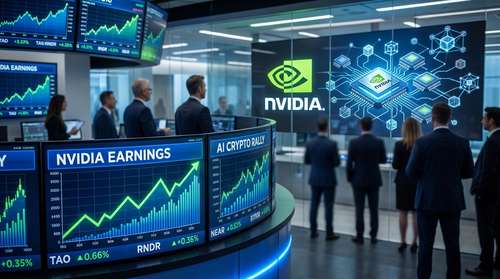
In a financial disclosure that has once again redefined market expectations, Nvidia (NVDA) reported a staggering $68.1 billion in quarterly revenue for Q4 fiscal 2026, shattering Wall Street forecasts and cementing the artificial intelligence supercycle as the decade's defining economic force. The chip giant’s report, released just 48 hours ago, revealed that its Data Center division alone generated $62.3 billion—a figure that exceeds the entire annual GDP of many nations. This unprecedented performance has sent immediate shockwaves through the digital asset markets, igniting double-digit rallies for high-performance computing crypto projects like Bittensor (TAO), Render (RENDER), and NEAR Protocol.
The $68 Billion Signal: AI Demand is Accelerating
For months, skeptics have questioned whether the global appetite for AI hardware was nearing a plateau. Nvidia’s latest earnings report silenced those doubts with emphatic precision. The company not only beat revenue estimates by over $2 billion but also issued bullish guidance for Q1 2027, projecting revenue to reach $78 billion. This growth is being driven by the voracious demand for its next-generation Vera Rubin chips, samples of which CFO Colette Kress confirmed were shipped to hyperscalers earlier this week.
For the broader tech sector, this is a validation of the "AI Capex" narrative—the idea that major tech firms are locked in an existential arms race to build out intelligence infrastructure. However, for the cryptocurrency market, the implications are even more profound. As centralized computing power becomes scarcer and more expensive, the value proposition of decentralized AI infrastructure is becoming undeniable. Investors are rapidly pivoting capital into blockchain protocols that offer permissionless access to compute, storage, and machine learning models.
Bittensor (TAO) Leads the Decentralized AI Charge
The immediate beneficiary of the Nvidia news was Bittensor (TAO), which saw a price surge of over 10% in the hours following the earnings call. As the leading decentralized machine learning network, Bittensor represents the open-source answer to the closed AI gardens built by tech giants. The protocol's unique "Proof of Intelligence" consensus mechanism rewards nodes for training models that provide value to the network, creating a meritocratic marketplace for algorithmic intelligence.
With Nvidia's results confirming that AI training is the world's most valuable computational task, Bittensor's ecosystem of subnets—specialized networks for text, image, and logic generation—has seen renewed inflow. Traders are betting that as the cost of centralized AI training continues to skyrocket, developers will flock to Bittensor’s decentralized alternatives to access high-quality intelligence without the exorbitant premiums charged by traditional cloud providers.
Render Network and the GPU Squeeze
While Bittensor focuses on the software layer of intelligence, Render Network (RENDER) is tackling the hardware bottleneck. Nvidia’s $62.3 billion Data Center revenue figure underscores a critical reality: GPUs are the oil of the 21st century, and there aren't enough to go around. This scarcity is the primary driver behind Render's recent momentum.
By connecting artists and developers needing compute power with idle consumer-grade GPUs, Render acts as a decentralized release valve for the global chip shortage. Following the earnings report, RENDER tokens rallied as the market realized that Nvidia's supply constraints for enterprise chips would trickle down, forcing more creators to seek decentralized distributed computing solutions. The narrative is shifting from Render being just a "CGI tool" to a critical pillar of high-performance computing crypto infrastructure.
NEAR Protocol and the User-Owned AI Future
Beyond raw compute and model training, NEAR Protocol AI growth has emerged as a key theme in this post-earnings cycle. NEAR has positioned itself as the abstraction layer for user-owned AI, allowing applications to run complex agents on-chain without the user needing to manage the underlying complexities. The protocol's focus on "Chain Abstraction" makes it an ideal environment for deploying AI agents that can transact, trade, and interact with the web autonomously.
Following Nvidia's guidance, which hinted at the explosion of "agentic AI" (software that takes action, rather than just generating text), NEAR's price action formed a structural recovery signal. Investors are recognizing that while Nvidia builds the brains, blockchains like NEAR are building the nervous system that will allow these AI agents to operate securely and independently in the digital economy.
Why Decentralized Infrastructure is the "Pick and Shovel" Play
The correlation between Nvidia's stock performance and AI crypto tokens has reached a coefficient of nearly 0.8 during earnings seasons, according to recent market data. This "beta" relationship suggests that crypto assets are functioning as a leveraged bet on the growth of the AI sector. However, unlike owning NVDA stock, which is a bet on a single hardware monopoly, owning tokens like TAO, RENDER, or NEAR is a bet on the democratization of that technology.
As we move deeper into 2026, the divergence between utility-driven projects and vaporware is widening. The market is rewarding protocols that solve actual infrastructure problems—specifically those related to GPU scarcity, model censorship, and data provenance. Nvidia's $68 billion quarter proves the money is there; decentralized infrastructure promises to distribute that value beyond a handful of Silicon Valley boardrooms.
With Nvidia's stock touching $200 and the AI supercycle showing zero signs of fatigue, the crypto market is bracing for a volatile but potentially lucrative Q1. For investors, the message is clear: the hardware boom is real, and the decentralized networks built to support it are just getting started.