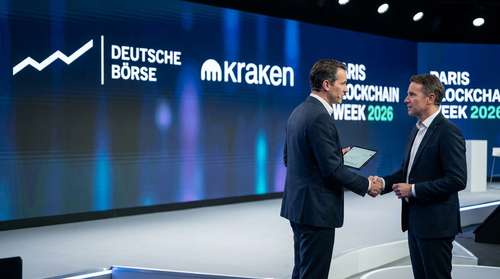
The barriers between traditional financial markets and the digital asset economy are officially collapsing. On April 14, German stock exchange operator Deutsche Börse acquired a 1.5% fully diluted stake in Payward, the parent company of Kraken, via a strategic $200 million secondary transaction. Confirmed and heavily discussed during the closing sessions of the Carrousel du Louvre summit, the Deutsche Börse Kraken investment is accelerating the rollout of regulated trading frameworks across the Eurozone. This strategic maneuver establishes a unified liquidity pool capable of processing everything from traditional securities to blockchain-native tokens.
Paris Blockchain Week 2026 Highlights Shift Toward Legacy Finance
If the overarching theme of this week's summit was bridging the gap between legacy infrastructure and Web3 innovation, this landmark acquisition provided the perfect real-world case study. Among the major Paris Blockchain Week 2026 highlights was the stark pivot toward institutional crypto adoption. Over 10,000 policymakers, banking executives, and developers converged in Paris to analyze how traditional finance operations are actively deploying blockchain technology.
The timing of Deutsche Börse's announcement dominated panel discussions on Wednesday and Thursday. Market leaders noted that building robust crypto exchange infrastructure is no longer a fringe endeavor but a core operational mandate for national stock exchanges. The deal builds on an initial cooperative framework established between Deutsche Börse and Kraken in December 2025, moving decisively past speculative trading into comprehensive asset servicing. Instead of viewing decentralized platforms as competition, national exchanges are now securing equity in the infrastructure providers powering the next generation of finance.
Strategic Asset Servicing and Digital Asset Banking
By deepening its ties with Kraken, Deutsche Börse is securing the technological foundation required to handle the lifecycle of tokenized assets. The partnership will deliver a frictionless experience for institutional clients, spanning custody, settlement, and collateral management. Managing traditional securities alongside crypto assets requires an incredibly sophisticated backend. Kraken's unified infrastructure layer allows institutional clients to seamlessly transfer value between fiat systems and decentralized networks.
Integrating with the Federal Reserve
Kraken is proving to be a highly strategic partner for traditional institutions looking to modernize their operations. Just last month, the firm became the very first crypto business to secure access to the Federal Reserve's core payment systems. This unprecedented integration into mainstream financial pipelines significantly bolsters the narrative around modern digital asset banking. It demonstrates to European operators like Deutsche Börse that Kraken can pass rigorous governmental scrutiny and operate at the highest levels of global finance.
MiCA Regulation Compliance 2026: Setting the European Standard
As the European Union implements its comprehensive Markets in Crypto-Assets framework, regulatory certainty is driving massive capital inflows. The $200 million injection is a direct response to the demands of MiCA regulation compliance 2026. Financial institutions can no longer afford to operate in gray areas, and buying into an established, compliant exchange offers a massive shortcut to market readiness.
European policymakers attending the closed-door institutional gatherings at the Château de Versailles this week emphasized coordinated approaches to market governance. By acquiring an equity stake rather than building from scratch, Deutsche Börse mitigates execution risk while capturing a slice of existing trading volume. The transaction, expected to close in the second quarter of this year pending customary regulatory approvals, effectively establishes a blueprint for how legacy exchanges will consume Web3 infrastructure to remain compliant and competitive.
Market Outlook and Bitcoin Price Forecast April 2026
Unsurprisingly, the fusion of a major European stock exchange with a top-tier digital asset platform has energized spot markets. Analysts are rapidly updating their models, factoring in the long-term liquidity that this unified ecosystem will unlock. When evaluating the Bitcoin price forecast April 2026, the macroeconomic signals provided by this deal are overwhelmingly bullish.
Institutional capital is sticky. Unlike retail speculation, the infrastructure required to support custody and settlement for entities like Deutsche Börse implies decades-long time horizons. Trading desks are closely monitoring key resistance levels as traditional banks finalize their tokenization strategies. As market structure solidifies under new European laws, the liquidity bottlenecks that previously deterred major corporate treasuries are being resolved. If this week's momentum at the Louvre is any indication, the convergence of regulated capital markets and decentralized finance will fundamentally reshape asset valuation through the rest of the year.