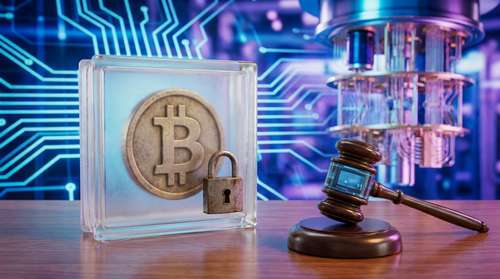
Binance founder Changpeng Zhao has just ignited one of the most contentious philosophical debates in cryptocurrency history. Speaking on a June 18 episode of the Galaxy Brains podcast hosted by Alex Thorn, the crypto billionaire floated a controversial idea: the community might need to freeze Satoshi Bitcoin wallets to prevent a catastrophic heist. The suggestion comes amid mounting anxiety over a looming quantum computing crypto threat, a technological leap that could eventually crack the cryptographic foundation of digital assets.
Zhao, widely known as CZ, argued that while quantum computing is not an insurmountable problem, the industry must prepare for a post-quantum reality. His proposed solution involves migrating to quantum-resistant cryptography and establishing a strict grace period for users to move their assets. What happens to the estimated 1.1 million BTC—worth roughly $70 billion—mined by the network's pseudonymous creator if they never move? According to CZ, those dormant Bitcoin wallets should be locked permanently.
Changpeng Zhao and the Quantum Computing Crypto Threat
The debate surrounding the CZ Satoshi Nakamoto commentary didn't emerge in a vacuum. Earlier this year, breakthrough research from Google Quantum AI indicated that quantum machines could potentially derive private keys from exposed public keys much faster than previously estimated. While experts suggest a functional quantum attack is still years away, the theoretical risk has put blockchain developers on high alert.
During the podcast, Changpeng Zhao emphasized that quantum-resistant encryption algorithms already exist. The true challenge, he noted, lies in coordinating a network-wide migration. CZ suggested that following a quantum-safe protocol upgrade, the community should offer a six-to-twelve-month window for users to transition their funds to secure addresses.
If coins remain untouched after that period expires, Zhao proposed that the remaining funds should be frozen under the new protocol. Leaving vulnerable addresses active indefinitely, he warned, would essentially hand a multi-billion-dollar fortune to whichever attacker first develops the ability to crack legacy encryption. He stressed that this would create an entirely unfair method of wealth redistribution, rewarding technical exploiters over legitimate owners.
BIP-361 Bitcoin: How Would a Network Freeze Work?
The mechanics of how to actually freeze Satoshi Bitcoin stashes align closely with a recently drafted technical plan known as BIP-361. Introduced by cypherpunk Jameson Lopp and a team of developers, the Post Quantum Migration and Legacy Signature Sunset proposal outlines a phased approach to sunsetting quantum-vulnerable coins.
BIP-361 Bitcoin documentation targets early Pay-to-Public-Key (P2PK) addresses. Because more than a third of the circulating supply has already revealed a public key on-chain, these funds are theoretically exposed. The proposal sets a multi-year timeline where legacy signatures would gradually lose validity. If a user fails to migrate their holdings to a modern, quantum-resistant format, those coins become unspendable.
By referencing the necessity of sunsetting old addresses, Changpeng Zhao effectively threw his weight behind the core concept of BIP-361, even if he didn't explicitly demand immediate implementation. He clarified that any such drastic measure must be a collective community decision driven by consensus mechanisms and voting, rather than a personal directive.
The Unique Problem of Dormant Bitcoin Wallets
The idea of locking up dormant Bitcoin wallets creates a unique friction point. Satoshi Nakamoto disappeared in late 2010, leaving behind thousands of addresses that have not recorded a single outgoing transaction in over fifteen years.
If a quantum computer successfully breaks the elliptic curve cryptography securing these addresses, the network could wake up to a sudden, massive supply shock. Dumping over a million BTC onto the open market would devastate prices and shatter institutional trust in Bitcoin security. By locking these coins out of the active supply, developers would neutralize the biggest single target for a prospective quantum thief.
Immutability vs. Bitcoin Security: The Community Backlash
Despite the clear security rationale, the suggestion to freeze Satoshi Bitcoin funds has sharply divided the digital asset space. For many long-term advocates, intervening in user balances violates the foundational ethos of decentralized money.
Critics, including some prominent researchers who have analyzed the CZ Satoshi Nakamoto remarks, argue that overriding ownership rights—even for self-defense—destroys the network's promise of absolute censorship resistance. If the protocol can agree to confiscate or freeze one set of coins, purists worry it sets a dangerous precedent for future seizures. Galaxy Digital's Alex Thorn noted that the technical reality of Satoshi's holdings, which are spread across roughly 22,000 separate addresses, complicates the feasibility of a single sweeping hack anyway.
Ultimately, the clash highlights a growing tension between pragmatism and ideology. Safeguarding Bitcoin security against a legitimate quantum computing crypto threat may eventually require hard compromises. Whether the community will actually vote to freeze the holdings of its own creator remains one of the most fascinating unresolved questions in the industry today.